


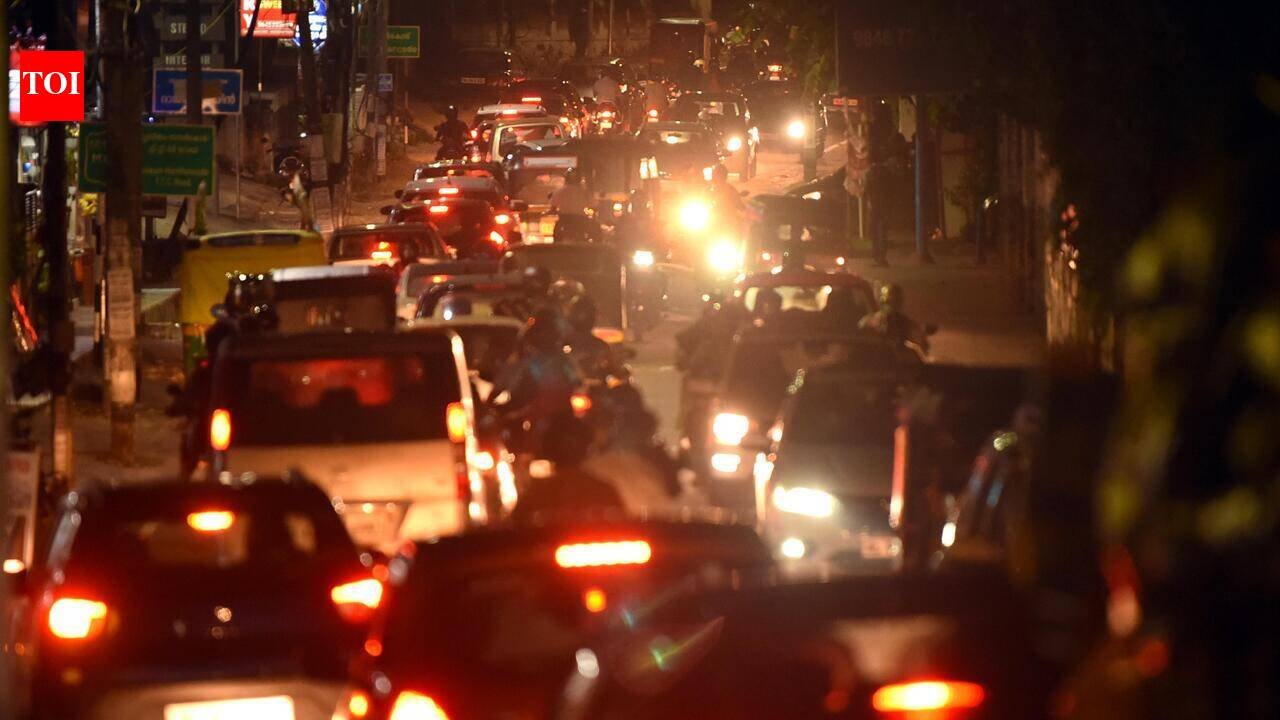
Thiruvananthapuram: With nearly 250 new vehicles being added to its roads every day, the state capital is witnessing rapid motorisation that is placing increasing pressure on its transport infrastructure. Experts warn that unless road capacity, public transport and safety measures are strengthened, the district could face a higher risk of road accidents.Official figures show that the district’s vehicle population rose from 18.03 lakh in 2020-21 to 21.69 lakh in 2024-25, an increase of 3.66 lakh vehicles over five years.The growth in vehicle numbers has coincided with a sharp rise in road accidents. Reported crashes increased from 1,825 in 2022 to 2,500 in 2025, while the number of people injured in accidents rose from 2,081 to 2,890 during the same period.Road safety experts say traffic volumes on several major roads have already exceeded the limits recommended under the Indian Roads Congress guidelines. According to Kerala Road Safety Authority expert member Upendranarayan, a four-lane road is designed to carry about 50,000 to 60,000 passenger car units a day. However, the Kesavadasapuram-Pattom-PMG corridor is now handling more than 76,000 PCUs daily.“The existing traffic volume is well beyond the carrying capacity of a four-lane road. The Kesavadasapuram-Pattom-PMG stretch now requires a six-lane carriageway to safely accommodate current traffic,” he said.He noted that higher traffic density reduces the gap between vehicles, leaving drivers with very little time to react to sudden changes in traffic conditions. Even minor disruptions can result in collisions as motorists need crucial reaction time to brake, he explained. He also criticised the lack of effective road safety governance and the absence of sustained public pressure for stronger safety measures.National Transportation Planning and Research Centre director R Ashalatha said poor road design is further increasing accident risks. Referring to Kazhakkoottam-Technopark and Vetturoad stretches, she pointed out that highway crash barriers are frequently cut to provide easier access to nearby shops and residences.“Crash barriers should ideally be continuous and extend for 100 to 150m. In many locations, they have been cut, leaving pointed metal edges facing the carriageway, which can prove fatal during accidents,” she said.Ashalatha stressed that expanding and improving public transport, along with efficient last-mile connectivity to railway stations and bus terminals, is essential to reduce dependence on private vehicles.“Our goal should be to build a reliable public transport system that encourages people to choose buses and trains over private vehicles,” she said. Traffic officials, meanwhile, attributed the severity of accidents largely to unsafe driving behaviour. Assistant commissioner of traffic R Suresh said nearly 80% of grievous injury accidents are caused by rash and negligent driving, including driving under the influence of alcohol.
