



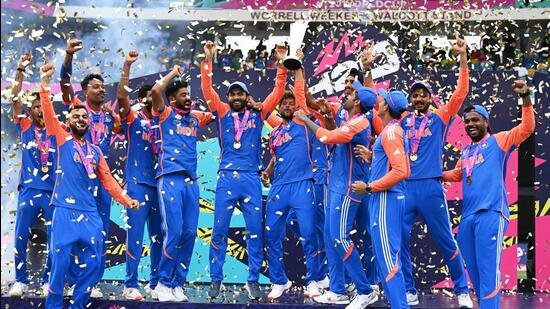
New Delhi: Given the sheer quality of resources India had at their disposal over the years, waiting 16 years for a T20 World Cup trophy — thanks largely to their predilection for a safety-first approach — was an anomaly waiting to be addressed. Denied by an immaculate Sri Lankan attack in the 2014 final, bludgeoned by raw Caribbean power in the 2016 semis, and stunned by a fearless English team in the 2022 last-four, India finally won their second T20 World Cup in 2024 in Bridgetown.
The triumph signalled India’s long overdue reconciliation with the evolving concept of T20 batting, trading inhibition for ambition and shunning years of conservatism. Led superbly by Rohit Sharma, India became the only team in T20 World Cup history to have an unbeaten run to the title, achieving dominance as elite and a campaign as perfect as possible.
While the final itself was one for the ages, what also merits a generous mention is Rohit once again walking the talk. The Mumbai right-hander was handed the reins after India’s early exit at the 2021 edition. The coaching setup also changed: Rahul Dravid took over as the head coach from Ravi Shastri.
Among the first things the duo spoke about was the need to change how India approached their T20 cricket. While the 2022 World Cup did have some shades of the said template, albeit against lesser pedigreed opponents, the batting was found wanting in the semis against England.
The 50-over World Cup that followed next year finally saw the plan ticking, with Rohit leading the charge. India’s unblemished run to the final was built on Rohit’s adventure and Virat Kohli’s resolve, and although India fumbled at the final hurdle, their brave new template had shown its worth.
The 2024 T20 World Cup, though, posed a different set of questions. Played in the Caribbean and the USA where the pitches were sluggish and dual paced, batting required a fair degree of application and smarts. India’s resolve, more than their talent, was put to test and skipper Rohit was up to the challenge at the top of the order. The match that would’ve given him and India a fair degree of confidence was the one against Australia, the side that stopped their 50-over juggernaut in Ahmedabad seven months back.
The Aussies got Kohli for a duck in the second over, but Rohit went on a six-hitting spree. His 41-ball 92 contained seven fours and eight sixes as India ended their innings at 205/5. Travis Head, India’s nemesis at the World Test Championship final and the 50-over World Cup final (both in 2023) threatened to inflict a hat-trick of hammer blows with a 43-ball 76 but India held their nerve to stop the Aussies at 181/7.
Buoyed by the win, India swatted aside England by 68 runs in the semi-final, Rohit once again providing the early impetus before spinners Axar Patel and Kuldeep Yadav picked three wickets apiece. An in-form South Africa waited in the summit clash, riding an undefeated run of their own.
Batting first, India lost three of their top-four for single-digit scores but Virat Kohli showed the old-fashioned values still had a place in the shortest format. He found an able ally in Axar Patel whose 31-ball 47 gave India the impetus while a crucial 16-ball 27 from Shivam Dube was the push India needed to go past the 170-run mark. Kohli batted for 19 overs for his 59-ball 76, holding the innings together beautifully. There were legitimate questions about his strike rate in the months leading up to the tournament, but on the night that mattered, the ace batter showed batting was a bit more than cold numbers.
South Africa, though, weren’t going to go down tamely. They were two down by the third over but Tristan Stubbs and later Heinrich Klaasen got them to the brink of their first T20 trophy. Among the cleanest hitters of this generation, Klassen was in fine touch, comfortably clearing the boundaries and pushing the Proteas to the finish line.
With five overs to go and South Africa needing to go at just run-a-ball, India looked set to lose another ICC final. Cricket fans of a certain vintage would remember Bridgetown as a venue where India fluffed a chase of 120 for a rare Test win back in 1997. That’s when Rohit returned to Jasprit Bumrah. And he delivered.
As has been his wont, Bumrah nailed yorkers after yorkers and threw in some well-disguised slower ones to suck the momentum out of the innings. Arshdeep Singh played a great supporting act, but when Klassen took a liking to Axar’s finger spin, the match was far from over.
Sixteen needed off the final over, and David Miller swung Hardik Pandya to long off where Suryakumar Yadav completed a memorable catch at the ropes. India eventually stopped South Africa seven runs short to win their second T20 title, the introspection that began after the 2021 campaign finally coming to fruition. Rohit, Virat and Ravindra Jadeja announced their retirement from T20 internationals, and Rahul Dravid finally had a world title to show after years of service to Indian cricket.


