



Srinagar, Aug 29: Beneath the soil of Zehanpora in north Kashmir lies a story waiting to be told – a nearly 2,000-year-old Buddhist settlement that archaeologists believe could rewrite the region’s ancient history.
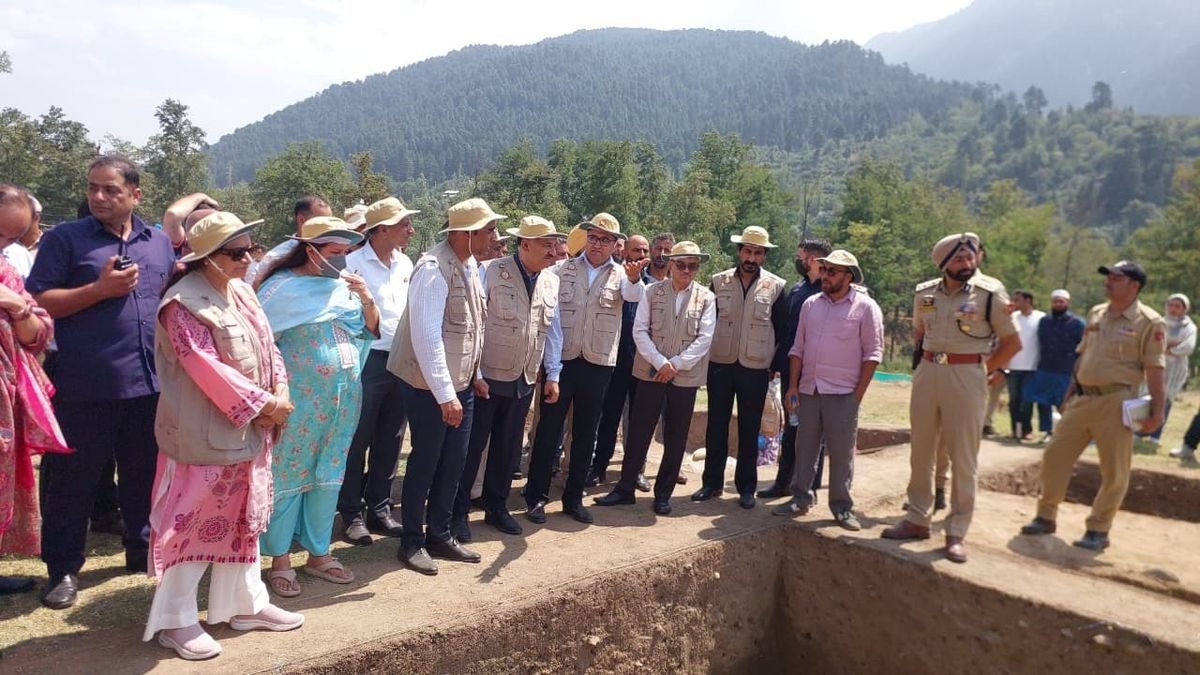
The second phase of excavation at the Kushan-period archaeological site began on Saturday, with Chief Secretary Atal Dulloo visiting the location to inaugurate the work. He was accompanied by officials from the Department of Archives, Archaeology and Museums (DAAM), University of Kashmir, police and civil administration.
Speaking to reporters, Dulloo said the excavation had so far indicated the presence of a Buddhist archaeological site dating back around 2,000 years. “Last year, in October, the Department of Archives, Archaeology and Museums and the Centre of Central Asian Studies at the University of Kashmir decided to carry out excavation at this site. After obtaining the necessary permissions, excavation was conducted last year, and some surprising findings emerged,” he said.
He said permission has now been granted for the second phase of excavation and the work has commenced.
“What we have understood so far is that this is a nearly 2,000-year-old Buddhist archaeological site. Its description is found in several historical documents, and the department is now trying to match those accounts with the archaeological findings,” Dulloo said.
The CS said the excavation would help establish how people of that civilisation lived and what tools and instruments they used.
“Once the excavation is completed, more things will become clear, and it will add to our history,” he said, adding that the site could also emerge as a major tourism attraction.
Dulloo congratulated the University of Kashmir and its students for undertaking the excavation, saying modern technology was being used in the archaeological work. “The results are going to be interesting,” he said.
The Chief Secretary said excavation work had begun in November last year but could continue for only about a month due to the onset of winter. This year, the team has been permitted to undertake excavation for around three months. “Whatever findings we get from here are being tested,” he said.
Dulloo further said that understanding and excavating the entire archaeological site could also take up to five years.
Officials from DAAM had earlier told Rising Kashmir that excavation at the site had yielded remains of three stupas, structural walls, pottery, copper artefacts and apsidal stupas believed to belong to the Kushan period.
The findings are considered significant as they could provide insights into the religious, cultural and material life of the region around 2,000 years ago. Officials said the excavation would also provide students involved in the project with valuable practical and academic experience in archaeology.
The site was identified through a combination of literary and scientific evidence, including references in Rajatarangini, historical travelogues and ground-penetrating radar (GPR) surveys, which indicated the presence of ancient structures beneath the surface.
The excavation is being undertaken jointly by DAAM and the Centre of Central Asian Studies at the University of Kashmir. The two institutions had signed a Memorandum of Understanding (MoU) on October 31 last year to strengthen archaeological research, documentation and heritage conservation in Jammu and Kashmir.
The collaboration includes joint fieldwork, scientific study of artefacts for research and museum display, 3D digital documentation, and the development of on-site museums and interpretive spaces.
Preliminary surveys involving drones, mapping and ground verification had identified large mounds near Zehanpora, which were long believed to contain remnants of ancient stupas. Archaeologists are now using modern techniques, including high-resolution mapping, drone documentation and digital archiving, to systematically excavate and document the site.
Officials and archaeologists believe further excavation could reveal additional structures and artefacts, helping researchers piece together the historical significance of the Kushan-era Buddhist settlement and its place in Kashmir’s ancient past.


