


Singapore: Their eyes are fixed through microscopes, their attention narrowed to a tiny piece of biological tissue held carefully between their fingers. Around them, the manufacturing floor is quiet and controlled, but at these workstations there is an extraordinary intensity of concentration. A needle moves through the delicate tissue, a stitch is made, the position is checked, and the process continues with a precision that comes not from a machine, but from years of training and the practiced steadiness of human hands.Over 70 to 80 per cent are women who are here not sewing clothes, surgical gowns or ordinary pieces of fabric. They are stitching components of heart valves devices that will eventually be implanted inside another human being. Depending on the valve model, the assembly can involve around 1,000 stitches, with multiple operators taking responsibility for different stages of the process. Every movement has to be precise, every stitch has to meet a defined specification and every operator has to know that the work taking place under the microscope will eventually become part of someone’s heart.
For the women doing the work, this is a specialised manufacturing skill built through months of training and repeated practice. But for the person who eventually receives the valve, the significance is far more profound. Most patients will never see the hands that assembled the device that beats inside their chest, nor will they know how many people were involved before that valve reached an operating room.
Jai Arora was one such patient. Five years ago, Arora underwent open-heart surgery at the age of 42 after doctors discovered severe aortic stenosis associated with a congenital bicuspid aortic valve. A fitness professional who had spent years running, cycling, exercising and training others, he suddenly found himself confronting a heart condition he had never known he had. After discussions with his doctors, he chose a bioprosthetic valve and, following surgery and recovery, gradually returned to the active life he had feared he might have to give up.
For five years, he knew the valve inside his heart as a medical device that had given him back that life. He knew its name and understood why he had chosen it, but he had never stopped to imagine how it had actually been made.
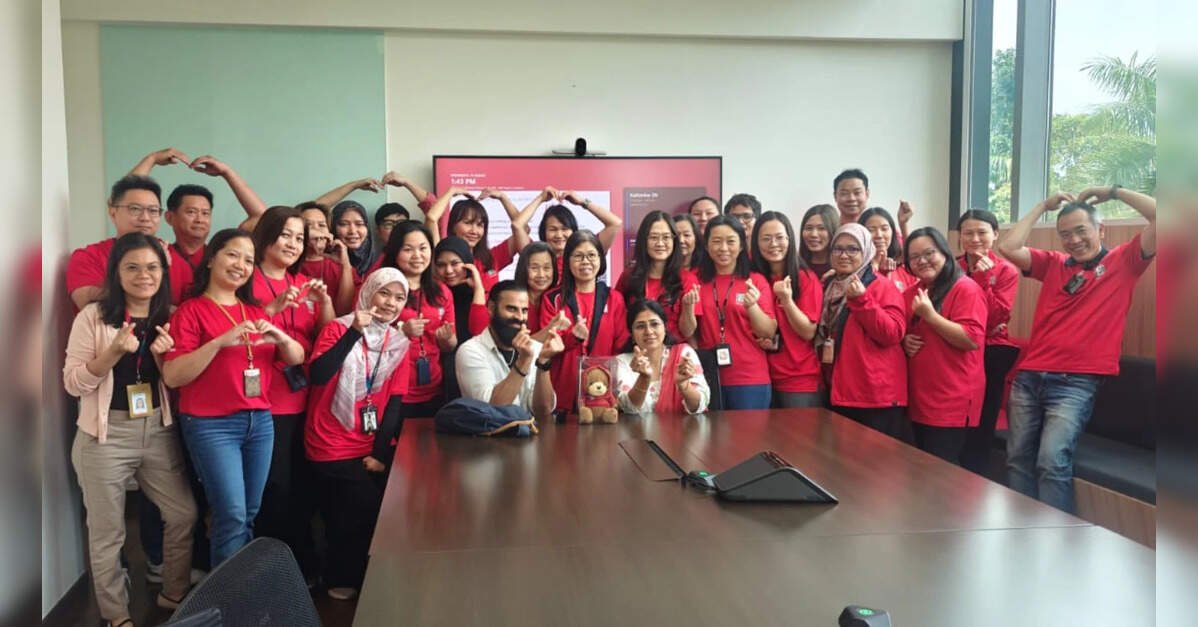
That changed when Arora visited the Edwards Lifesciences manufacturing facility in Singapore as part of a patient experience day and came face to face with the women behind the intricate sewing process. Watching them work under microscopes, carefully positioning the tissue and stitching the valve with remarkable precision, he discovered something about his own heart that he had never known. His valve had been hand-sewn.
“I thought it could be generated or manufactured through automation, through robotics. Knowing that you are hand-sewing it is absolutely commendable,” Arora said.
The discovery gave him a completely different way of looking at the valve that had been inside his heart for five years. What he had once seen simply as a medical device now had a human story behind it a story of trained hands, painstaking concentration, thousands of carefully executed stitches and people who may never meet the patient whose life their work ultimately touches.
“Human beings can do such complicated work that even now automation may not be able to achieve in this field,” he added.
And that is where the story of Arora’s valve begins not in the operating room where it was implanted, but much earlier, under the bright lights of a manufacturing facility, where women sit behind microscopes and use their hands to stitch together a device that will one day become part of another person’s life.
The People Behind the Precision
Inside the surgical valve assembly area, the work looks remarkably different from what one might expect from a modern medical-device manufacturing facility.
There are no robots performing every movement. Instead, trained operators sit at individual workstations, working with small components and carefully sewing the valve together.
The process is divided into stages. One operator completes a specific portion of the assembly and passes it to the next person, who continues the work. The process moves down the line until the valve is complete.
On one surgical valve line, there are around 14 sewers working on different stages of the assembly.
“This is a kind of step assembly, a modular assembly,” the manufacturing team explained. “Each person does a step, a step, a step, until the final step, and then the valve is complete.”
The reason for having so many operators is not that the process is inefficient. It is because the assembly itself requires multiple specialised operations, with each operator trained to perform a particular stage according to defined specifications.
The figure of around 1,000 stitches gives a sense of the scale of the manual work involved, but the number is not identical across every valve. Different models have different stitching requirements, and operators are trained according to the specific model and standard operating procedure they are working with.
The precision seen on the production floor is built over months. For new hires, training lasts approximately two to three months before they can be deployed to work on actual valves. They have to complete the required training and pass the necessary tests before they are permitted to enter production.
And learning one model does not mean an operator can immediately work on another.
“If they have to perform a dual model, they have to retrain again for another three months for another model,” a representative from Edwards Lifesciences manufacturing team explained.
The facility has about 7 to 8 heart surgical valve models, but every batch or operators are generally trained on a maximum of two models.
Even after they enter production, the training process does not simply stop. Their performance is monitored as they move through the learning curve, which can extend for around six months.
That period is important because the work involves much more than learning how to sew. Operators have to learn the precise requirements of the particular valve, understand the specifications and recognise when something is not right.
Once the sewing is completed, functional testing and quality inspections are carried out. There are inspection points throughout the process rather than waiting until the very end to determine whether a valve has met the required standard.
“After completing our sewing, there will be functional tests and QA inspections. Every station there will be an inspection to ensure that we produce a good valve for our patients,” the representative said.
The phrase “for our patients” is significant. It is a reminder that what begins as a highly controlled manufacturing operation ultimately becomes part of someone’s body.
When Eyesight becomes Part of Patient Safety
The work also demands physical abilities that might seem ordinary until they become essential to the quality of a heart valve.
Operators work with very small components and require good vision to identify fine details. The facility conducts annual vision tests, including checks for colour blindness, and employees who require glasses are expected to wear them during the assessment.
The environment itself is carefully controlled, with restrictions on what can be brought into the production area. Personal mobile phones, for instance, are not permitted inside the controlled environment.
The reason is not simply discipline. “It is a controlled environment, so you do not want to bring in any additional contamination,” a manufacturing team head from Edwards Lifesciences explained, emphasising that the level of environmental control is part of ensuring product quality.
For the operators, this means spending a significant part of their working day in an environment where concentration and consistency are essential.
A normal working shift is around 6.5 hours, with breaks. But it is not six and a half hours of performing exactly the same stitch.
“There are different operations. The area of the stitches is different, but the process is the same as sewing. It is just different cuts of the valve,” he added.
That combination of repetition and variation allows operators to become highly skilled in their particular part of the process. The wet tissue makes the job even harder. The challenge becomes more visible when the processed tissue enters the assembly area.
The tissue arrives from the earlier processing stage and is combined with the prepared valve frame. Three tissue leaflets are carefully positioned and sewn onto the frame in a wet environment containing glutaraldehyde as part of the processing. The operator must control the tissue while simultaneously carrying out precise stitching.
For an untrained person, even holding the wet tissue correctly can be difficult.
“I also tried to do the sewing, the leaflet one. It is very difficult, because it is wet tissue, and then you have to actually control the tissue leaflet. It is very difficult. You can see this is what they do every day,” Arora said.
That everyday familiarity is perhaps what makes the operators’ work easy to underestimate. What looks like a simple sewing movement is actually a skill acquired through training and repetition, performed under strict specifications and ultimately connected to a patient’s life.
When a stitch is not right, the valve does not move forward. If an operator notices something that does not meet the required specification, the issue is raised with the line lead. The valve can be rejected and discarded rather than being allowed to continue through the process.
The manufacturing team said the rejection rate is not high, but there is no attempt to preserve a valve simply to meet a production target.
“If the sewer sees something is wrong, they will highlight it to the line lead, and therefore we will just discard that one,” one of the manufacturing head of Edwards Lifesciences explained.
That decision is made possible by the training of the operators.
“They know the process and the specifications of the valve sewing. That is why we produce a good-quality valve for each individual patient,” he added.
It is a sentence that brings the entire manufacturing process back to the person who is not in the factory.
The patient
For Arora, a fitness professional who had been exercising regularly for years, never considered himself careless about his health. He had been following a fitness regime for about six years before his surgery and believed he was doing the usual preventive checks.
But two episodes of blackout during runs eventually made him question whether something was wrong.
“I was already into a fitness regime for the last six years before this surgery, so I was pretty conscious about my own health. It was not that I was taking my health lightly. I was doing the preventive measures that we usually take, like a blood count, complete blood count and ECG, and you are done. This is what I used to do because I never had any symptoms that made me think I should go for any special heart preventive care.”
Then came the blackouts. “At one point, I had two blackouts during my runs. I thought it could be fatigue, exhaustion or dehydration because people do have those things. Somehow, I didn’t ignore it. I thought, no, I think it is time I should get it checked. I did delay it a little, maybe another month. But in the same month, walking and taking the stairs became tougher. I was getting breathless and coughing a lot,” Arora added.
Initially, he suspected an allergy because construction work was taking place near his home.
A pulmonologist eventually examined him and found that his lungs were fine. The doctor then advised him to undergo a complete health check-up, including a cardiac evaluation. That decision changed his life. An echocardiogram revealed severe aortic stenosis associated with a congenital bicuspid aortic valve.
“I just heard the words ‘serious stenosis’. I didn’t know what it meant. Then they did the echo, and I was about to go for the treadmill test. Suddenly, the doctor stopped me and said, ‘No, no, you don’t go for the TMT. The doctor will meet you.’ That was the moment it hit me that something was definitely wrong.”
The diagnosis was difficult to absorb.
Arora learned that he had been born with a bicuspid aortic valve, meaning his aortic valve had two leaflets rather than the usual three.
“I was totally unaware. I started searching and came to know that bicuspid valve is congenital, something you can be born with. Instead of having three leaflets in a valve, I was born with two. That puts more overload and work on the valve, and hence the calcification can progress faster. Suddenly, I could connect the dizziness and blackouts to the condition, realizing they weren’t due to exhaustion, fatigue or dehydration. It was this,” he said.
For someone who had cycled 600 kilometres in a single stretch and built his life around fitness, the diagnosis was particularly confronting.
“I had achieved so many milestones, and suddenly here I was standing with a diseased valve. The doctor was saying I couldn’t even do a treadmill test because it could increase my heart rate too much and jeopardise my condition. That was very shocking for me.”
From “Why me?” to “What can we do now?” The days that followed were filled with uncertainty.
“I was just searching and processing the thought. Then I told my family that this was the problem I was facing. And they gave me hope. They said, ‘It is not your problem, it is our problem. We will treat it. Instead of asking why me, let’s see what we can do now and what the best option is for you so that you can get yourself back on track.’”
He eventually had to make another difficult decision of choosing between a mechanical valve or a bioprosthetic valve. At the time, both were unfamiliar concepts.
“I had no knowledge of mechanical or bioprosthetic valves. Even those were technical terms for me. I was completely alien to them. I searched, spoke to doctors and took two or three other consultations. They told me that at my age, choosing a mechanical or bioprosthetic valve was ultimately my decision because this is my life and I have to decide how I want to lead it.”
His active lifestyle played a major role in that decision.
A mechanical valve would require lifelong blood-thinning medication, something that concerned him because of his cycling, running and hiking.
“As a sports person, I know that injuries can happen. I thought about the possibility of falling while cycling or running, or having an accident and bleeding. The thought of constantly worrying about whether I had taken my medication or whether an injury could become dangerous was something that stayed in my mind.”
The bioprosthetic valve presented another concern its limited potential lifespan.
“I knew that a bioprosthetic valve has its own limitation. I was young, and I was told that it could have a life of around 15 to 20 years. So it was a big decision. I was 42 at that point, and I thought, okay, for those 15 or 20 years, I want a quality life. I want to be stress-free regarding medication and blood thinners. It was not a very futuristic approach, but it was my decision about how I wanted to live my life,” he said.
Fearing what might come next, he chose the valve knowing the uncertainty ahead. He knew that another intervention might eventually be necessary.
“Of course I was scared. What happens after 20 years is concerning. But ultimately, it was my decision about what kind of lifestyle I wanted to live,” Arora said.
His doctors also gave him a reason to remain optimistic about the future, particularly given advances in transcatheter procedures.
“I was told that after 15 or 20 years, it may not necessarily mean another open-heart surgery. It could potentially be through TAVR. So I thought, okay, it is not about opening my ribs again. Fifteen or 20 years is a long time. Medical science can advance a lot in that period. You never know what will happen by then.”
For now, he has chosen not to live in fear of that future. “I am aware that I may have to go through another procedure someday, maybe in my 60s, but till that time I am living my life to the fullest. Whatever I am doing, even small achievements, they make me happy. I think that is what life should be.If you are living, you should be happy and satisfied with your life,” he said.
Four days in ICU changed his perspective. Recovery, however, was not easy. After open-heart surgery, Arora spent four days in the ICU.
“I was overthinking because there was nothing to do. I couldn’t drink, I couldn’t talk, I couldn’t do anything. I was just sitting there. When your rib cage is open, you are so helpless that you cannot do anything except press a button to call somebody even for your daily needs.”
Those days left him uncertain about what his future would look like.
“There were moments when I thought, would I be able to do all this again?” Then came the gradual signs of recovery.
“When I was shifted to the normal ward and could take small steps, I saw my family together—my father, my wife, everyone sitting there. I was lying there and could see my wife beside me. She didn’t say any magical words or give me some perfect solution. She was just there. And that matters.”
One of the most powerful memories from his recovery was also one of the simplest.
“I realised how much we take life for granted. Even drinking water was something I suddenly understood differently. There was a time after surgery when I couldn’t drink. A caregiver came and dabbed some water with cotton on my tongue just to make my mouth moist. Those two drops gave me such a sense of relief. Then, when they finally gave me a couple of teaspoons of water, I realised the value of something as simple as water.”
That experience changed more than his physical life. It changed his perspective. Back to fitness, but with a different mindset. About two months after surgery, his doctor told him that he could return to the gym and train others, with appropriate precautions.
For Arora, it was the moment he had been waiting for.
“After about two months, my doctor told me, ‘I think you can resume your gym and you can train others.’ That was the thing I was missing the most—that I could do it again. And I am doing it again and again.”
Today, he remains physically active, but he approaches fitness differently.
He no longer sees fitness only as a series of milestones.
“Earlier, I was challenging myself and thinking, I have to run this, I have to do this marathon, I have to lift so much. Now it is more towards longevity and sustainability. I want to go easy but take challenges with careful effort. Earlier, I was careless. I would say that. Now the perspective has changed. Physically, I am good as I was before perhaps even better. It is an upgraded version of me.”
The economics of a second chance
For Arora, access to treatment was also made possible by health insurance. He had medical insurance covering Rs.5 lakhs, along with a Rs2 lakh top-up, and said the cost of his treatment was covered under the policy.
“The valve itself cost around Rs3.5 to Rs 4 lakh at that point, if I remember correctly. The entire operation and surgery cost around ₹6.5 to ₹7 lakh. Fortunately, I had medical insurance and all the premiums had been paid, so I did not have to pay anything out of my pocket.”
His experience has made him an advocate for being financially prepared for medical emergencies.
“Please have medical insurance. Everybody should have one. I was fortunate that I had good insurance. Your medical insurance and yearly preventive health check-ups should be taken seriously. Many people are careless and say, ‘Whatever happens, happens.’ But when something actually happens, you realise how important it is,” he added.
Five years later, he meets the people behind his valve
Arora now undergoes regular follow-up, including echocardiographic monitoring, to assess how his valve is functioning. Five years after his surgery, he remains active. But his visit to the manufacturing facility gave him something his medical records could not: a connection to the people who physically made the device that sits inside, helping his heart beat perfectly. A connection to the people who physically made the device that sits inside, helping his heart beat perfectly. Until this visit, he had never imagined that the valve was sewn and assembled by hand.
“Earlier, I had no idea. I just knew this was a mechanical valve and this was a bioprosthetic valve. I knew the name of the valve, that’s it. Now, coming here and realising that it is hand-sewn it gives you a ‘wow’ feeling.”
He paused to reflect on the contrast between automation and human skill.
“Somebody could give me a choice between something automated and something hand-sewn, and without knowing the process I might have preferred the automated one. But now that I have seen how intricate the work is and that they are doing it by hand, I understand it differently. I am sure research and development is also working towards automation, but if this intricate work is still being done by hand, there must be a reason for it.”
And there was another detail that made the visit particularly meaningful. He had already met the company and its team a year after his surgery, when they followed his recovery and documented his return to fitness. But even then, he had not known the full story of how the valve was made.
“Now, after five years, I have come here and learned this. It is news for me. I didn’t know this before.”
The hands that patients never see
The manufacturing floor and the patient’s story exist at opposite ends of the same journey. On one side are operators who spend months learning how to perform precise stitching, undergo vision tests, work in controlled environments and follow detailed specifications.
On the other is a patient who once wondered whether he would ever return to the life he had built around fitness. Between those two worlds is a small medical device containing around 1,000 stitches.
The bovine pericardial tissue that forms the biological component of the valve is carefully processed, inspected and prepared before it reaches the assembly floor. But it is the human operators who transform those components into a finished valve through a sequence of precise manual operations.
The work is divided across multiple people, with each operator responsible for a defined stage and each stage subject to inspection.
It is a manufacturing system built around consistency but also around judgement. The sewers must know how the stitch should look, how the tissue should be positioned and when something is not right.
And if something fails to meet the specification, it does not move forward. For the sewers, it is a professional responsibility. For the patient, it is deeply personal.
Five years ago, Jai Arora entered an operating room uncertain about what the future would hold. Today, he is back to cycling, fitness and the life he once feared he might have to give up.
Standing in the factory where heart valves are made, he found himself looking at his own medical history from a completely different perspective. He had thought of his valve as a medical device. Now he could see the people behind it.
Thousands of stitches with months of training and multiple pairs of hands, at the end of that chain, a human life. For the people who sew these valves, precision is measured in stitches. For the patient who carries one inside his heart, it is measured in the life those stitches helped him reclaim.
