






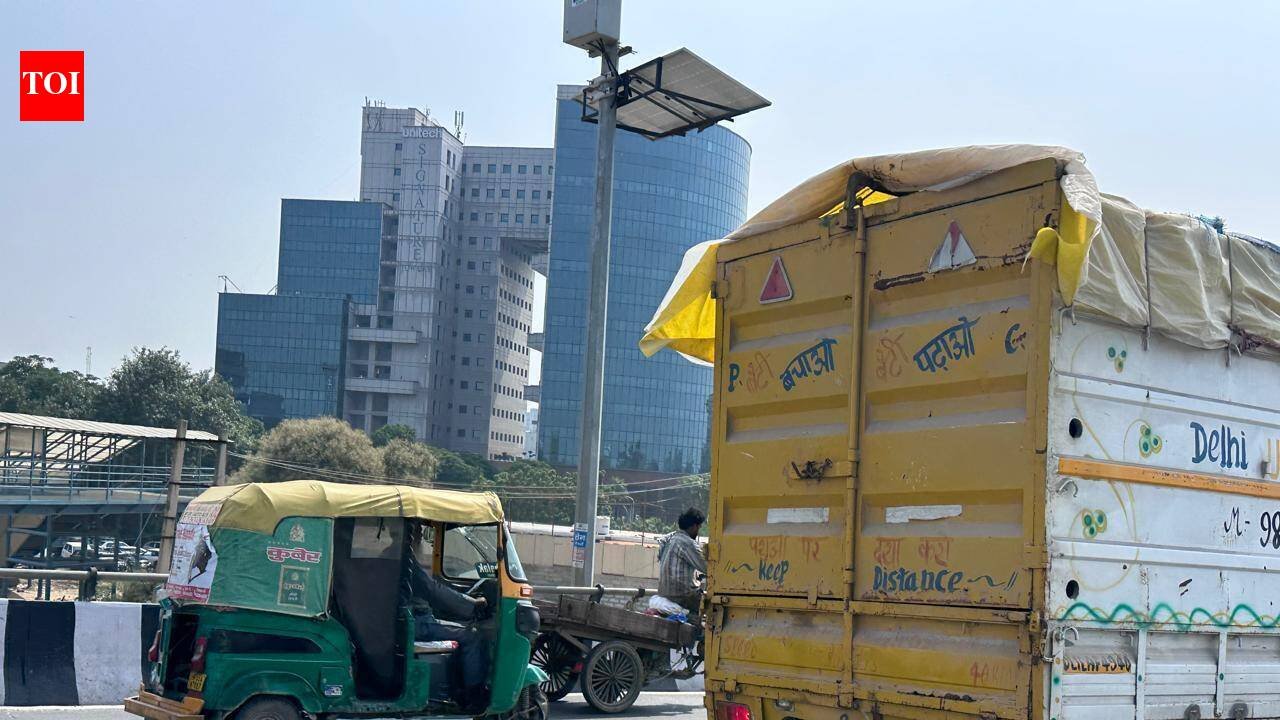
Gurgaon: Prohibited vehicles have continued to ply on Delhi-Gurgaon Expressway amid heavy traffic, raising questions as to whether a tragedy that took place in July has led to any meaningful change in enforcement. Nearly three months ago, a 22-year-old cab driver lost his life after iron rods jutting out of an e-rickshaw pierced his car’s windshield on the expressway.A TOI spot check on Tuesday found loaded e-rickshaws and other slow-moving vehicles moving on the high-speed corridor, even though such vehicles are barred from its main carriageway. Several e-rickshaws, auto-rickshaws and carts were also seen being driven at speed or in a rash manner, adding to the risks faced by commuters travelling alongside them.The July accident prompted traffic police to ask National Highways Authority of India (NHAI) to install prominent no-entry warning boards at key access points. However, the latest sightings suggest that signboards and enforcement drives have not been sufficient to prevent violations. In June 2025, following directions from Punjab and Haryana high court, traffic police barred motorcycles, scooters, tractors, e-rickshaws, auto-rickshaws and other three-wheelers, e-carts, quadricycles, multi-axle hydraulic trailers and other slow-moving or non-motorised vehicles from using the main carriageways of Delhi-Jaipur highway and Dwarka Expressway. Such vehicles were directed to use parallel service roads.The violations were not limited to three-wheelers. Motorcyclists were seen using the expressway despite prominent signboards restricting their entry. In another instance, two youngsters were spotted riding an electric scooter without helmets. The pillion rider was talking to the driver while recording the surroundings on a mobile phone, seemingly oblivious to the risks of travelling on a busy highway without protective headgear.Traffic police have cited manpower constraints as a challenge in preventing violations at every entry point. Officials have also pointed to CCTV surveillance and camera-based enforcement as important tools for identifying offenders and issuing challans.A traffic police officer told TOI,“We have around 1,400 traffic cops to manage heavy traffic or congested roads in the city. Lakhs of vehicles pass through or commute on Delhi-Gurgaon Expressway alone and thus it is not possible for the cops to be present everywhere, but rigorous challaning is being done through the cameras installed by NHAI or other agencies for enforcement. We regularly issue no-entry challans to curb such violations.” DCP (traffic) and ACP (highways) could not be reached for comments.The ground reality stands in stark contrast to the scale of enforcement on paper. Traffic police issued 1,51,312 challans for no-entry violations in the first nine months of 2026. Yet, prohibited vehicles continue to find their way onto high-speed corridors, raising questions about whether repeated challans are translating into effective deterrence. The monthly figures show that 8,742 no-entry challans were issued in Jan, 3,479 in Feb and 2,264 in March. The number jumped to 18,388 in April and 19,372 in May, before reaching 14,482 in June and 21,698 in July. Aug recorded the highest number, at 27,588, followed by 25,299 in Sept.The figures point to sustained enforcement, particularly in the later months, but the continued presence of prohibited vehicles raises a more fundamental question: if more than 1.5 lakh challans are being issued in nine months, why are such vehicles still entering roads where they can endanger other commuters?The risks are not merely theoretical. On July 17, cab driver Shivendra Kumar was killed on Dwarka Expressway near Sector 36A when his Hyundai Aura rammed into the rear of an e-rickshaw carrying long TMT rods. One of the rods pierced the windshield and struck him in the neck, while a woman travelling in the rear seat was injured. The e-rickshaw driver fled after the collision and was arrested almost a month later.The e-rickshaw had travelled nearly 3km on the access-controlled expressway before the crash, much of that distance in the extreme right lane meant for overtaking. The incident exposed how a prohibited vehicle carrying an unsecured, protruding load could enter a high-speed corridor and remain on it without being intercepted.The June 2025 restrictions were introduced because access-controlled highways are designed for fast-moving traffic, and the presence of slower vehicles can create dangerous differences in speed. Police had also undertaken awareness drives and installed signboards to warn motorists against entering the prohibited stretches. But the problem has persisted despite the restrictions and repeated enforcement action. While camera-based enforcement allows police to identify violations without having personnel stationed at every point, the continued presence of prohibited vehicles raises concerns about whether the existing system is adequately preventing dangerous entry onto expressways. A challan issued after a violation seemingly cannot, by itself, eliminate the immediate risk posed by a slow-moving vehicle mixing with high-speed traffic.


