


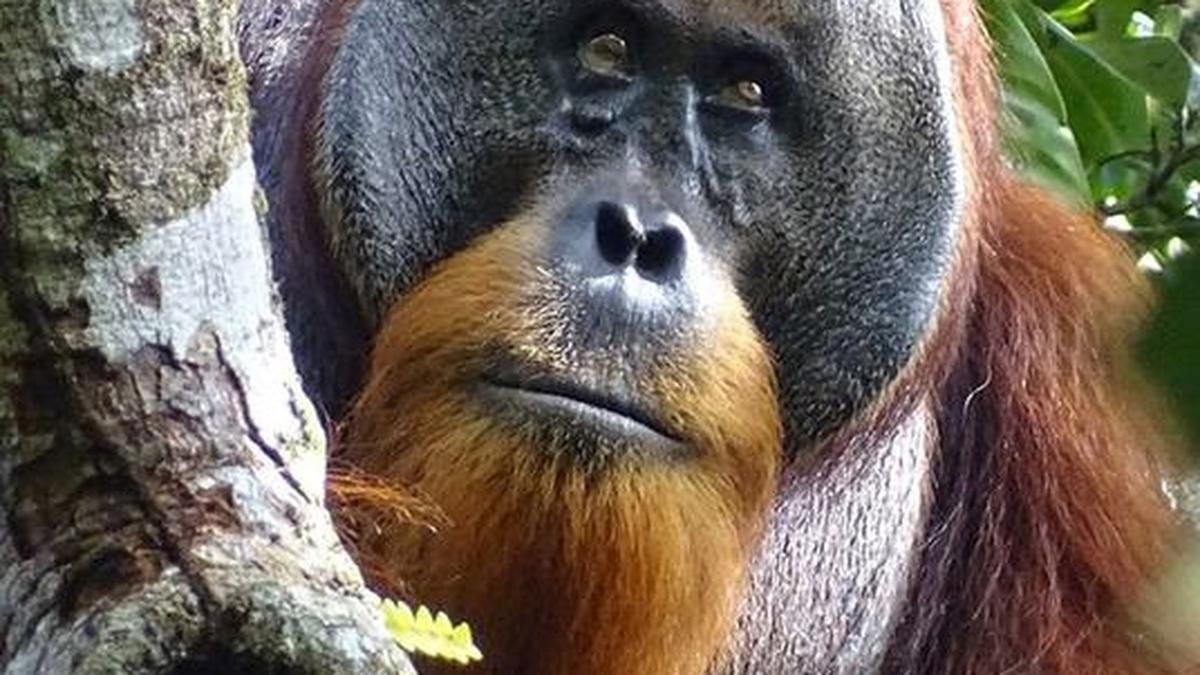
A male Sumatran orangutan named Rakus is seen two months after self-treating a wound with a medicinal plant in the Suaq Balimbing research site, August 25, 2022.
| Photo Credit: Reuters
An interesting review by G. Allen et al. in Scientific Reports (16,18690: 2026)reports on how orangutans, which are still present in the Sebangu forest in Central Kalimantan region in Indonesia, treat themselves by mixing saliva with the leaves of a plant botanists that call dracaena (a member of the asparagus family) and applying the mixture to their body in order to purify the air and relieve muscle pain and joint discomfort while carrying their babies.
Botanists from Gujarat University, Ahmedabad, had previously shown that this evergreen plant has antioxidant, antibacterial, antifungal, and anticancer activities (Vasava et al., Int. J. R. Tech., 2025; 117-120). Chimpanzees in Nigeria have also been to swallow leaves of the plant Desmodium gangeticum (called ‘shalaparni’ in India) to get rid of parasites that bother the animal’s skin. Ancient Ayurveda practitioners such as Sushruta were also known to use this plant and its parts as parts of formulations to manage asthma, haemorrhoids, and typhoid. What our ancestral primates millennia ago had practised has come down to us humans, and today we use several available plants such as snake plant, ginseng, oregano, and others for medicinal purposes.
Based on the fact that animals use plants like these to treat themselves, plant biologists have coined the term ‘zoopharmacognosy’ — ‘zoo’ stands for animals, ‘pharmaco’ for medicines, and ‘gnosy’ for knowledge. In the March 2008 issue of Resonance, the journal of the Indian Academy of Sciences, R. Raman and S. Kandula had reviewed this aspect of animals (vol. 13, pages 245-253 (2008)). Wikipedia itself lists around 70 publications in this area: of animals self-medicating with plants, roots, and fruits.
Eating earth for relief
Even common elephants have been known to chew the leaves of the oregano plant for relief from phlegm. Monkeys, sheep, dogs, and cats are also known to self-medicate by eating grass to remove parasites such as worms and amoeba that cause illness in the body. They also consume clay or soil particles, counting on substances therein to alleviate pain. This practice is referred to as geophagy — ‘geo’ referring to earth and ‘phagy’ to consuming. Birds are also known to use herbs to protect their nests from invaders (Phil. Trans. R. Soc. B (2018) 373 (1751): 20170196).
What about plants? Unlike animals, plants do not have a nervous system, although they too can sense their environment, respond to insect attacks, and try to defend themselves against herbivores.
There is also evidence that monkeys share with us humans the ability to track auditory regularities. In other words they also possess a faculty to appreciate music. Y. Ayala et al., in 2017 (Scientific Reports 7, 16687), pointed out that the rhesus monkeys respond to the acoustic syllables (musical scales), though not the rhythmic patterns as we humans do. Also in 2017, scientists at Glasgow University showed (DOI: 10.1016/j.physbeh.2017.01.024) that dogs show measurable changes in behaviour, heart rate, and stress levels when exposed to music, though the responses varied by genre, tempo, and the individual dog. On the other hand, cats have been found to respond to far different audio frequencies.
We should keep these details in when exposing animals to stressful environments like shelters and veterinary clinics, where the right kind of music can visibly calm anxious animals. As for friends with pet dogs: play music and let your dog enjoy it too!
dbala@lvpei.org
Published – July 24, 2026 09:00 am IST
