


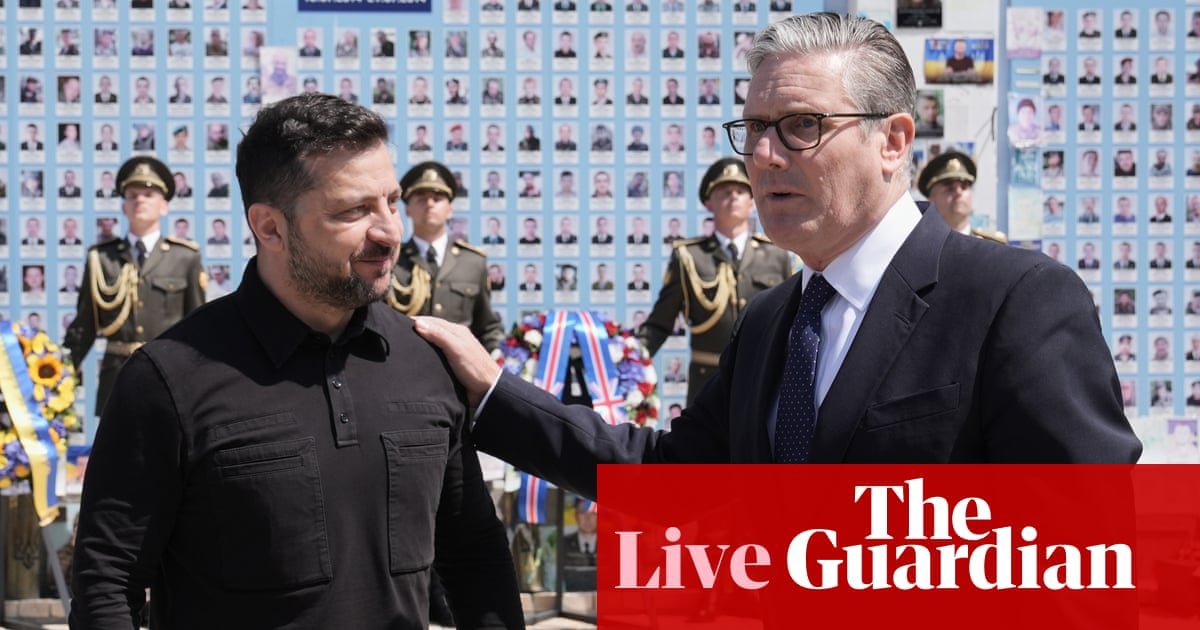
Zelenskyy thanks Starmer, UK for supporting Ukraine
Ukraine’s Volodymyr Zelenskyy said he and Starmer “paid tribute to the fallen Ukrainian warriors” as part of the UK prime minister’s final foreign trip, and thanked him and the UK for their support throughout the war.
“I thank Keir and the United Kingdom for their unwavering respect for our warriors, for all those who made the ultimate sacrifice to defend Ukraine and all of Europe.
It is important to always remember the heroism of all our people who stood up for Ukraine.
Eternal gratitude to every man and woman who defended Ukraine against Russian aggression.”
Key events
‘You can count on our full support,’ EU’s von der Leyen tells Ukraine’s new PM
Meanwhile, European Commission president Ursula von der Leyen congratulated Ukraine’s new prime minister, Sergii Koretsky, on his appointment.
Fresh back from her trip to Kyiv, von der Leyen said in a statement:
“We look forward to continuing our excellent cooperation with Ukraine.
We are confident that you will place Ukraine’s European integration at the heart of the country’s transformation effort.
You can count on our full support as you advance your ambitious reform agenda. Notably in the areas of the rule of law, energy and other key sectors of the economy.”
Notably, there is no reference to Zelenskyy’s removal of the popular defence minister, which sparked rare wartime protests in Kyiv.
Jakub Krupa
We are hoping to hear from Starmer and Zelenskyy at some point this afternoon, and I will obviously bring you the key lines when that happens.
Zelenskyy thanks Starmer, UK for supporting Ukraine
Ukraine’s Volodymyr Zelenskyy said he and Starmer “paid tribute to the fallen Ukrainian warriors” as part of the UK prime minister’s final foreign trip, and thanked him and the UK for their support throughout the war.
“I thank Keir and the United Kingdom for their unwavering respect for our warriors, for all those who made the ultimate sacrifice to defend Ukraine and all of Europe.
It is important to always remember the heroism of all our people who stood up for Ukraine.
Eternal gratitude to every man and woman who defended Ukraine against Russian aggression.”
No immediate plans of resuming peace talks with Ukraine, Kremlin says
Back to Ukraine, the Kremlin said it had no immediate plans of resuming peace talks with Kyiv, Reuters reported.
“We are well aware of our Turkish friends’ readiness to continue facilitating a shift toward a peaceful resolution of the situation surrounding Ukraine,” Kremlin spokesman Dmitry Peskov told reporters.
“We are grateful to the Turkish side for this. At the moment, however, there are no immediate prospects for resuming the negotiation process; we do not see any such signs. Nevertheless, the Russian side certainly remains open to this path.”
Reuters recalled that three short rounds of peace talks took place in Istanbul in 2025, followed at the start of this year by two rounds in Abu Dhabi and one in Geneva with mediation by the United States.
Peskov also told reporters that the Kremlin was monitoring a major reshuffle of Ukrainian president Zelenskyy’s government but the naming of a new prime minister and defence minister would make no difference unless Kyiv was willing to make decisions leading to a peace settlement.
Spanish amnesty law for Catalan separatists does not violate EU rules, top court says
Sam Jones
in Madrid
Meanwhile, the EU’s top court has ruled that a controversial Spanish law that offered an amnesty to those who planned and participated in the failed and illegal push for Catalan independence does not violate the bloc’s rules.
Thursday’s ruling was welcomed by Spain’s socialist-led government, which introduced the law two years ago in order to win the support of Catalan pro-independence parties in securing a return office following an inconclusive general election in July 2023.
Explaining its decision, the European court of justice noted that EU law does not preclude “the Spanish amnesty law for normalisation of the situation in Catalonia”, adding that the “adoption and application of an amnesty law falls within the competence of the member states”.
The amnesty law was designed to apply to about 400 people involved in the symbolic independence referendum of November 2014 and the illegal unilateral poll that followed three years later, which triggered Spain’s worst political crisis in four decades.
Its most high-profile beneficiary is the former Catalan regional president Carles Puigdemont, who fled to Belgium to avoid arrest over his role in masterminding the illegal push to secede in 2017, which culminated in a short-lived, unilateral declaration of regional independence. However, Puigdemont’s prospects of returning to Spain are still limited as he is still subject to an arrest warrant on a separate charge of embezzlement that is not covered by the scope of the amnesty.
Spain’s constitutional court is expected to rule over the coming months on whether that crime should also be covered by the amnesty.
Other beneficiaries of the law include headteachers who had faced criminal action for allowing their schools to be used as referendum polling stations, civil servants, firefighters, and dozens of the police officers who were dispatched to Catalonia to use force to stop people voting in the second independence poll.
The introduction of the amnesty law caused an outcry in Spain. The country’s socialist prime minister, Pedro Sánchez, had previously ruled out an amnesty and vowed to bring Puigdemont back to Spain to face justice. But he changed his mind after the July 2023 general election and agreed to the Catalan independence parties’ demands for an amnesty in order to win a return to power.
The decision led his his opponents to accused him of hypocrisy, cynical manoeuvring and putting his own political survival before the country’s interests.
While the conservative People’s party said it respected the court’s ruling, it renewed its attack on Sánchez, saying: “No prime minister should swamp impunity for power.”
Spain’s justice minister, Félix Bolaños, hailed the European court’s ruling, saying it had confirmed that the amnesty was “constitutional and compatible with European law”.
Oriol Junqueras, who served as Catalonia’s regional vice-president under Puigdemont and who was imprisoned and subsequently pardoned over his role in the independence push, welcomed the ruling.
“Today Europe has been clear,” he said. “The ruling strengthens the amnesty law and leaves only one option: to apply it in full. Restore rights. Bring back the exiles. And return politics to the place it should never have left: democracy.”
Dismissed Ukrainian defence minister declines offer to become Zelenskyy’s advisor
Meanwhile, we are getting more news from Ukraine, with the dismissed defence minister Mykhailo Fedorov saying he declined an offer to become president Zelenskyy’s advisor.
His firing sparked rare wartime protests in Kyiv, as reported earlier (9:59).
Fedorov also confirmed to reporters he had a dispute with Ukraine’s army chief Oleksandr Syrskyi, accusing him of blocking the defence ministry’s initiatives, Reuters reported.
Zelenskyy and Starmer lay wreaths at Wall of Remembrance in Kyiv
Koretskyi’s appointment comes just as Britain’s Starmer is meeting with Ukraine’s Zelenskyy in Kyiv.
Here are first pictures from their first official engagements this morning:
Energy executive Koretskyi confirmed as Ukraine’s new prime minister
Back to Ukraine, Sergii Koretskyi has just been confirmed by the Ukrainian parliament as the country’s new prime minister.
He is the third prime minister since the start of Russia’s full-scale invasion in 2022, replacing Yulia Svyrydenko, who resigned earlier this week.
Koretskyi told the parliament that Ukraine’s defence, economic stability and EU integration were among his key priorities, Reuters reported.
But Ukraine’s Volodymyr Zelenskyy explained his candidacy differently on Wednesday, telling reporters that “the priorities are clear – preparing for winter,” and Koretskyi – a former CEO the the state energy giant Naftogaz, was “the most prepared candidate” for the job.
Google may be held liable for commercial partners’ content on YouTube
Lisa O’Carroll
Elsewhere, we have got some big news from Luxembourg.
Google may be held legally liable for content on Youtube when it is made by a commercial partner, the European Court of Justice has ruled.
The case follows Google decision to challenge a €750,000 fine imposed by an Italian court in 2022 in relation to content that promoted online gambling, in breach of Italian law.
The administrative court in Italy had ordered Google to remove the videos from the YouTube which the US tech firm owns.
The ECJ found that the legal premise for the fine did fall within EU law on electronic commerce.
In addition, it rejected arguments Google could be exempt from regulations concerning content in this case because the YouTube video did not arrive on the platform through “automated and passive activity excluding any knowledge or control over the information which is transmitted or stored”.
“That is not the case where an operator reviews, for the purpose of concluding a commercial partnership contract, the main theme of a video channel, that channel’s most viewed videos or newest videos and the associated metadata. The operator thus acquires specific knowledge of the essential content of a set of videos and cannot therefore claim to act as an intermediary service provider,” the judges ruled.
Ukraine’s military struck six Russian tankers and two tugboats in the Black Sea and Sea of Azov overnight, the military’s General Staff said, as reported by Reuters.
The tankers are being used to transport Russian oil and petroleum products in circumvention of international sanctions, as well as to transport fuel for Moscow’s military, the General Staff said on Telegram.
EU fails to agree the latest round of sanctions against Russia
Jennifer Rankin
in Brussels
Meanwhile, the EU has failed to agree the latest round of sanctions against the Kremlin.
EU ambassadors agreed to maintain the current price cap on Russian oil of $44.1o a barrel until 23 July pending another attempt at finalising the measures. If the EU’s 27 countries do not reach an agreement soon, the price cap on Russian oil will automatically go up, boosting revenues for Russian president Vladimir Putin.
That would be a blow to the EU’s strategy and credibility when turmoil in the Middle East is already sending oil prices higher.
The deadline for the legal review was 15 July, but the new price cap does not come into force until later this summer.
The deadlock is a reminder that EU sanctions were never going to be sweet and simple to agree just because Moscow-friendly Viktor Orbán is no longer in power. The EU’s 27 member states have always had divergent interests over Russia sanctions, exemplified in the current proposals, the 21st round of restrictive measures since the full-scale invasion.
France and Italy have raised objections to a proposal to ban ex-Russian combatants from the EU. Germany objected to a proposal to ban Russian imports of cod and pollock, now scrapped. Bulgaria protected Patriarch Kirill from being sanctioned.
Ukraine’s president Volodymyr Zelenskyy said he wanted maximum sanctions pressure on Russia, as he urged the EU to see the big picture. “We must be very persistent and remember that it’s not only EU leaders who grow tired of adopting sanctions, of finding compromise and balance – Russia gets tired of every such package.”
The wide-ranging package also targets Russian banks, crypto firms, drone producers and refiners.
1000+ people protest against Zelenskyy’s move to fire popular minister, leaving Starmer in ’embarrasing’ position as he visits Kyiv
Luke Harding
in Kyiv
I will give you a flavor of the demonstrations this morning in Kyiv against Volodymyr Zelenskyy and his bizarre decision to fire Mykhailo Fedorov, the defence minister.
There are maybe 1000 people, 1000 plus, people already here in the summer sunshine right under Zelensky’s presidential office, and I’ve been talking to them about this decision.
They have basically been saying that they are furious, they are bewildered. They say Fedorov essentially represents openness and innovation and transparency, he has been very successful, and that it’s the kind of old forces, Soviet-style forces, who’ve got rid of him, and that that at heart this is about two things.
One is a conflict with Oleksandr Syrskyi, the commander in chief, who they allege is involved in, or his generals are involved in, various kind of corruption schemes. People now saying Syrskyi out, keep Fedorov.
And the other is just personal rivalry; that Fedorov is very popular. He’s young, 35, and is regarded by some people here as a kind of future presidential leader. And that Zelensky has got rid of him for really just pretty blatant political reasons. At least that’s the critique here.
There are posters, cardboard placards saying: “for what?,” “Syrskyi out,” and so on.
It’s a young crowd here. This is only the second big demonstration since the full-scale invasion against Zelensky, right on his doorstep.
And one final thing: a lot of people have been saying that it’s embarrassing for Starmer, and that Starmer has to raise the Fedovor issue with Zelenskyy if he wants to become Nato secretary general in the future.
We’ll have to see if that’s the case.
Volodymyr Zelenskyy dismisses Ukraine’s defence minister on eve of Starmer visit
Luke Harding
and Artem Mazhulin
in Kyiv
Fedorov’s six months in office coincided with a dramatic improvement in Ukraine’s position on the battlefield. Kyiv has repeatedly hit Russian oil refineries with long-range drones, embarrassing Vladimir Putin and creating nationwide fuel shortages.
In his farewell message Fedorov, 35, listed his achievements. They included disabling Starlink for Russian troops and procuring more drones, used to destroy “enemy logistics” and to isolate occupied Crimea. He said he had “radically improved” the procurement system, saving the state budget “billions of dollars”.
On the day of his departure the minister revealed Ukraine’s military had successfully tested a ballistic missile. “We fundamentally revised the technical requirements and achieved maximum accuracy. We reduced the cost by 30%. Ukraine will enter a new league,” he said.
The sacking appeared likely to overshadow Keir Starmer’s visit to Kyiv. The British prime minister, who is due to leave office this week, arrived on Thursday to mark the country’s support for Ukraine during his premiership.
Morning opening: Zelenskyy’s move to oust popular defence minister sparks protests as Starmer makes last visit
Jakub Krupa
Volodymyr Zelenskyy is facing public outrage this morning over his decision to remove Ukraine’s popular defence minister, Mykhailo Fedorov, as he welcomes the UK’s departing prime minister Keir Starmer to Kyiv.
The Ukrainian president moves to oust Fedorov despite pleas from foreign partners and civil society for him to keep his job, as part of wide-ranging government reshuffle which also saw Yulia Svyrydenko leave the post of the prime minister.
The timing makes it a bit awkward for Starmer who is finishing his legacy tour and is keen to highlight Britain’s support for Ukraine under his premiership.
But Zelenskyy will be keen to portray it as a clear sign of continuing international support, a day after he welcomed the EU’s Ursula von der Leyen and several national leaders from south-eastern Europe.
I will also keep an eye on Emmanuel Macron’s visit to France’s historic Fontainebleau forest after days of raging fires, and his later engagement with Germany’s Friedrich Merz.
We will no doubt have plenty of updates from Kyiv and beyond to cover for you.
It’s Thursday, 16 July 2026, it’s Jakub Krupa here, and this is Europe Live.
Good morning.
