



Key events
A Saudi-owned vessel was targeted while sailing in the Red Sea, causing a fire at the front of the ship, the Saudi state news agency SPA reported on Thursday, citing an official source at the General Transport Authority.
The source was quoted as saying all crew members aboard the Encelia were safe and that authorities had taken necessary measures to secure the vessel and crew and protect the marine environment.
The report came after Yemen’s Houthis said they had carried out missile and drone strikes on two Saudi oil tankers in the Red Sea on Wednesday – naming one as the Encelia – as part of a maritime embargo on the kingdom amid the US-Iran war.
Iran says it stopped three tankers transiting Hormuz strait
Iran’s Revolutionary Guard is saying it stopped three oil tankers from passing through the strait of Hormuz.
In recent weeks Iran has hit tankers using a route hugging the Omani coast to traverse the waterway, in an effort to push vessels into using its own waters and pay for safe passage as Tehran and Washington vie for control of the vital energy pathway.
The Islamic Revolutionary Guard Corps (IRGC) said in a statement quoted by Iranian state media on Thursday that three oil tankers “provoked” by the US military were trying to pass through a mine-laden route south of the strait “but after one of them exploded and caught fire, the other two quickly turned around and turned back”.
The statement, cited by AFP, did not say when the incident happened. The IRGC added that its navy “emphasises that the strait of Hormuz is under our control … and any ship that is deceived by the US and intends to pass without coordination with the Islamic Republic of Iran will suffer the same fate”.
The US military’s Central Command earlier posted on social media that “Iran does not control” the strait, saying: “The international waterway remains open for transit regardless of IRGC threats and attacks. Commercial vessels continue to use the strait with US military support.”
The Houthis’ claim to have hit two Saudi oil tankers as part of the naval blockade on Saudi Arabia elevates the threat of a second chokehold on global oil supplies at the Red Sea in coordination with Iran’s attempt to control the strait of Hormuz.
The Iran-aligned militants, who control areas near the Bab el-Mandeb strait on the opposite end of the Arabian Peninsula from the Hormuz strait, said on Monday they were imposing a naval blockade on Saudi Arabia in what some analysts have viewed as a tactical move by Iran to seek leverage in any diplomatic efforts to end the war.
But even before the renewed threats to shipping traffic in the Red Sea, Iran’s blockade of the strait of Hormuz had pushed up oil and petrol prices and stoked inflation around the world.
Five tankers changed course in the Red Sea to avoid the Bab el-Mandeb strait on Wednesday, and three tankers loaded with Saudi oil for China and India made U-turns on Tuesday, as Reuters reports. Then the Yemen-based Houthis said their forces carried out missile and drone strikes on two Saudi oil tankers in the Red Sea.
Millions of barrels a day of Saudi oil have been heading to the kingdom’s Red Sea port of Yanbu to avoid the strait of Hormuz. If shipments cannot pass through the Red Sea’s southern strait, they have only the northern route through the Suez Canal, adding weeks to the journey and significantly raising costs.
Two killed in US strike at Iran border crossing – report
Two people have been killed in a US strike at the Shalamcheh border crossing in south-western Iran, the country’s Students News Network is reporting, citing a security offical.
A little earlier Iran’s Mehr news agency was cited as quoting a provincial security official saying a US missile attack near a passenger terminal at the Shalamcheh crossing with Iraq had caused no casualties.
The reports come as the US continues what Central Command said were more strikes against Iranian military targets, beginning from 5.30pm ET Wednesday (9.30pm GMT).
More now on the US signing a landmark nuclear agreement with Saudi Arabia that could allow the kingdom to enrich uranium in the future.
Full details of the deal have yet to be released, but the timing of the announcement is controversial as the US’s war with Iran is being fought in part to prevent Tehran enriching uranium domestically and make it near-impossible for Iran to build a nuclear weapon, as Maya Yang and Patrick Wintour report.
A civil nuclear deal with Saudi Arabia has been in the works for years during both Donald Trump’s first administration and that of former president Joe Biden. No deal has come together before now, in part because of warnings from nonproliferation groups that say it could offer Saudi Arabia a path to develop a nuclear weapon.
The deal will be submitted to the US Congress for review, where it could face opposition among lawmakers who fear a lack of monitoring safeguards to restrict Saudi Arabia’s uranium enrichment.
As mentioned, the US Department of Energy said its secretary and his Saudi counterpart signed the “peaceful nuclear cooperation agreement” along with a “bilateral safeguards agreement”.
The full report is here:
Iran warns ‘eye for an eye’ response to US
Before the US launched its 12th night of strikes against Iran, the Islamic republic’s foreign minister warned: “Our defense doctrine is clear: eye for an eye.”
Abbas Araghchi also said in the post on X several hours ago:
Any aggression against Iran, including our infrastructure, will compel a powerful and decisive response.
Those who contribute to such aggression, whatever the kind of support, will also be considered as legitimate targets.
More on Yemen’s Houthis claiming strikes on two Saudi oil tankers in the Red Sea:
The master of one tanker reported being struck by an unknown projectile about 70 nautical miles south-west of Al Shuqaiq, causing a fire that the crew was fighting, the British naval security monitor UKMTO said.
The Iran-aligned Houthis warned shipping companies on Wednesday that their tankers risk being attacked if they used Saudi Arabian ports, as the militia enforced a blockade it announced the previous day.
The Houthi warning for the Red Sea – coming on top of Iran’s threat to shipping on the other side of the Arabian peninsular in the Gulf – could affect the substantial Saudi oil exports that have so far been unscathed by the months-long conflict and deepen the rapidly escalating crisis in the region, as Peter Beaumont has written.
Donald Trump said he would “take care of” the Houthis if they followed through on their blockade threat against Saudi ports.
The Houthis have been broadcasting radio warnings to vessels, the International Chamber of Shipping told Agence France-Presse.
The message warned that “in case of non-compliance of Yemeni armed forces decision, those ships will be in our target”.
Kuwait’s air defences are responding to hostile drone threats amid “Iranian aggression”, the Kuwaiti army is saying.
Any explosion sounds heard were the result of attacks being intercepted, it said on social media.
Iran has continued to strike at countries around the region hosting American forces in response to ongoing US attacks.
Opening: US launches more strikes on Iran as Yemen’s Houthis claim Red Sea attacks
Welcome to our live coverage of the continuing crisis in the Middle East.
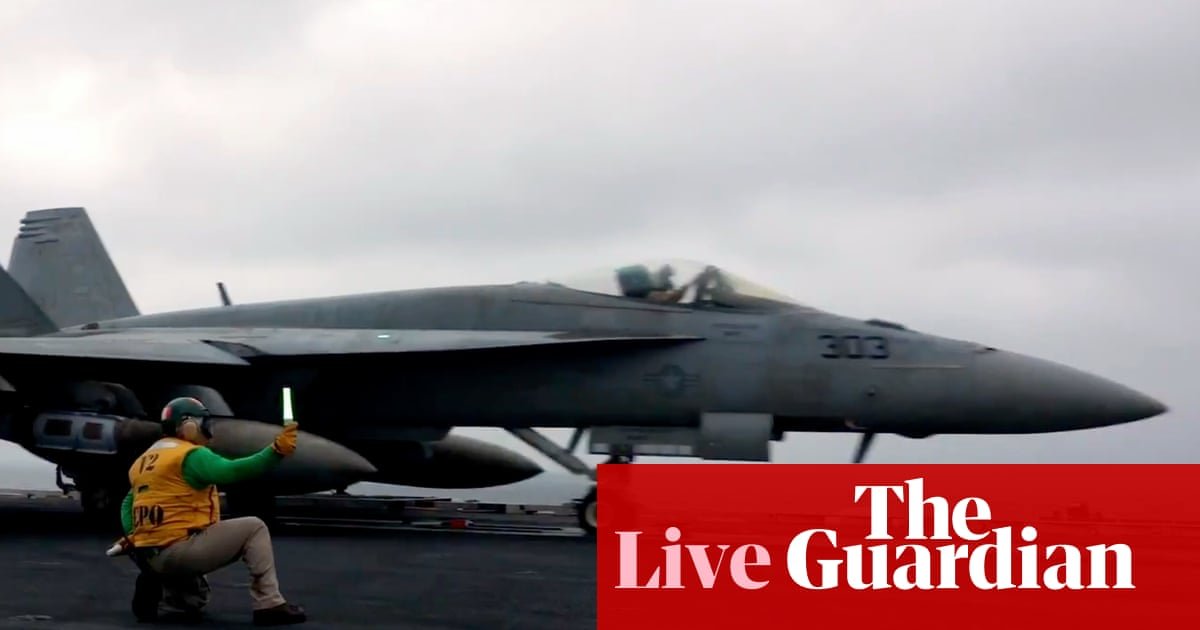
The US military announced on Thursday evening it had began a 12th consecutive night of strikes against Iranian military targets at the direction of Donald Trump.
US Central Command said the strikes would “continue to further degrade Iran’s ability to threaten civilian mariners and commercial vessels transiting regional waters”.
It came as Yemen’s Houthis said they carried out missile and drone strikes on Wednesday on two Saudi oil tankers in the Red Sea after declaring a maritime embargo on the kingdom amid the US war with Iran.
The Houthis said in a statement posted on Telegram that they “carried out a qualitative military operation targeting two Saudi oil tankers that violated the blockade”, naming the vessels as the Encelia and the Layla.
Meanwhile, the US signed a landmark nuclear deal with Saudi Arabia that could allow the kingdom to enrich uranium.
The US Department of Energy said on Wednesday its secretary and his Saudi counterpart signed a “peaceful nuclear cooperation agreement”, along with a “bilateral safeguards agreement”.
We’ll bring you more on these and other developments in our continuing live coverage.


