


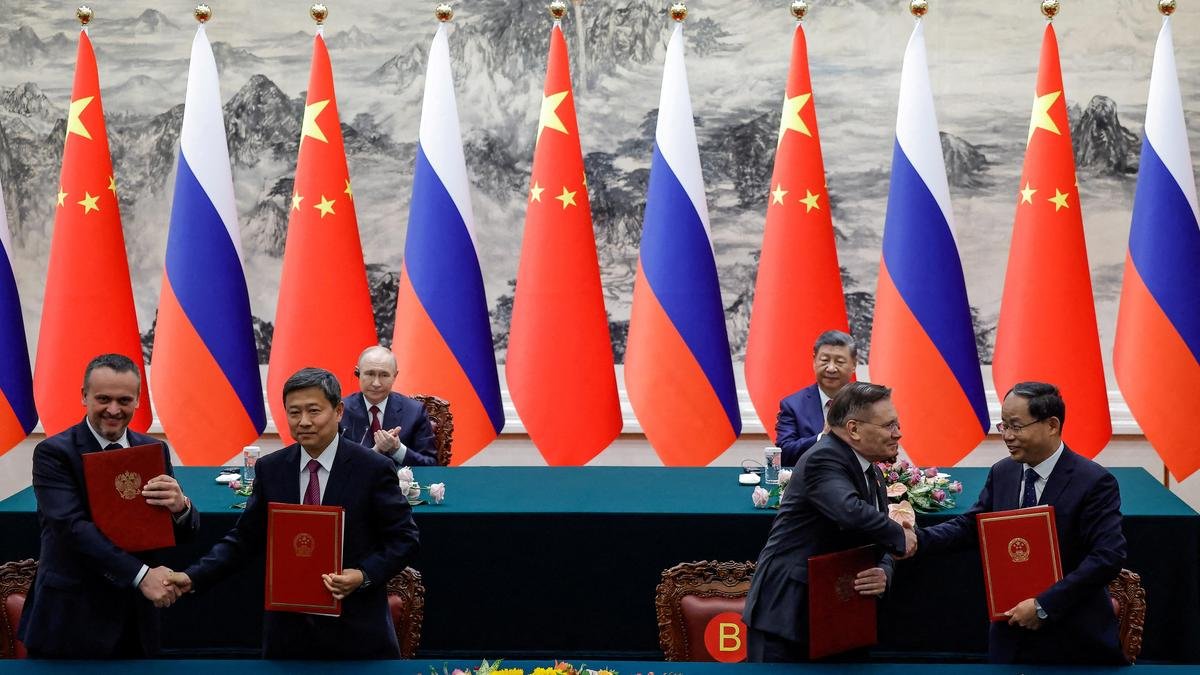
Chinese President Xi Jinping on Wednesday (May 20, 2026) called for an immediate end to hostilities in West Asia, saying the situation had reached a “critical juncture”, as he held talks with his Russian counterpart Vladimir Putin here amid escalating regional tensions.
Welcoming Mr. Putin at the Great Hall of the People, Mr. Xi said renewed fighting in the Gulf and the wider West Asia must be avoided and stressed that negotiations should continue.
An early end to the conflict will help ease disruptions to energy supplies, industrial and supply chains, and the international trade order, the Chinese President said.
The talks between Mr. Xi and Mr. Putin came days after U.S. President Donald Trump visited China from May 14-15 and held extensive discussions with the Chinese leader on the Iran-Israel conflict, the Strait of Hormuz and bilateral trade frictions.
The meeting is being closely watched as both China and Russia are key strategic partners of Iran with close economic and military ties to Tehran and could influence its tough stand on the closure of the Strait of Hormuz, which has triggered a major global energy crisis.
Mr. Xi described the international situation as “fluid and turbulent” and, in an apparent criticism of Mr. Trump’s policies, said that “unilateralism and hegemonism are resurging”.
“Yet peace, development and cooperation remain the aspiration of the people and the prevailing trend of our times,” he said.
Calling for closer China-Russia coordination, Mr. Xi said the two countries should work together to make the global governance system “more just and reasonable”.
“As permanent members of the UN Security Council and important major countries in the world, China and Russia should take a strategic and long-term perspective, drive the development and revitalisation of our respective countries through comprehensive strategic coordination of even higher quality, and work to make the global governance system more just and reasonable,” he said.
According to the Kremlin, around 40 deals are expected to be signed during Mr. Putin’s visit.
Mr. Putin, who is making his 25th visit to China, described Mr. Xi as his “dear friend” and highlighted the close coordination and cooperation between the two strategic partners.
“Dear Mr. President, Mr. Xi Jinping, dear friend! It would be appropriate to use a Chinese saying: as far as we know, people in China say, ‘One day apart feels like three autumns’,” Russian news agency Tass quoted Mr. Putin as saying in his opening remarks.
“We are really happy to see you, and we constantly synchronise watches – both personally and through our aides,” he said.
The two leaders also agreed to further extend the China-Russia Treaty of Good-Neighbourliness and Friendly Cooperation, signed 25 years ago.
Mr. Xi said the treaty had laid the institutional foundation for long-term friendship and comprehensive strategic coordination between the two countries, adding that bilateral ties had achieved “leapfrog development” since then.
“China supports the further extension of the treaty,” Mr. Xi said, adding that Beijing will work with Moscow to uphold the spirit of the agreement and firmly advance China-Russia “back-to-back strategic coordination”.
Ahead of the talks, Mr. Putin was accorded a ceremonial welcome by Mr. Xi.
The Russian leader, who arrived in Beijing on Tuesday (May 19, 2026) night, was received by Chinese Foreign Minister Wang Yi.
In a video message issued ahead of his visit, Mr. Putin said Russia-China ties had reached an “unprecedented level” and noted that bilateral trade had crossed $200 billion, with transactions increasingly being conducted in roubles and yuan.
He also said the Russia-China strategic partnership played a “major stabilising role” globally and stressed that the two countries would continue coordination through multilateral forums such as the United Nations, Shanghai Cooperation Organisation and BRICS.
Mr. Putin’s visit comes amid heightened tensions in West Asia following Iran’s blockade of the Strait of Hormuz and the U.S. seizure of Iranian ports.
China imports nearly 90% of Iranian oil despite U.S. sanctions, while both Moscow and Beijing maintain close strategic ties with Tehran.
Published – May 20, 2026 06:54 pm IST
