


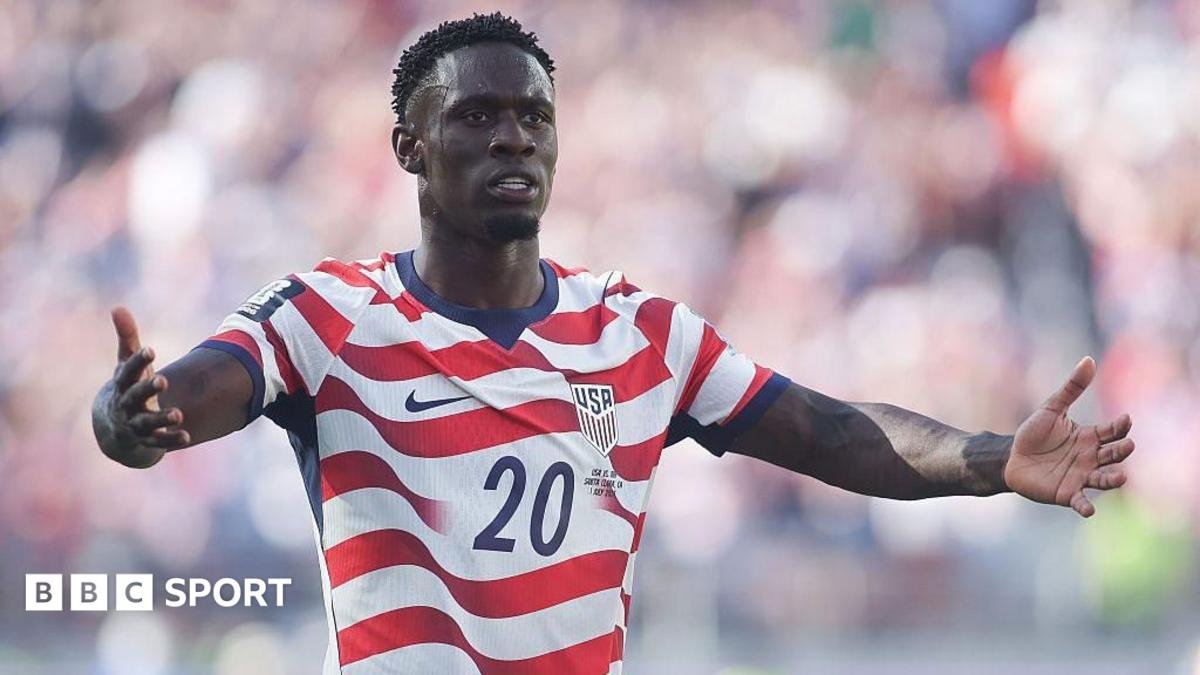
There is one overriding question many people are now asking. How?
Fifa’s disciplinary code states that Balogun should receive a ban of “at least two matches for serious foul play”.
Indeed, the World Cup rules do not allow teams to appeal against a red card.
Fifa’s statement offered no reason or explanation for suspending Balogun’s ban. It just cited “article 27 of the Fifa disciplinary code”.
Article 27 allows Fifa “to fully or partially suspend the implementation of a disciplinary measure”.
It is a wide-ranging rule that allows Fifa to effectively make whatever decision it wants without having to meet any other criteria.
Article 27 has never before been used at a World Cup.
In addition, Balogun’s suspended ban is only for one match, not two as per the disciplinary code. This has not been explained.
BBC Sport has asked why this happened.
But we were not provided with any reasoning. We were simply directed to Cristiano Ronaldo’s suspended ban before this tournament.
Under Fifa’s disciplinary code, Ronaldo should have received a three-match ban for elbowing Dara O’Shea during Portugal’s 2-0 qualifying defeat by the Republic of Ireland in November.
He served one match in the final qualifier against Armenia – but the remaining two games of the ban were suspended.
Ronaldo’s red card, though, was received in qualifying. It was not a red card at a World Cup.
There have been many cases of players being shown some leniency before a tournament, not just Ronaldo.
See France’s Laurent Koscielny in 2014, or Ecuador’s Moises Caicedo and Argentina’s Nicolas Otamendi before this World Cup.
At least with Ronaldo, we were given some justification, with Fifa saying it had taking into account that “he had no red cards in his other 225 international appearances”.
With Balogun, we did not even get that.
It has left a vacuum of information which can only lead to speculation.
Why was this a special case? What factors were taken into account? Who made the decision?
BBC Sport has been told there are no suggestions that the referee asked for the suspension to be removed, or that video assistant referee protocol was not respected.
In England, the Football Association would publish the full written reasons.
The United States have the right to ask Fifa to publish them, Belgium do not.
BBC Sport pundit Micah Richards, a former England defender, said it was a farce.
“To have it suspended for a year makes a mockery of the whole tournament,” he said.
“It is to keep the big stars in the competition. How can that happen? Fifa needs to do better.
“It has left a bad taste in a lot of people’s mouths.”
Belgium are, of course, furious. They issued a statement on Sunday saying they were “astonished” that Balogun had been cleared to play.
The Belgian FA referenced several regulations, workshop presentations and pre-tournament co-ordination meetings.
They are adamant that the decision contradicts the tournament regulations which state that a player “will automatically be suspended from their team’s subsequent match”.
In effect, they say Fifa used its disciplinary code to override the competition regulations.
Belgium head coach Rudi Garcia, speaking at a news conference, went further. He said: “I didn’t know that [at] the Fifa World Cup 5 July is now 1 April, and that is April Fool’s.
“We are not defending the national team or the federation, we’re defending football.”
What must the other players sent off at this tournament be thinking?
Take Qatar’s Assim Madibo, involved in an unfortunate incident which led to a broken leg for Canada’s midfielder Ismael Kone.
There is a clear case here that Madibo did not even make a challenge, that the injury happened by chance and not because of the nature of the tackle.
Yet Fifa handed Madibo a five-game ban – an extra three on top of the standard punishment for serious foul play.
