






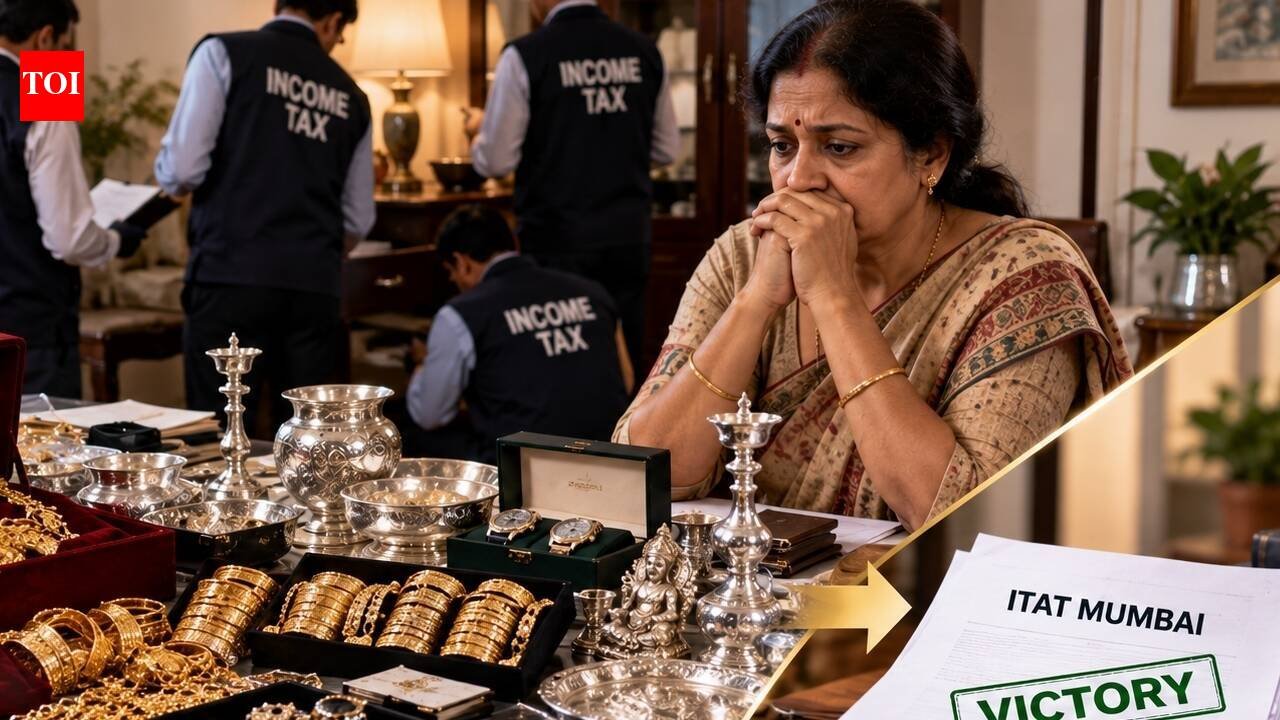
A woman, who has been married for 35 years and lives with her husband in Navi Mumbai, found herself caught up in a tax dispute over jewellery that was seized by the Income Tax Department. She eventually approached the ITAT Mumbai to seek the return of the gold, diamond and silver items seized during the department’s search operation.
What the case is about
The matter began after the woman filed her income tax return (ITR) on August 12, 2019, declaring an income of Rs 1.34 lakh. However, around a year before she filed the return, the Income Tax Department came across information about her while conducting a search at the offices of a company.Based on the information it had received, the department suspected that the woman was in possession of several high-value gold, diamond and silver jewellery items. It subsequently issued her multiple tax notices and also conducted searches at her residence and bank lockers.During the search of her house, Income Tax officials found the following items:
- Gold jewellery – 392.71 grams
- Pure gold – 92 grams
- 27.4 carats of diamond jewellery containing 161.33 grams of gold
- 800 grams of silver items and coins
The search of her bank lockers resulted in the recovery of:
- 166 grams (81+85 grams) of pure gold
- 10.4 kg (10 kg + 400 grams) of silver mixed articles
- 35 grams of gold jewellery
The Income Tax Department seized all these items and the Assessing Officer (AO) asked the woman to produce bills and other supporting evidence to establish their ownership and source.In response, the woman explained that she had been married for 35 years and that part of the jewellery had been received as gifts from relatives at the time of her marriage. She said other pieces formed part of her inheritance and streedhan. Her husband also stated that he had disclosed income of Rs 4 crore in his ITR and had occasionally gifted jewellery to his wife, including a gold chain given to her recently, ET reported.
What the Income Tax Department said
The AO was not fully convinced by this explanation. He referred to Central Board of Direct Taxes (CBDT) Instruction No. 1916 and held that the woman was entitled to retain a total of 700 grams of jewellery, which includes 500 grams for a married woman and 100 grams each for her husband and son.The quantity beyond this limit was treated as unexplained under Section 69A by the AO.The AO consequently assessed Rs 19.4 lakh as unexplained income and imposed tax on the amount, along with a penalty. The woman challenged the assessment before the Commissioner of Appeals (CIT A).The CIT (A) partly allowed her appeal but upheld the remaining additions. She then took the matter to the ITAT Mumbai, where she secured a complete victory on July 14, 2026.
How did the woman win the case?
Chartered Accountant Suresh Surana explains why the ITAT Mumbai ruled in the woman’s favour and removed the remaining additions totalling Rs 11.23 lakh.Surana told ET that the key reason the woman succeeded was that she was able to explain how she came to possess the different gold, diamond and silver items.Her explanation was that the jewellery and other articles had been accumulated over a long period and acquired through customary family practices, which was consistent with the circumstances of the family. The Income Tax Department, however, did not bring any contrary material to establish that the assets had been recently acquired using undisclosed income.The ITAT Mumbai therefore deleted the addition of Rs 8.1 lakh relating to pure gold and another Rs 3.12 lakh concerning silver articles. The two additions amounted to Rs 11,23,190 in total, and the woman’s appeal was allowed.Surana also pointed out that the tribunal specifically limited its finding concerning pure gold to the facts of this particular case.The decision, therefore, should not be understood as establishing a general rule that every holding of gold bullion or pure gold automatically receives the benefit of CBDT Instruction No. 1916.
What ITAT Mumbai said:
Silver articlesOn the silver articles, Surana said the tribunal considered the circumstances in which such items were held instead of insisting that the woman produce old purchase invoices for them.The ITAT Mumbai referred to the Indore ITAT decision in Shri Dinkar Laxman Mujumdar v. DCIT, where the benefit of CBDT Instruction No. 1916 had similarly been extended to silver articles.Taking into account the woman’s long marriage, the customary receipt of silver articles at the time of marriage and on other family occasions, inheritance and the family’s financial standing, the tribunal concluded that the silver articles could reasonably be treated as explained.Pure goldThe tribunal dealt separately with 258 grams of pure gold. It clarified that CBDT Instruction No. 1916 does not, by itself, grant automatic immunity to every quantity of pure gold or bullion. At the same time, the instruction can provide a reasonable reference point when assessing the gold held by a family.The tribunal first excluded 195.996 grams of gold jewellery for which purchase bills were available. After this exclusion, the remaining gold, comprising ordinary jewellery, the gold component in the diamond jewellery and pure gold, came to 651.044 grams.According to Surana, the ITAT observed that this quantity remained within the 700-gram family benchmark that the AO himself had accepted by applying the CBDT Instruction.The tribunal also found it difficult to justify a distinction within the same family holding by accepting ordinary gold jewellery and diamond-studded gold jewellery while treating the pure gold as unexplained simply because it was held in a different physical form.More importantly, Surana said the ITAT Mumbai found that neither the AO nor the CIT(A) had produced any evidence showing that the pure gold had been acquired afresh during the relevant year using undisclosed income.The fact that old purchase invoices were unavailable was therefore not considered sufficient, on its own, to reject the woman’s explanation, particularly when her explanation was based on marriage gifts, inheritance and assets accumulated over several decades.The tribunal’s decision also makes clear that CBDT Instruction No. 1916 is not an absolute tax exemption or a statutory upper limit on the amount of jewellery that can be held.Surana says “the quantities specified in the instruction provide a practical benchmark for assessing whether family possession of jewellery can reasonably be accepted as explained.”Such an assessment, according to the ruling, has to consider factors including the taxpayer’s length of marriage, family customs, inheritance, streedhan, social and financial status and other surrounding circumstances.The ITAT Mumbai consequently held that an addition under Section 69A cannot be upheld merely because purchase invoices are unavailable for assets that have been accumulated over several decades, especially when there is no evidence showing that those assets were acquired from undisclosed income during the relevant year.


