



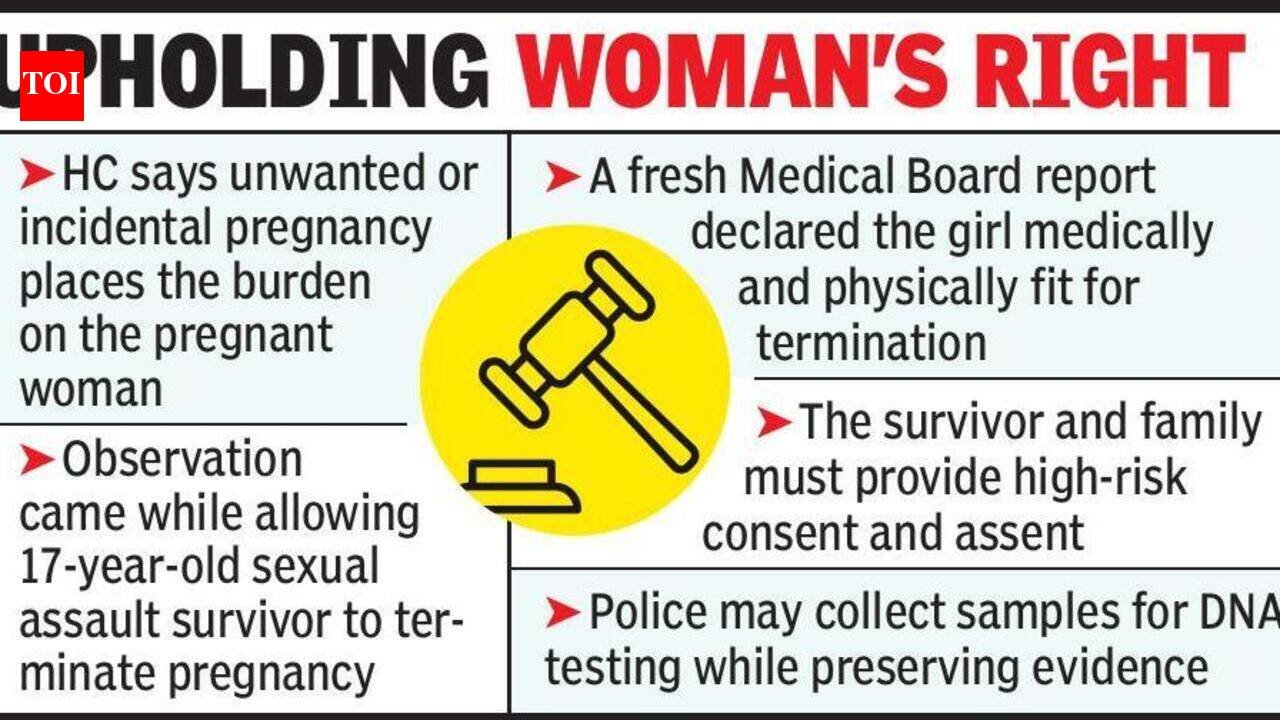
Nagpur: “A woman alone who has full right over her body and is the ultimate decision-maker on the question of whether she wants to undergo abortion,” observed Nagpur bench of Bombay high court recently while permitting a 17-year-old survivor of sexual assault to terminate her 28-week-and-six-day pregnancy.A division bench comprising Justices Anil Kilor and Rajnish Vyas said an unwanted or incidental pregnancy becomes a burden for the pregnant woman, while relying on observations of Supreme Court on a woman’s autonomy in deciding whether to continue a pregnancy.The court was hearing a petition filed by the minor, through her father, seeking permission to terminate the pregnancy. The court had appointed Sweety Bhatia as counsel to represent the minor girl. An FIR had been registered at Koradi police station on September 6 under sections 64, 70(1) and 137(2) of the Bharatiya Nyaya Sanhita, 2023, and sections 4 and 6 of the Protection of Children from Sexual Offences Act, 2012.The bench had initially referred the girl to Medical Termination of Pregnancy Board on September 10. The Board’s first report, submitted on September 11, stated that she was not medically fit to undergo the procedure.After Bhatia submitted that she could be re-examined after a week, the court directed that the matter be listed again on September 17. A fresh report submitted that day stated that the girl was medically and physically fit to undergo termination of pregnancy.“Considering the fact that there is no life threat to the petitioner and the opinion given by the Medical Board, we deem it appropriate to direct dean of Govt Medical College and Hospital (GMCH) here, to permit her to undergo the medical termination of pregnancy at the earliest by taking recourse of safety protocols and by complying with our observations,” the judges said.Since the FIR is under investigation, the bench permitted Koradi police to collect samples of the survivor and foetus for DNA testing in accordance with law and while preserving evidence for the criminal case. “The survivor and her family members will have to furnish an undertaking of high risk consent and assent before the concerned medical authority,” it said before disposing of the plea.
