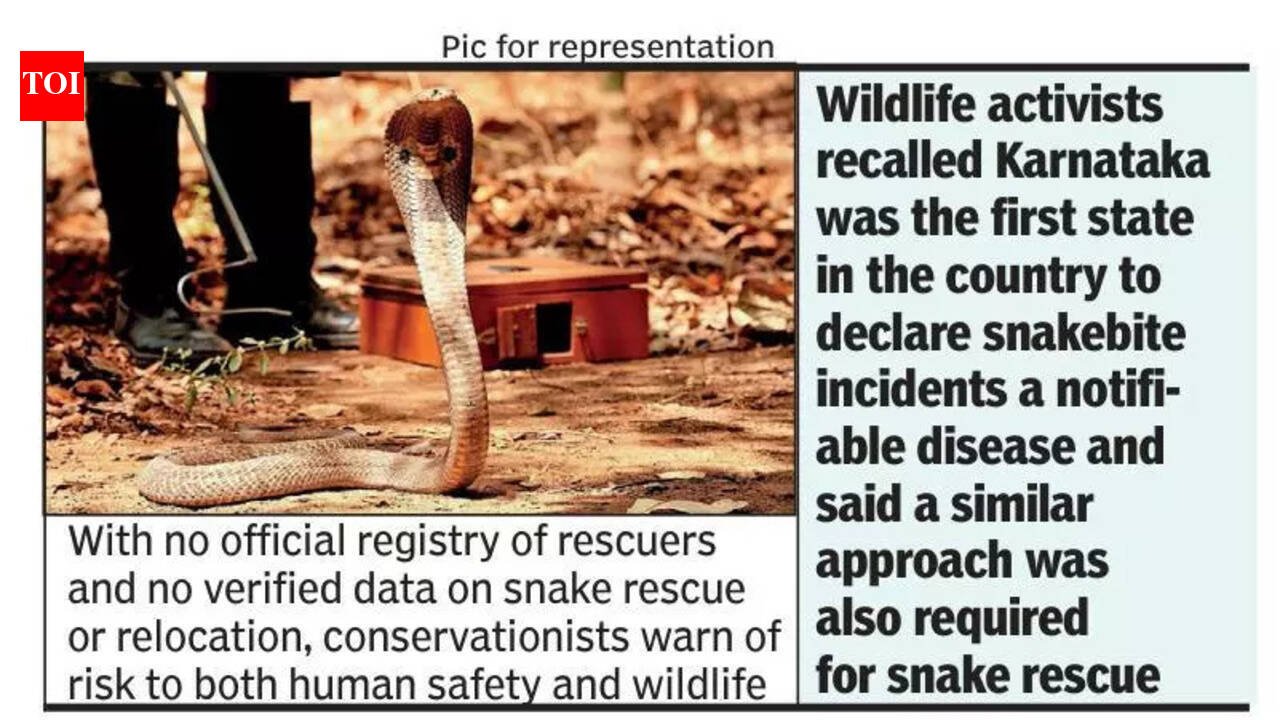
Bengaluru: Wildlife rescue — particularly snake rescue — in the city increasingly slipped into an unregulated, profit-driven activity, triggering growing demands to recognise snake rescue as a free public service. Several self-proclaimed rescuers allegedly charge panic-stricken families between Rs 1,000 and Rs 5,000 per call.With no official registry of rescuers, no verified data on snake rescue or relocation, and the absence of a transparent, govt-run mechanism, conservationists warn both human safety and wildlife are being put at risk. In response, a group of conservationists and citizens launched a campaign urging GBA or the forest department to formally declare snake rescue a free govt service.Former BBMP-authorised snake rescuers are among those leading the call. Rajesh Kumar, founder trustee of the Wild World Conservation Trust (WWCT) and an authorised wildlife rescuer with the erstwhile BBMP, said, “Amid increasing human-snake conflicts across Bengaluru, the city is also reporting an alarming surge in the number of self-styled snake rescuers operating at their own will. While the BBMP had only seven authorised snake rescuers, today, Bengaluru has about 250 to 300 self-claimed snake rescuers. Citizens do not know who to call or where to find snake rescuers if they sight a snake in the neighbourhood. Who will be responsible if they are bitten during the rescue?” he asked.Alleging that snake rescue was given a business touch, Rajesh pointed to violations of established protocols. “There is a standard operating procedure (SOP) in place for snake rescue, as a few varieties of snakes are listed under Schedule I and II of the Wildlife Protection Act, seeking the highest protection. But that SOP is grossly violated. A five-minute rescue is made into a half-an-hour exercise only to film the incident and post it on YouTube or Instagram for self-promotion,” he said. Questioning the lack of accountability, he added, “If you search for snake rescuers on the internet, one will find at least 20 to 30 rescuers in one location. But the question is who has authorised all of them, what is the cost of the rescue operation, and who has to bear it?”Nagabhushan, another authorised wildlife rescuer earlier attached to the Mahadevapura zone, said the forest department itself is stretched thin. “The forest department lacks human resources, as their time is increasingly spent on attending to litigation, recovery of encroached land, meetings, and courts,” he said. Explaining the current system, he added, “The forest department runs a helpline — 1926. But the rescue calls are diverted to range forest officers (RFOs), who in turn pass them on to local rescuers for immediate relief. Today, not many rescuers are aware whether a snake is terrestrial, aquatic, or arboreal. Without this knowledge, where will they rehabilitate these snakes?”Activists also recalled Karnataka was the first state in the country to declare snakebite incidents a notifiable disease and said a similar approach was needed for snake rescue. “Kerala designed an app based on location with details of rescuers. The Tamil Nadu govt also adopted the same method,” Rajesh said. Questioning the lack of action by Bengaluru city corporation, he added such streamlining would not require additional funds and could be integrated into the existing system.