


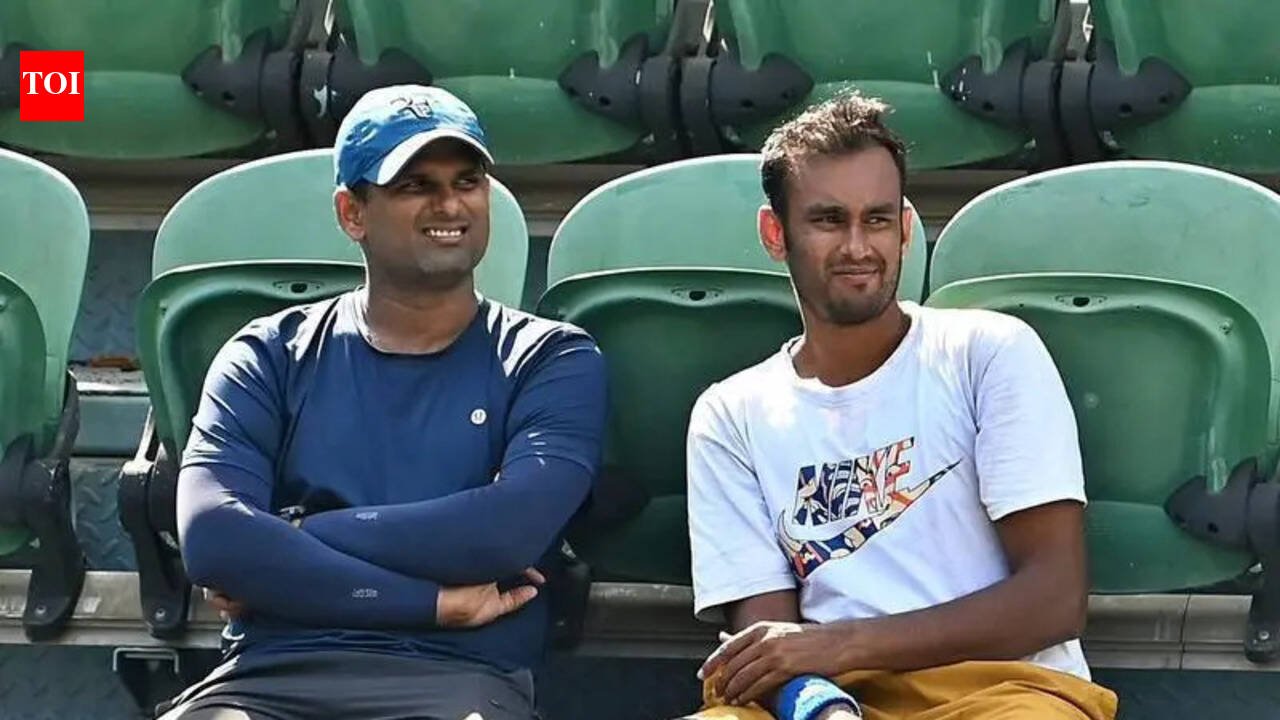
Pune: To the casual sports fan, their partnership is a fascinating experiment: two former rivals and close friends navigating the transition from professional opponents to coach and student.The professional tennis circuit is a lonely grind, where today’s friend is tomorrow’s obstacle across the net. Mukund Sasikumar and Karunuday Singh know this dynamic intimately. They were contemporaries, colleagues, and on a couple of occasions, fierce opponents competing for the same ATP ranking points.But when a sudden coaching transition left Mukund searching for direction in May 2025, he didn’t look for a veteran strategist or a high-profile academy. He reached out to a peer.“He just asked me to literally like improve whatever I could,” KU, as he is affectionately called by his friends, recalls of their early days. “We started with a few things, and then it led to him enjoying the way I was doing the work. And then it just went on to ‘take care of tennis’, ‘take care of fitness’. Then it went to ‘manage tournaments’, then eventually after like three-four months, was ‘just take care of everything’.”For 29-year-old Mukund, moving his training base to Delhi under KU watchful eye was a total shift in perspective. “Coaching, yeah, overall it was a day and night of a change,” Mukund, who had touched a career-high 229 in singles but now ranked 545, says. “But the coaching style, I think this has worked better for me… It was fresh and new, it was actually more enjoyable than difficult. That coaching can also be like this, tennis can be played like this, I could learn a lot of new things.”KU’S 5% PHILOSOPHY To an ordinary observer, a player who has already been ranked as high as 229 in the world doesn’t need to learn how to play tennis again; they just need minor adjustments. But KU’s philosophy steers clear of conventional wisdom.Having played college tennis on a full scholarship in the US — he joined the University of Illinois before transferring to University of Georgia — and following it up with Masters in the UK, KU treats the game less like a battle of execution and more like a puzzle of marginal gains.“I don’t think it’s about flaws,” the 35-year-old KU, who won three Futures titles before he stopped playing in 2020, explains. “I think it’s about maybe where you can look to get a little better. If you look with a positive outlook, you can find like an area that you can get like 5% better. If that 5% better helps you win 10 more points in a match, that’s the difference between like losing in the first round and winning the final.”Because of his unique background, KU brought a fresh vocabulary to the court. He broke down Mukund’s serve, his forehand, his net game, and his transition play not with rigid technical jargon, but with real-world application.The strategy began to bear fruit on the comeback trail. After a slow start to 2026 as Mukund rebuilt his physical confidence following a late-2025 knee injury, everything clicked during a blistering May fortnight at the ATP Challengers in Bangalore. Mukund reached the singles quarterfinals, falling just a couple of points shy of the semis, and went on a spectacular tear to capture the doubles title alongside compatriot Adil Kalyanpur.“I’m playing very close to my prime again,” Mukund says, self-belief and happiness evident in his voice. “From what I remember, when I was 200 and how I felt on the court, moving and hitting the ball, that same feeling is coming now again, if not better.”NAVIGATING THE AWKWARD LINEMixing a deep personal friendship with a high-stakes professional partnership can be dicey. How do you tell a close friend that their footwork is lazy, or that their tactical choices cost them a match?“Professional topics sometimes can get awkward, right,” KU muses. “Like this conversation, like at some point it will get awkward.”Yet, their shared history has become their shield. Because they know each other’s games inside out, they can bypass the polite diplomatic filters that usually exist between a player and a hired coach. “We are also friends, so it helps a little bit more than just having to work with each other, that does make it a bit easier to discuss what would be usually tougher topics, right? “With him, it’s been very simple. I get along with his family members also. He gets along with my family members, also. So that makes life very easy.” There is no rigid, year-round traveling mandate either. KU manages the partnership on a fluid, need-based schedule, giving Mukund the autonomy an experienced 29-year-old player deserves.“It’s based on his requirement,” KU said. “There are certain weeks where he is required to travel by himself. There are certain weeks where he can travel with a family member.“There are certain weeks he requires a coach. Because he is, like you said, older. So he does not need someone around all the time. So, it’s very need-based.”While the spectacular doubles victory in Bangalore gave Mukund a massive confidence boost, both coach and student remain fiercely locked into the ultimate goal: the singles circuit, and the dream of a Grand Slam debut.“Well, we’re aiming for the top 100, so let’s hope to get there,” KU says, his pragmatic outlook giving way to quiet determination. “That’s what we’re gonna aim and do our best to get there. We’re gonna use all the resources and not rest till that’s done.”Mukund isn’t stressed about the numbers anymore. “The first goal would be to try and play a Grand Slam, that’s something that has not been ticked off the bucket list unfortunately, due to Covid. So I think that’s something that I would like to get off the line as soon as possible. But no rush at the same time.”With a former rival turned brother-in-arms in his corner, he’s just enjoying the climb.
