



Mumbai: Nuwan Thushara wants to play the IPL. But he requires a No Objection Certificate from his employer Sri Lanka Cricket (SLC), which is not forthcoming.
In a renewed focus on fitness, SLC has mandated its contracted players to be certified fit before playing league cricket. Thushara hasn’t made the cut. His ₹1.6 crore contract with Royal Challengers Bengaluru (RCB) hangs in the balance.
There are three entities in this saga: the cricket board, the franchise, and the supervising body, the International Cricket Council (ICC). The player is forced to pick sides and he decides to stand up for himself.
Thushara’s national contract is not as lucrative. At 31, the right-arm pacer, with a bowling action modelled on Lasith Malinga is confident he can make a living from the franchise circuit. He’s taken SLC to court. As per local reports, Thushara’s petition argues that his national contract was due to lapse on March 31 and that he had informed SLC of his intention to step away from international cricket.
The Thushara-SLC standoff is the most recent reminder of cricket’s broken revenue model. A few years ago, the player might have been labeled a rebel against his parent body. Today, he stands a good chance. It is the local board which is losing control over its workforce. Recently, South African spinner Tabraiz Shamsi won interim relief from a Johannesburg court when he sought an NOC from Cricket South Africa to play league cricket.
All three entities mentioned earlier are grappling over dates in the cricket calendar. The ICC has carved a window to stage white-ball world events annually. The IPL is the mother of all leagues, with every other country having a smaller league, ambitious of making it bigger.
The cricket boards are also left to run a spate of bilateral series littered over the calendar. They are a legacy of the past and are fast losing currency. When SLC mandates Thushara to maintain high fitness standards for international action, part of the deal includes these bilateral matches, which the player, in the second half of his career, no longer has the time and inclination for.
Outside the Big Three boards – India, England and Australia – every other cricket board runs the show from its share of ICC revenue. Their bilateral losses are covered up only when the commercially attractive Indian team comes calling every few years. India can afford to do that with its vast talent pool across formats, but the arrangement may not remain sustainable for too long.
Breaking point
If it isn’t already, we are close to the breaking point when it comes to crammed schedules and meaningless matches. Mitch Santner missed the first of Mumbai Indians’ ties last week after playing three home T20Is against South Africa, immediately after the T20 World Cup final.
Australia’s three leading pacers — Pat Cummins, Mitch Starc and Josh Hazlewood — are awaiting clearance from Cricket Australia to play the IPL while recuperating from injuries. All of them have agreed to fresh national contracts, but Test captain Cummins recently admitted in a podcast of “a tension point” between the board and those players who stand to earn a lot more from the leagues.
“At the moment our guys are so keen to play for Australia that they’re happy to forgo that (Hundred), but I don’t think we can accept that that is going to be the case forever,” Cummins said about the impending clash between the Hundred and Bangladesh Tests.
IPL teams hit hard
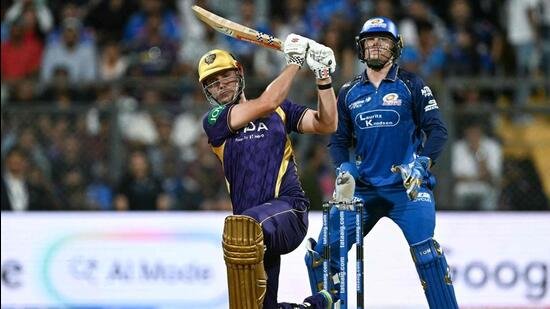
In the current melee, IPL franchises are at the receiving end. Australian all-rounder Cameron Green has been certified fit to play for KKR by CA, but not to bowl. On a losing streak and facing misfortune in losing fast bowlers- Mustafizur Rahman for unspecified reasons, Harshit Rana and Akash Deep due to injuries, and Matheesha Pathirana because SLC refused to certify him fit—KKR are frustrated. Securing Green and Pathirana’s services in the auction had left KKR with a hole of $ 43.2 crore (35 %) from their salary purse.
“From a franchise perspective, from the IPL perspective, that’s the shame about there being just so much cricket on,” Shane Watson, KKR’s Assistant coach said. “And every time in the lead up to the IPL, you’ve really just got your fingers crossed that everything you do, the main auction, the mini auction, that you set everything up to give yourself the best chance with the playing group to be able to help get the best out of them.”
While Australia wants to protect its pacers for a heavy dose of Test cricket ahead, plenty of England players voluntarily decline IPL money. Ahead of this year’s IPL, opener Ben Duckett dropped out of his Delhi Capitals’ contract to keep himself fresh for the Test season ahead. Test captain Ben Stokes and white-ball captain Harry Brook have been giving the IPL a miss for the same reason.
This may not be an Indian problem for the moment, but it may soon become theirs to solve. That the best players play in the IPL has been the league’s biggest hook.


