



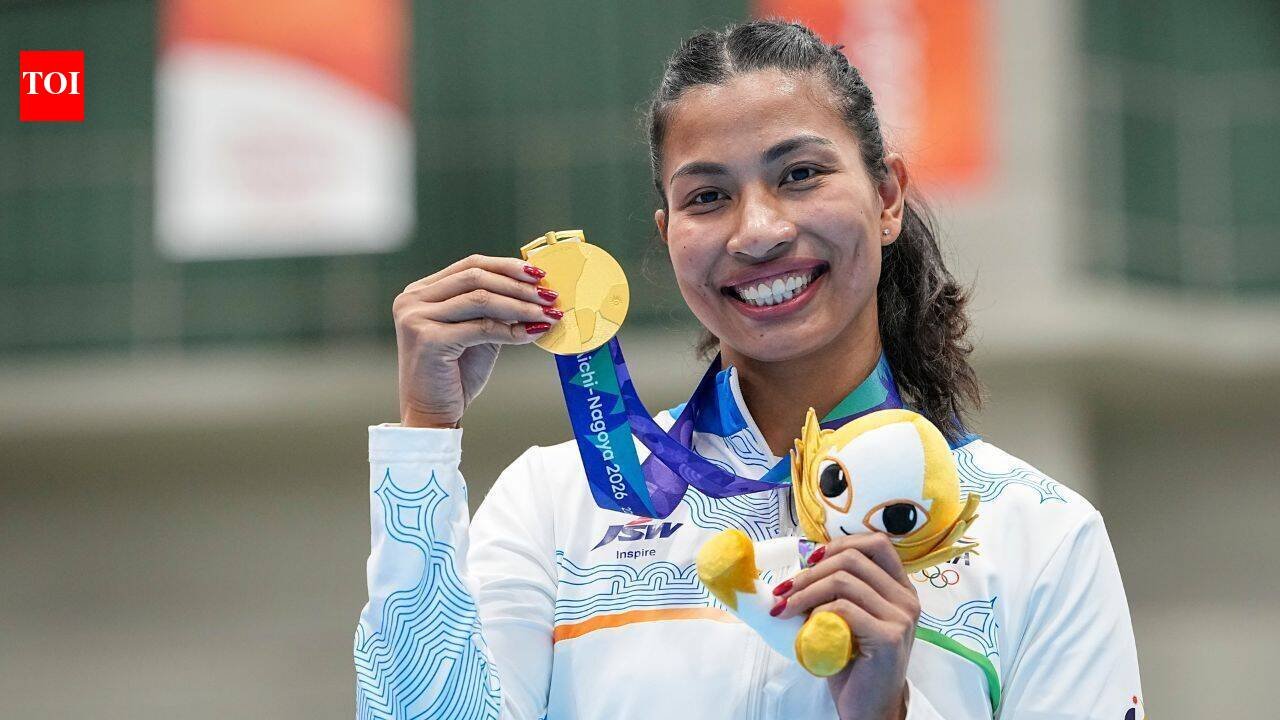
Lovlina Borgohain celebrated her 29th birthday with a gift she had long dreamed of: an Asian Games gold for India. On October 2, at the Aichi-Nagoya Asian Games in Japan, the boxer defeated China’s reigning Asian champion, Bao Ziyi, 5-0 in the women’s 75kg final. She upgraded her silver from the 2022 Hangzhou Games to gold and became only the second Indian woman boxer, after MC Mary Kom, to win Asian Games gold.“I was living my dream,” Lovlina tells Bangalore Times in an exclusive chat, reflecting on one of the most special moments of her career. The victory carried even more weight because she did not realise, in that moment, that she had also made history. “I didn’t know at that time that the record had been broken. I found out later,” she says.For Lovlina, though, the gold was never just about a medal or a record. It was about bringing something special home to her country on her birthday.‘My 2020 Olympic medal came from Japan too’Lovlina had one more reason to feel hopeful about the Asian Games: Japan was where she won her Olympic medal at the 2020 Tokyo Games, held in 2021. “I was very excited because I was going to Japan. My Olympic medal in 2020 came from Japan too, so I believe Japan is lucky for me,” she says. Having already competed at one Asian Games, she also arrived with greater confidence. “The first time, you are a little nervous. But the second time, you have that confidence that, ‘Okay, I can do this.’ My mindset was like that,” she shares. Above all, she refused to let the pressure of winning keep her from enjoying the experience. “I was trying to live in the moment. I enjoyed the whole competition very well, and I feel that is why the result was also good,” she says.‘People see the fight inside the ring, not beyond it’The ring shows only a small part of an athlete’s life, Lovlina points out. “We work extremely hard before every competition. People only see three or four matches in the ring. Sometimes we win, and sometimes we lose. But nobody sees how much we fight outside the competition,” she says. Training itself is a constant test. “We fight four days a week. That is what we live in. Every day, when a punch lands during training, we take just as many punches because every opponent is strong,” she adds. At the highest level, she believes mental preparation can matter as much as physical training. “Sometimes we can give 100 per cent in training but may not perform well in a competition. I feel that depends on the mindset,” she says.‘We need to develop a champion mindset from childhood’Lovlina believes India’s sporting culture has changed as more athletes inspire and support one another. “When we see someone winning a medal, we learn from them and feel that we can do it too. That feeling helps us move forward,” she says. Still, she sees room for growth, especially when it comes to changing one’s mindset. “We can never say that we have done everything and there is nothing more that can be done. We have to keep doing more,” she says.She hopes confidence is nurtured in female athletes from an early age. “When a girl wants to do something, the first thought often put into her mind is, ‘Be careful, think before you do it.’ Somewhere, she starts thinking, ‘What if I make a mistake?’ We need to develop a champion mindset from childhood. We need to tell our female athletes, ‘You can do anything. You are strong,’” she shares.‘I’ve learnt that I have to live boxing’Her biggest personal learning from the Asian Games, however, has little to do with boxing itself. “We become so focused on achieving something that somewhere we forget to enjoy the moment. Everyone works hard. Everyone gives their 100 per cent. Everyone wants to win. But amidst everything, we sometimes forget to live,” she adds. Her takeaway from the Asian Games is simple: “The journey is more important. The result can be anything. The moment has to be lived. I have learnt that I have to live boxing,” she says.‘Sometimes, I forget I have won so many medals’Today, Lovlina herself has become an inspiration for young athletes. “Sometimes, I forget I have won so many medals; it doesn’t really stay in my mind. I don’t believe I have done so much,” she says. What does stay with her are the conversations with young fans. “When people come and tell me, ‘You are like this, you have done so well, you have won so many medals,’ it feels good. When young people ask me how they can do it and tell me they are big fans of mine, it feels good to know that I am able to inspire someone,” she shares.
