


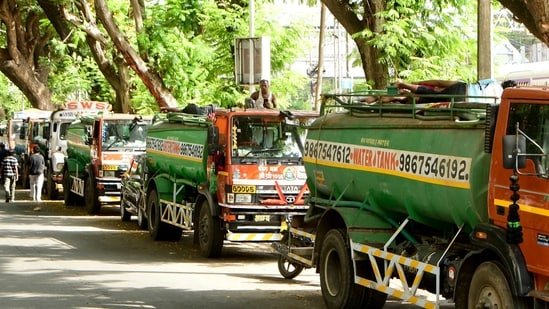
At a time when developers are already navigating supply chain disruptions and cost pressures triggered by the US-Iran conflict, the Brihanmumbai Municipal Corporation’s (BMC) water restrictions have added another layer of uncertainty for the real estate sector. While construction activity is unlikely to grind to a halt, as most project sites rely on groundwater, recycled water and other non-potable sources, the curbs could still disrupt operations, slow execution and put additional pressure on project timelines, say experts.

BMC-supplied water is primarily used for drinking, sanitation and labour welfare facilities at project sites. However, the suspension of new water connections may delay the launch and approval of upcoming projects until reservoir levels recover. Industry experts also caution that if water shortages persist and begin to affect site operations, projects scheduled for completion this year could face delays, putting additional pressure on the housing delivery pipeline.
Developers say the water shortage is likely to cause short-term disruptions, extending construction timelines and increasing execution costs. Some estimate that higher costs could translate into a 5-10% rise in housing prices if the restrictions persist.
Experts caution that a further delay in the monsoon could prompt other civic bodies in the Mumbai Metropolitan Region to impose similar restrictions. Such a scenario would broaden the impact across multiple projects and housing units, potentially leading to project completion delays reminiscent of those witnessed during the COVID-19 pandemic.
What are the restrictions BMC has imposed on construction and water use?
Mumbai’s seven reservoir lakes are currently at just 10.35% of their total storage capacity, prompting the Brihanmumbai Municipal Corporation (BMC) to impose a series of water conservation measures from June 17, 2026. The civic body attributed the low reservoir levels to a delayed monsoon, which it linked to El Niño conditions.
The restrictions include:
- Suspension of all water supply connections to ongoing construction sites within Mumbai city limits, with no new connections to be sanctioned until further orders.
- A 20% reduction in water supply to industrial, commercial and sports facilities.
- Complete discontinuation of water supply to swimming pools.
- Continuation of the 10% citywide water cut that has been in effect since May 15.
BMC’s jurisdiction is only for Greater Mumbai – some 437 sq km. The rest and much larger MMR is spread over 6,328 sq km in eight other municipal corporations, including Thane (TMC), Navi Mumbai (NMMC), Kalyan-Dombivali (KDMC), Mira-Bhayandar (MBMC) and Vasai-Virar. These come under different civic bodies, which have not imposed similar restrictions so far.
Will construction activity come to a halt immediately?
Experts say construction activity is unlikely to halt immediately, as most project sites rely on groundwater, recycled water, and other non-potable sources for core construction work. BMC-supplied water is primarily used for labour welfare, sanitation and drinking purposes at construction sites.
However, the suspension of fresh water connections could delay the launch and approval of new projects until reservoir levels improve. Industry stakeholders also warn that constraints on water availability for worker facilities could affect labour welfare compliance and reduce workforce productivity at active construction sites, potentially impacting project timelines.
Anarock Research shows that the entire MMR is scheduled to see completion of around 2.07 lakh housing units in 2026, the highest delivery pipeline in a decade. Of this, Mumbai alone accounts for 69% of the share, or approximately 1.43 lakh units. The direct construction disruption from BMC’s water curbs can therefore impact various Mumbai city micro-markets – specifically the South Mumbai, BKC, Andheri, Borivali and Mulund belts.
“The direct construction disruption from BMC’s water curbs can impact various Mumbai city micro-markets – specifically the South Mumbai, BKC, Andheri, Borivali and Mulund belts,” said Prashant Thakur, executive director and head, research and advisory, Anarock Group.
“If other MMR municipal corporations face similar reservoir stress and impose copycat restrictions, the impact on the wider 2.07 lakh unit pipeline could widen considerably,” he said.
Shishir Baijal, International Partner, chairman and managing director, Knight Frank India, noted that activities such as concreting, curing, masonry, and finishing works require substantial quantities of water, and in the absence of adequate municipal supply, developers will increasingly have to depend on alternative sources such as private tankers, treated wastewater, or other arrangements, all of which can lead to cost overruns and delays.
The way forward
While the BMC’s water restrictions pose a localised risk to Mumbai’s real estate market, they are unlikely to significantly disrupt the broader Mumbai Metropolitan Region (MMR) housing pipeline, as most upcoming supply is concentrated in peripheral municipal jurisdictions outside the BMC’s limits, said Thakur.
“However, if the monsoon remains weak and other civic bodies across the MMR adopt similar restrictions—and with supply chains still recovering from disruptions caused by the West Asia conflict—housing deliveries in the second half of 2026 could come under meaningful pressure. It could mirror the pandemic period, when only 46% of planned project completions were ultimately delivered,” he said.
Baijal noted that the impact of water-related disruptions will vary across cities depending on local water availability and rainfall patterns. While Gurugram faces challenges due to limited and erratic rainfall, Mumbai remains particularly vulnerable because its water supply depends heavily on monsoon-fed reservoirs. Bengaluru’s recent experience with severe water shortages has already demonstrated how rapidly urban centres can face supply constraints, underscoring that water security is no longer merely a seasonal concern but a critical urban infrastructure challenge.
“A collaborative framework involving government authorities, civic bodies, and developers will be essential to balance water conservation priorities with the need to ensure the timely delivery of housing and infrastructure projects, while building greater resilience against future water shortages,” he said.
Niranjan Hiranandani, real estate industry expert, noted that BMC’s decision to suspend temporary water connections is a necessary short-term measure to prioritise essential consumption. However, restrictions alone cannot be the long-term answer; they can slow project timelines and eventually affect end users.
Mumbai’s sustainable solution is to treat water as a reusable resource. The city already has the capacity to recycle around 8 MLD, but it is not being fully optimised. If Mumbai scales up wastewater treatment and reuse, recycled water can substitute for fresh water for non-potable uses, thereby protecting drinking water and reducing pressure on groundwater, he added.
