



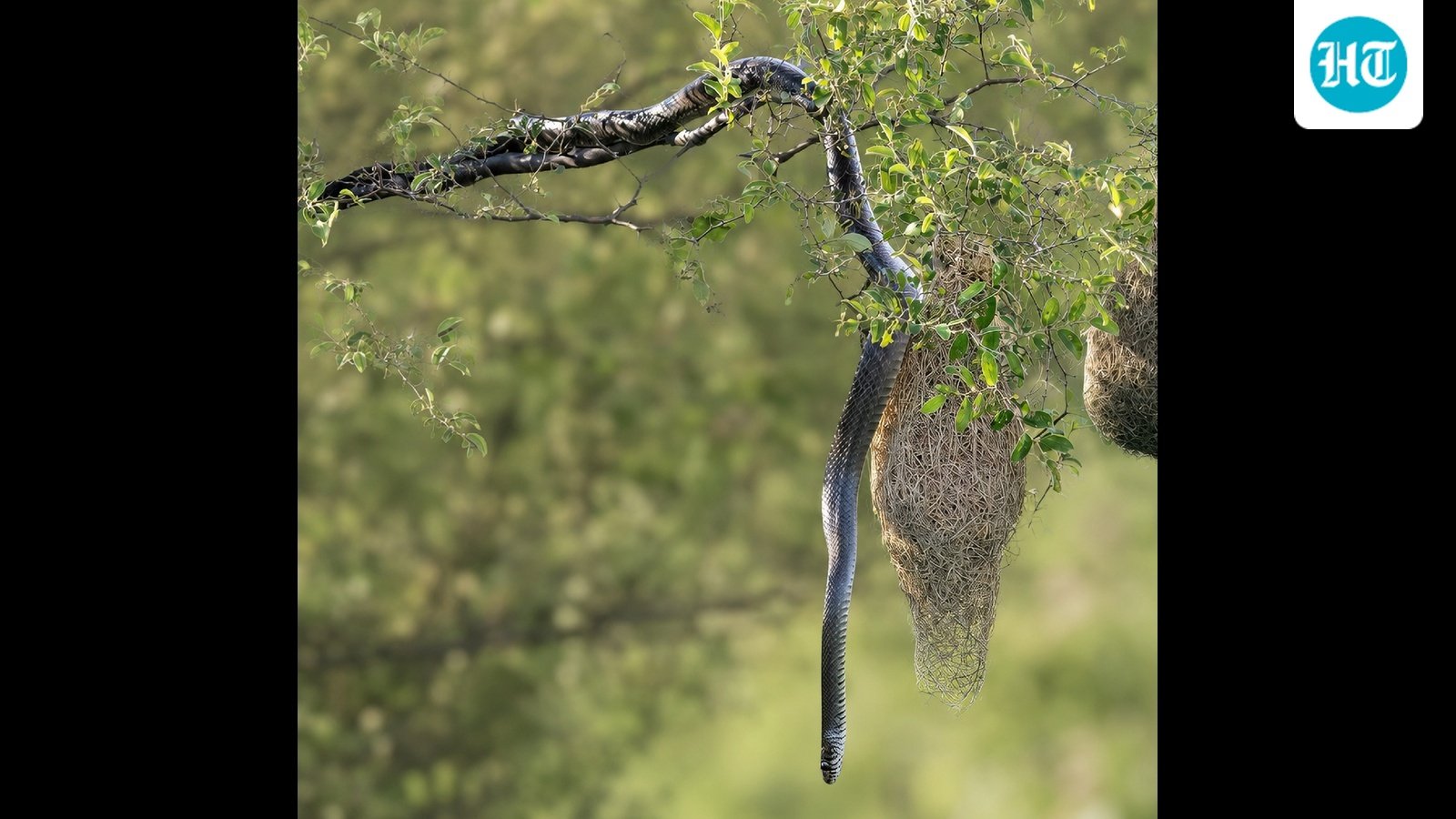
Arun Khanna was engrossed in photographing nest construction by baya weaver in the Saketri grasslands. “Then I spotted an interesting object on a babul branch: an elongated, blackish, tube-like object. My first thought was amusing: maybe some kid had flung an old bicycle tube up the tree. The ‘tube’ moved. The weavers got agitated. It was a rat snake, manoeuvring to a nest,” recalled Khanna.
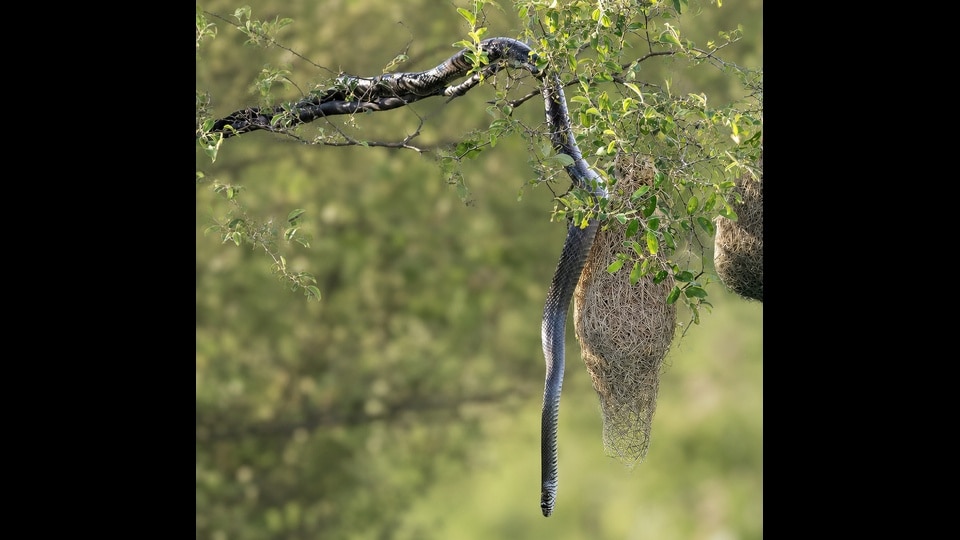
Rat snakes can climb incredibly high trees to gobble eggs and nestlings. However, weaver nests are challenging. The weaver can build two entrances, a false and a concealed real one, or a very narrow one to the nest, which frustrates the serpent. Nests can be tactically sited on branches hanging over a waterbody or a well to increase risk for the predator. The choice of branch can be thorny to inflict wounds or a flimsy one that cannot bear the marauder’s weight.
The interwoven, tightly laced fibres in layers are resilient: they bend but do not yield. A snake trying to butt through the nest wall rarely succeeds: “Strand after strand, the intricate weave resisted the assault. What looked like a delicate bundle of grass turned into a remarkably strong fortress — proof of the extraordinary engineering hidden in a weaver’s tiny beak” (Surendra P Agnihotri’s observation).
The ultimate tribute comes from Baljit S Kang, an organic farmer from Nawanshahr. “Weavers deliberately choose nest material from tensile leaves of sugarcane and young ‘khajoor’ trees. But nest site selection favours old, high ‘khajoor’ trees. My tractor’s ploughing rakes and rotors passed over fallen nests but they never got sliced!”
Nana’s Parinda in real life
A rugged yet sensitive actor. Dressed in khadi and a banyan, gazing lovingly into the eyes of a stricken little bird cupped in his hands. That was a different dimension of a multifaceted actor, volunteer soldier and farmer philanthropist.
The late Vishwanath ‘Nana’ Patekar had exerted an escape velocity from Mumbai’s star planet. He retreated to rusticity, a farm of extravagant simplicity: 27 acres where shady trees and winds were the only air conditioners and the Sinhagad valley mountains (Pune) as the walls of his home. “In the morning, I don’t need an alarm clock. It is the calls of birds at dawn that awaken me. Peacocks come to my farm every morning: 25-30, sometimes 40. It brings me an otherworldly ‘sakoon’ (peace),” Patekar once remarked.
A son of the soil, Patekar had taken a conscious decision to return to his village roots, to nature as best as a farmhouse that alters pure wilderness possibly can. A thinking actor, he had famously declared that his last property was an earmarked “12 maunds of dry wood, not wet wood which would send smoke into the eyes of the funeral assembly and create misgivings about me after departure!”
A lesser-known role was playing Dr Prakash ‘Baba’ Amte in the ‘The Real Hero’, a 2014 Marathi biographical drama that chronicles Prakash and Mandakini’s deeply-empathetic work among the Madia Gond tribals and distressed, wounded and orphaned wildlife.
Patekar himself could not turn a casual eye to the suffering of voiceless, unowned creatures. He turned his Thar jeep into a mobile rescue and shelter for kittens and stray dogs during rains.
vjswild2@gmail.com
