



New Delhi: The 2026 Formula 1 season has brought an aura of pure unpredictability.


The introduction of sweeping new technical regulations has sparked fierce skirmishes up and down the grid — like we saw at the British Grand Prix on Sunday— with traditional powerhouses and resurging contenders snatching their moments.
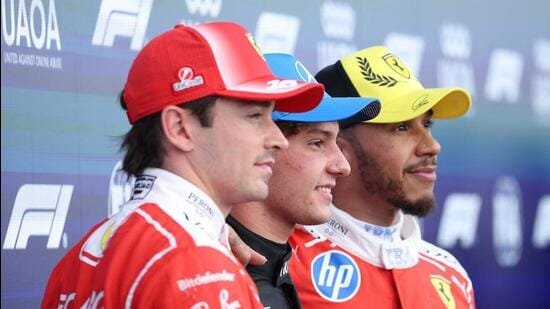
We saw Ferrari bounce back into the winner’s circle — Lewis Hamilton won in Barcelona and Charles Leclerc at Silverstone, a late-charging Max Verstappen looming large in a recovering Red Bull and McLaren lurking just on the periphery.
Yet, beneath the noise of changing podium line-ups at varied tracks, the overarching reality of the 2026 F1 championship is rapidly narrowing down to a single narrative: an intense, intra-team battle at Mercedes between George Russell and teenage sensation Kimi Antonelli.
Despite the intermittent threats from rival garages, the Brackley-based outfit holds the ultimate trump card this year.
“The most likely situation will be that Kimi and George will be the ones to fight for the world title. Mercedes are very used to having two drivers as the main protagonists for a world title so they’ll have to use all their experience when it gets to the crunch,” 1996 world champion Damon Hill said from Silverstone.
“The favourite is Kimi because he’s got the equipment. People have come, they’ve been pretenders but Mercedes have been the most consistent and he’s got points advantage. What I’ve seen this guy (do) is something else.”
The points table bears out that consistency. While Ferrari and McLaren have swapped punches on a track-to-track basis depending on circuit characteristics, Mercedes has established a robust baseline. However, the true test lies not in the machinery but in how the dynamics between its two drivers are evolving.
Antonelli’s season has defied every historical metric of how a rookie should behave. At just 19, the Italian rookie took the championship by storm, cruising to a streak of five Grand Prix victories early in the year, including an authoritative, textbook weekend execution in Monaco. This sudden, explosive arrival has completely disrupted what many assumed would be George Russell’s coronation year.
According to Hill, this maturity from a teenager isn’t an accident; it is the product of modern motorsport’s industrial-scale driver cultivation. “Now the drivers are well aware from a very early age… they are prepared many years in advance,” says the 65-year-old in a call facilitated by FanCode, the official broadcaster of F1 in India.
This institutional education, spanning hours in hyper-realistic state-of-the-art simulators, media coaching, and assimilation into junior academies means today’s rookies arrive as fully formed sporting weapons. “It’s almost like preparing doctors or fighter pilots. They’ve had a massive education before they get to actually racing in a Grand Prix… Kimi’s been in the Mercedes clan now for a while. They are a different breed,” said the Briton.
For Russell, who spent years waiting in the wings at Williams and then playing the dutiful understudy to Hamilton, this sudden shift in the spotlight is an agonising psychological hurdle. Having a 19-year-old rookie pop into the sister garage and immediately start hogging the limelight is bound to create deep-seated friction.
“As a driver, if you spend a number of years with a team… you have a sense that this is your team,” Hill explained, drawing from his own experiences fighting Michael Schumacher in 1994 while Williams rotated wildcards like David Coulthard and Nigel Mansell into the other car.
“The problem with being a racing driver in our sport is that you’re not really part of the team. For the time you’re there you’re part of the team, but you still have to prove yourself against the other guy. You’re in a constant battle to establish your position.”
When a new teammate arrives and starts delivering immediately, the emotional toll can feel like a breach of trust. “You feel like you’ve been betrayed a little bit if they’ve employed someone else who’s better,” says Hill. “But that is sport. If that person is getting attention because they’re doing great things and delivering results, then the only answer to that is you just have to do better than them.”
Mercedes finds itself managing a high-stakes luxury problem. The Silver Arrows are historically well-versed in handling two primary protagonists locked in a title fight (remember Hamilton and Nico Rosberg) but 2026 presents a distinct danger. Because the field behind them is so tight — with Verstappen’s Red Bull or the Ferraris capable of capitalising on any mistake — a prolonged intra-team feud could inadvertently hand the title to an outsider.
If it comes to the crunch, Toto Wolff may be forced to deploy the most hazardous tool in a team principal’s arsenal: team orders. It’s an intervention that goes against the very DNA of elite athletes.
“Inevitably, Kimi and George will be the ones to fight for the world title. But that might mean asking a driver to sacrifice himself for the greater good — which is a big ask for a racing driver. We’re very selfish,” concluded Hill.


