


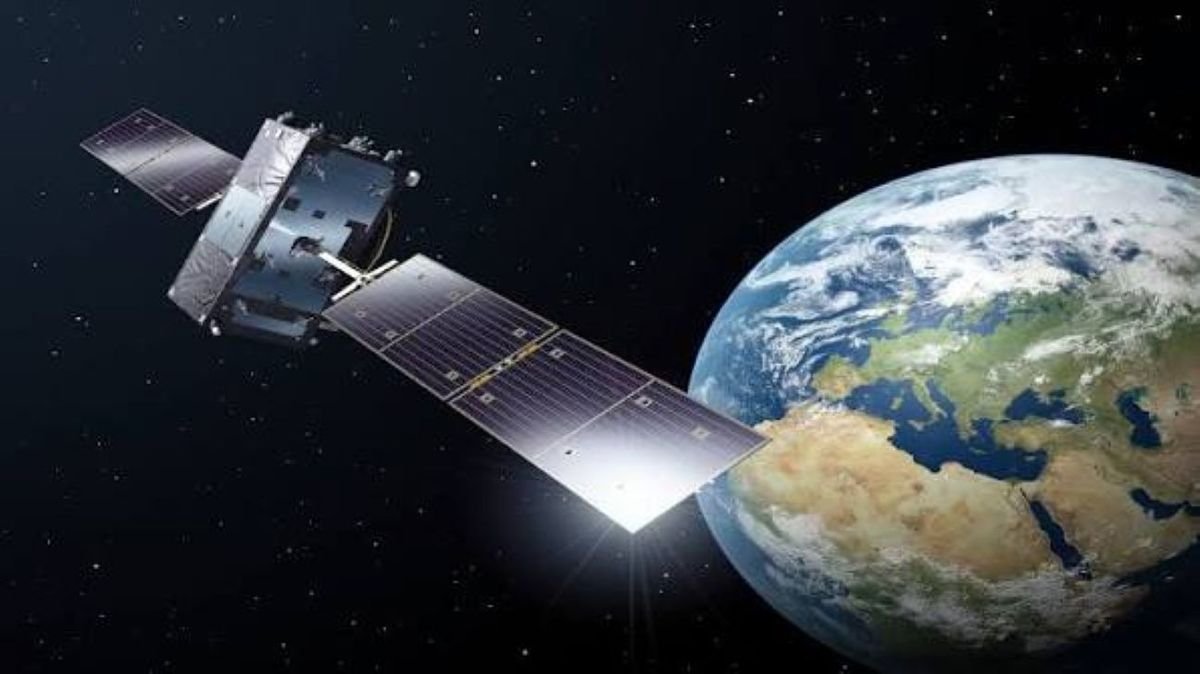
While space technology already shapes everyday life, its greatest impact may still lie ahead
BEYOND THE HORIZON
A summer morning in Kashmir begins like any other. Some people check the weather before leaving home. Others open a map to find the quickest route, make a digital payment, connect with family and friends or simply begin their day online. These everyday moments may seem routine, but they are made possible by technologies that often go unnoticed.
Much of this invisible support comes from space. Satellites orbiting high above the Earth help us predict the weather, navigate with GPS, access the internet, make phone calls, watch television and respond more effectively to natural disasters. Quietly and reliably, they have become an essential part of modern life.
For generations, people associated space mainly with astronauts, rockets and missions to the Moon. Today, it has become much more than that. Space is now an important part of the global economy, supporting agriculture, healthcare, banking, transport, communication, education and scientific research. Experts believe this sector will continue to expand strongly.
According to a joint report by the World Economic Forum and McKinsey & Company, the global space economy was valued at about 630 billion US dollars in 2023 and is projected to reach around 1.8 trillion US dollars by 2035. Lower launch costs, rapid technological progress and growing private investment are driving this remarkable expansion.
The benefits of space already reach almost every sector of society. Farmers use satellite images to understand crop health and water needs. Scientists observe rivers, forests, glaciers and coastlines from space. Weather experts rely on satellite data to improve forecasts and issue timely warnings.
Communication satellites connect cities as well as remote communities. A large share of the information used to study Earth’s changing climate also comes from satellites. Without them, understanding weather patterns, changing temperatures, and the health of the natural environment would be far more difficult.
This has special significance for Kashmir. The Valley is known for its mountains, rivers, lakes and changing seasons. Satellite technology helps scientists observe snowfall, glaciers, forests, water resources and environmental changes across the region. This information strengthens scientific research, improves understanding of the natural environment and supports informed planning for the future. As space technology continues to advance, its value for environmental research, disaster preparedness and sustainable development is expected to grow even further.
The future of space is being shaped by collaboration between leading universities, space agencies and private companies. Researchers at the Massachusetts Institute of Technology, Stanford University, Harvard University, the California Institute of Technology, the University of Oxford, the University of Cambridge and the University of Colorado Boulder continue to advance work in space science, engineering, robotics and artificial intelligence.
Major space agencies, including NASA, the European Space Agency, the Indian Space Research Organisation, the Japan Aerospace Exploration Agency and the Canadian Space Agency, continue to expand scientific knowledge through research and international cooperation. Companies such as SpaceX, Blue Origin, Rocket Lab, Planet Labs and Maxar Technologies are also helping reduce launch costs and accelerate innovation across the global space sector.
India is becoming an important part of this global story. According to the Government of India, the country’s space economy is currently estimated at about 8.4 billion US dollars, with nearly 400 startups working in satellite technology, launch vehicles, propulsion systems and space electronics. The opening of the sector to greater private participation has encouraged innovation, investment and entrepreneurship.
Alongside ISRO, private companies are strengthening India’s space ecosystem and creating new opportunities for scientific research, advanced manufacturing and technology-driven businesses. This progress is expected to support economic growth and inspire a new generation of innovators.
The opportunities created by the space economy extend far beyond becoming an astronaut. Engineers, software developers, computer scientists, mathematicians, physicists, environmental scientists, electronics specialists, data analysts and entrepreneurs all have an important role to play.
For young people in Kashmir, this opens exciting new possibilities. Success in tomorrow’s space sector will depend not only on rockets but also on knowledge, creativity, research, critical thinking and problem solving. These skills can be developed in schools, colleges, universities and research institutions, preparing students for careers that combine science with real-world impact.
While space technology already shapes everyday life, its greatest impact may still lie ahead. Scientists are using the unique conditions of space to develop new medicines, stronger materials and advanced optical fibres that could improve healthcare, communication and industry. Researchers are also exploring space-based solar power, where large solar panels placed in orbit could one day transmit clean energy back to Earth.
Another promising field is asteroid resource utilisation. Scientists believe some asteroids contain water and useful minerals that could support future space missions by providing fuel and construction materials. Although these technologies are still under development, they demonstrate how rapidly scientific ideas are becoming practical innovations with benefits that extend far beyond space itself.
These advances are possible because reaching space is far less expensive than it was only a few decades ago. Reusable rockets, better engineering and new technologies have transformed access to space, making it easier for universities, research organisations, startups and private companies to participate.
Leading global organisations, including the World Economic Forum, the Organisation for Economic Co-operation and Development and the United Nations Office for Outer Space Affairs, continue to study how this growing sector can support scientific progress, innovation and sustainable development. Their research is helping shape international cooperation and expand the practical benefits of space technologies for people around the world.
For the Valley, these developments represent more than technological progress. They create opportunities to learn, innovate and contribute to one of the world’s fastest-growing industries. Many future careers will involve developing software, analysing satellite images, building sensors, studying climate data, designing advanced technologies and solving practical problems that improve life on Earth.
As universities, research centres and technology companies continue to expand their work, young people with strong foundations in science, mathematics, engineering and computer science will find increasing opportunities to contribute to this rapidly evolving field. Success in this new economy will depend as much on curiosity, creativity and lifelong learning as on technological expertise.
Every generation witnesses a technological breakthrough that changes the world. The internet transformed communication. Smartphones reshaped everyday life. Artificial intelligence is changing how people work and learn. Space technology is becoming the next great chapter in that journey. The night sky above Kashmir has always inspired wonder. Today, it reminds us that the future belongs to those who continue to ask questions, pursue knowledge and imagine what is possible.
(The Author writes on science, technology and innovation. Feedback: [email protected])
