






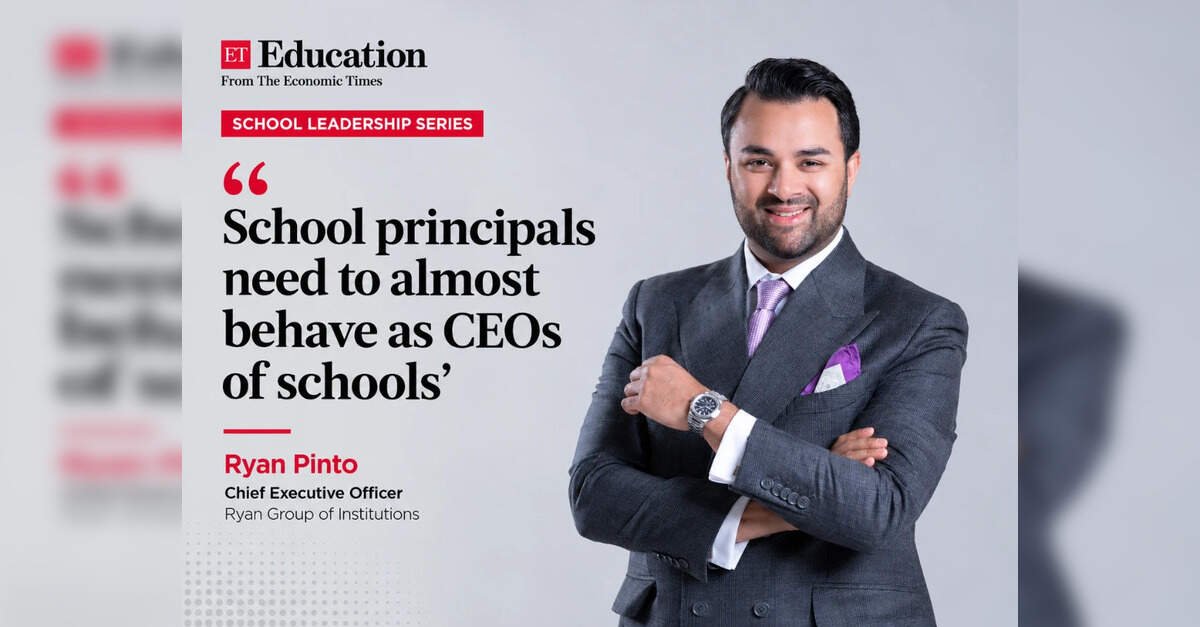
School leadership is changing, and so are the expectations from schools. As Ryan Group marks 50 years in education, its CEO Ryan Pinto reflects on leading a network of 150+ schools across 40 cities, spanning multiple school brands and curricula.
In an exclusive conversation with ETEducation, Pinto discusses how parent expectations have changed, why school principals increasingly need to think like CEOs, how schools should approach AI without falling for FOMO, and why critical thinking and adaptability will matter as careers evolve. He also speaks about Ryan Group’s international expansion, including its partnership with the 500-year-old Royal Grammar School Guildford.
Q. Ryan Group is completing 50 years in education. What does this milestone mean to you personally, and how do you see the next chapter?
Ryan Pinto: Fifty years is a very significant milestone for us. We really thank God Almighty for getting us here. Our chairman, Dr Dave Pinto, and managing director, Dr Grace Pinto, are the visionaries and pioneers. They were teachers 50 years ago and they still are teachers at heart. Their dream and vision continue to lead us.
This 50 years is a milestone of a lot of determination, sacrifice and focus on giving quality education to the nation.
Today, we have grown significantly, including our presence in the UAE. We have more than 150 schools and a very large number of children. When we started, nobody had a plan that we would reach this scale.
Now that we are this size, it brings a sense of responsibility. We will continue growing, but we don’t grow for growth’s sake. We grow at a pace that we feel is sustainable because quality is very important to maintain at the school level.
We are not a franchise. For us, every school is like our own baby. We are also expanding across different segments and brands to cater to different parent groups and demographics. We are looking at different verticals as well, including preschool and potentially aspects of higher education in the future.
Q. Your network has grown across different cities, brands and curricula. How do you maintain consistency while responding to different markets?
Ryan Pinto: When we started, we were focused on the state board in Maharashtra. When we came to Delhi, we started our CBSE schools. Then we had ICSE, and over a period of time we moved into IB and Cambridge.
We see a growing demand for international curricula, particularly in tier-one cities. So we are looking at that as well.
At the core, in terms of academic delivery, we need to ensure that the academic part is taken care of at a network standard. We have systems, processes and teams that audit academic delivery. With technology, we can track syllabus delivery, lesson plans, content, homework and assignments.
At a central level, we evaluate assessments and benchmark how children are doing in areas such as English, arithmetic, science and STEM.
The core curriculum is therefore standardised. But around that, we add programmes such as performing arts, international partnerships and projects where students collaborate with children from other countries and schools. That global exposure can be very enriching.
Q. You are also partnering with Royal Grammar School Guildford. What do you see happening in India’s international-school segment?
Ryan Pinto: I see that there will be more such schools. I think this is just the beginning. International schools and educational groups are looking at India because India has the largest young population, it is one of the fastest-growing economies and it offers scale. We are also seeing international universities looking at India and setting up campuses.
We are currently partnered with a 500-year-old UK school, Royal Grammar School Guildford, and are bringing them to India as exclusive partners. We will be establishing the first school in Bengaluru and then expanding into other metros.
So our growth is in different segments and different kinds of schools, but we will continue innovating while keeping our core value system at the heart of what we do.
Q. How have parents’ and students’ expectations from schools changed over the last few decades?
Ryan Pinto: Earlier, it was pretty much that everybody wanted a good school so that children would get good marks, then get into a good college and ultimately get a decent job.
That is changing dramatically. It is no longer simply about good marks, good college and good job. There is now a greater focus on meaningful education. Especially in bigger cities, parents want their children to be taken care of and given opportunities to explore their passions.
There are different categories of parents. Some want a strong academic foundation but also want children to explore other interests. There are still parents who are very focused on engineering and medicine and exams. One aspect that I feel has really changed is that parents are beginning to look at schools as a service provider.
They think that if I pay fees to a school, then it is the school’s responsibility to nurture, shape, guide, mentor and correct everything. But it is not. Parents have to be involved. It has to be hand in hand. We have to go together with the school.
Q. Has this also changed the relationship between parents and teachers?
Ryan Pinto: Yes. Culturally, we have always been respectful of teachers. A teacher was like a guru. But that has changed. Maybe 15 or 20 years ago, if a school called a parent and said the principal wanted to meet because the child had done something wrong, the first thing the parent would do was question the child.
Today, it can be the opposite: “My child is never wrong.”
That is not good because children will never learn or grow if they don’t understand that choices and actions have consequences. At home, children can be in a very protective world. Then they go into the real world and meet people with different views. Suddenly, everything is not being given to them on a platter.
Technology is also changing this. A child in a small town can now access the same information, news, trends, entertainment and social media as a child in a big city. That is changing parents’ perception of what the role of the school and teacher should be.
Q. Can a large school network provide common standards while still giving students local and global exposure?
Ryan Pinto: Yes, and we see this through the opportunities we provide. We have students from big cities as well as smaller towns. One example is a child from our network who reached the finals of a programme at Princeton University. The child did not have a passport and the parents had never travelled abroad.
We helped the family with the passport process. Our teachers and school team supported the child, who then travelled to the US. Later, the child went for programmes in Singapore and is now working with a multinational company.
These are the kinds of opportunities we want to provide. It should not matter whether a child comes from a big city or a small town. Opportunities should be borderless.
Q. What should schools prioritise in an age of AI and rapid technological change?
Ryan Pinto: Schools should avoid FOMO.
Right now everybody is talking about AI. Before AI, it was machine learning. During COVID, everybody was talking about online learning and how technology would completely disrupt physical education. These things can be very thematic and seasonal.
AI is absolutely important, but that does not mean a school should simply adopt something because it is the latest technology. We need to ask what is really important as a learning experience for a child and what will help prepare them for the future.
The focus should be on the child’s wellbeing and the whole learning experience, rather than chasing the current technology theme.
Q. How is Ryan Group approaching AI among teachers and students?
Ryan Pinto: There is no one solution. Everyone is trying to adopt and adapt AI to their own situation. Teachers need more handholding than students. Students have already started experimenting with AI. Teachers need to be guided, and there can be apprehension, particularly because of the generational gap.
I remember one faculty member who was over 60. During COVID, she had to learn how to use technology. She told me that earlier she was even afraid of email and her computer teacher would do it for her.
But after being pushed to learn, she became comfortable conducting online classes and virtual meetings. She told me that when her grandchildren wanted to do a virtual call, she knew how to do it.
That is the right way to approach technology. If you keep burdening staff with “learn this, learn this”, it becomes a burden. The way you train and expose them to the tool is important.
We have periodic in-person and virtual training, self-paced modules and AI certification for staff. We are also piloting projects with Google Gemini.
Q. You have given an example of AI being used by teachers, students and even parents. Are schools at risk of outsourcing learning itself?
Ryan Pinto: We are very conscious of how students are using AI. I think every child is using AI in their homework today. We have seen a situation where a teacher uses AI to create homework or an assignment. The teacher sends it to the students. The students give it to AI and get the homework done. Then the assignment comes back to the teacher, who can give it to AI to mark.
Then the marks go to the parent. At the time of the parent-teacher meeting, the parent asks AI to give them questions to ask the teacher. So ultimately, who is learning here? Who is growing here? It is only AI.
AI can be very useful when used correctly. But it can also become almost like a slow poison if we become so dependent on it that we stop enhancing our thinking capability. For me, one of the biggest skills schools should focus on is critical thinking. Children should remain curious. They should have the ability to ask the right questions: Why is it like this? Why can’t it be like this? What is causing this?
Today, information is constantly being thrown at children through Instagram, TikTok and algorithms. They need to be able to distinguish between the right information and the wrong information.
Q. What does the modern school principal need to be able to do that may not have been expected a decade or two ago?
Ryan Pinto: Technology is obviously important, but that is the most obvious answer. School leaders need to keep themselves updated with changing trends and changing requirements. Student wellbeing and mental health are also very important today. Principals need to understand different needs, including ADHD and specially-abled children.
But from a skill-set perspective, I think principals now need to almost behave as business heads and CEOs of schools rather than traditional academics.
They need to understand marketing and admissions. They need to be good at communication and PR. They need to engage with parents, students and the community. They need to understand social media. They need to ensure the school is financially viable and competitively positioned.
There are so many more operational aspects to running a school. Earlier, the principal’s role was largely about padhai, taking care of studies. Today, that role is evolving and changing.
Q. Looking five years ahead, what will have the biggest impact on how schools prepare students?
Ryan Pinto: I don’t think it is simply about what impact AI will have on schools. I am more interested in what impact AI is already having on the workplace.
Look at call centres, IT, marketing and consulting. Tomorrow, it could have a much bigger impact on the medical profession as well. Different sectors are already being disrupted.
So the question is how we, as educators, need to re-engineer and reassess the way we prepare students for the future.
For us at Ryan, exams and marks are important, but that’s not the end goal. We want children to be better equipped for what the world has to offer and for the challenges it will put before them.
The career a child aspires to today may not even exist five years from now, perhaps even earlier. So how does that child pivot? How does that child use the same skill sets and move into something else?
I don’t think we have a clear answer yet. But critical thinking is very important. Adaptability is very important. Those are the kinds of skills that will matter alongside academic knowledge.
I think we need to go beyond simply talking about 21st-century skills and prepare children for a world that is still changing.


