



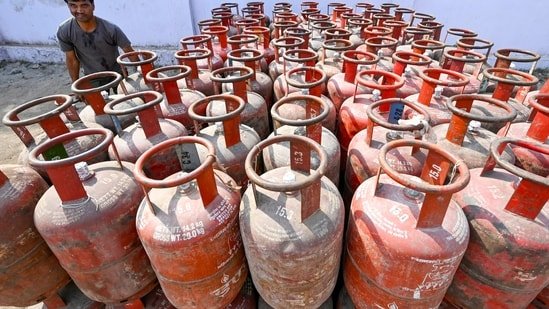
As Iran’s war with US-Israel disrupts global energy flows due to the impact of drones and missiles on the entire oil-rich Gulf region, many countries, including India, are facing one of a major fuel crisis in decades.


In India, the government has been pushing people to opt for PNG (piped natural gas) over LPG (liquified petroleum gas) cylinders amid the chokehold on key waterway Strait of Hormuz, through which a fifth of world’s gas and fuel requirements travel, due to the Middle East conflict sparked by US-Israeli strikes on Iran.
The government of India recently issued an order under which it said LPG supply will be snapped for those not opting for PNG if a switch is available.
With the government promoting PNG, it is important to first understand the difference between pipeline gas (PNG) and LPG and where PNG comes from.
What is piped natural gas (PNG)?
Pipeline gas, or piped natural gas (PNG), is primarily natural gas (mostly methane) delivered directly to homes through underground pipelines. PNG is extracted naturally from gas fields and transported into India in liquified form as liquified natural gas (LNG).
LPG, on the other hand is refined (produced) in oil refineries from crude oil. Track latest in US-Iran war here
PNG flows continuously, not needing refilling and is supplied at low pressure via city gas networks.
Where does PNG come from?
Domestically, PNG in India comes from gas fields like the Krishna-Godavari (KG) basin, Assam, and Tripura. The deepwater Krishna-Godavari (KG) basin off the eastern coast is reportedly the biggest contributor. Three fields in the KG basin, namely R Cluster, Satellites Cluster, and MJ, accounted for nearly 25 per cent of India’s total net production of 36 bcm in 2024, and are expected to produce a combined 85 bcm over their lifetime, according to an indiatoday.in report.
The Assam and Tripura basins have contributed nearly 47 per cent of India’s onshore production and 13 per cent of its total gas supply, per the report.
While imported natural gas (LNG) does come from the Middle East, primarily Qatar, other countries like the US and Australia also export LNG to India.
Why is PNG not hit as bad as LPG?
The government of India has been pushing households to shift from LPG cylinders to piped natural gas (PNG) largely because PNG is structurally more resilient in situations like the current Iran war-driven energy crisis. The key difference lies in how the two fuels are supplied.
LPG depends heavily on imports shipped from the Middle East, much of which passes through the strategically sensitive Strait of Hormuz, in which tankers have been targeted with drones and missiles recently. Any disruption there immediately affects tanker movement, leading to delays, shortages, and visible supply breakdowns-like empty cylinders and long waiting times.
PNG, on the other hand, is delivered through a fixed pipeline network and draws from a mix of domestic gas production and imported liquefied natural gas (LNG). Because it is part of a continuous distribution system, it doesn’t rely on discrete delivery events like cylinder refills. This means even if global supplies tighten, the impact is less abrupt at the consumer level. Households continue to receive gas, while adjustments-such as reduced supply to industries-happen behind the scenes.
India imports roughly 25–26 million metric tonnes of LNG per year. For example, according to S&P Global, India imported about 25.5 million tonnes in 2025, and this is expected to rise to 28–29 million tonnes annually going forward.
Official Indian government data is published by the Petroleum Planning and Analysis Cell (PPAC), which tracks LNG imports and confirms that around 50 per cent of India’s natural gas demand is met through imports, largely in the form of LNG.
According to PPAC data, the country imports as much as 50 per cent of its natural gas requirements. While LNG is not totally untouched by the Middle east conflict, given that Qatar accounted for 41 per cent of India’s imports in FY25, there are other regions too that the gas can be imported from. In fy2025, the US accounted for 19 per cent of India’s LNG imports.
What is LPG and why is it hit?
Liquefied Petroleum Gas (LPG) is a mixture of propane and butane, stored as a liquid under pressure in cylinders.
It is a byproduct of crude oil refining, which the world depends primarily on the Middle East for, or natural gas processing.
India imports about 60 per cent of its LPG consumption and out of these imports about 90 per cent come through the Strait of Hormuz, which has been impacted due to current happenings, according to a recent inter-ministerial briefing.
While LPG is more vulnerable to immediate logistical shocks of the Middle East conflict, PNG faces slower, systemic pressure.
The government of India earlier this week ordered households in areas with existing piped natural gas infrastructure to switch from LPG cylinders to PNG connections within three months of receiving notice, or face discontinuation of gas refill supplies — a move driven by mounting pressure on India’s LPG imports following the West Asia conflict.
Sujata Sharma, joint secretary in the ministry of petroleum, confirmed the order at an inter-ministerial briefing and framed it as a supply security measure. “Our import dependency for LPG is much higher than the import dependency for PNG or LNG. We produce 50% domestically as far as PNG is concerned. So, this is in the interest of nation that we shift from LPG to PNG,” she said.
The order provides one exemption: LPG supply will not be cut if the distributor issues a no-objection certificate certifying it is technically infeasible to provide a piped connection to that address.
India currently has 16.2 million domestic PNG connections — against over 332 million LPG consumers, a number that grew from 140 million in 2014, including 105.6 million poor households with subsidised connections under PM Ujjwala Yojana, according to an earlier HT report.


