



The “Intel Inside” marketing campaign made Intel a household name and a ubiquitous personal-computer chip supplier in the 1990s.
These days, “Nvidia Inside” has a lot more selling power.
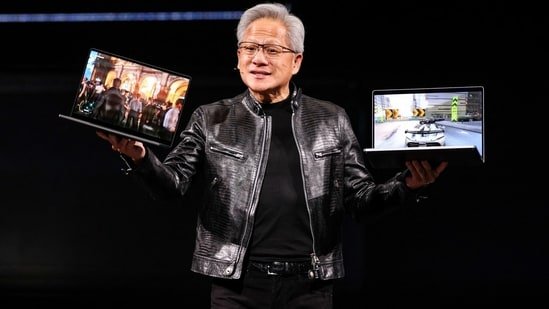
That is what Nvidia is betting with its new line of PC chips, set to be in Windows-based computers launching later this year. With its artificial-intelligence cachet, it is very likely that Nvidia will succeed, potentially upending an order in the PC world that has prevailed for pretty much the past five decades.
Investors are optimistic. Nvidia’s shares jumped more than 6% on Monday, while Windows-maker Microsoft rose more than 2%. Shares of PC makers Dell Technologies and HP both surged more than 8%. Arm Holdings, which licenses the basic blueprints that Nvidia uses in its PC chips, jumped more than 15%.
The direct impact of Nvidia’s PC play on its finances will likely be limited, given the enormous size of the company’s business selling AI chips for data centers. But the move does put Nvidia in a position to supercharge the market for AI-enabled computers and disrupt incumbents in the process.
Nvidia isn’t exactly a new entrant to the market. It has been a big player in PCs for decades through its graphics chips, which produce sharper and smoother images on computer monitors—a capability videogamers prize. But before detailing its latest chips at a trade show in Taiwan, it hadn’t made the central-processing units at the computational hearts of PCs. Intel and Advanced Micro Devices dominate that market.
Nvidia’s new chips, which combine a CPU with the company’s wildly popular AI-computing hardware, come at a time of weakness for Intel. Intel remains the biggest supplier of CPUs for traditional Windows PCs, with a market share of about 64% in the final quarter of last year, according to Mercury Research. But Intel and other players in the PC market haven’t been able to convince huge numbers of consumers or companies to buy new computers because of the AI capabilities of their chips.
Around 270 million PCs were sold last year, according to Gartner, up by around 9% from 2024. That isn’t a stellar increase amid an AI boom that is supposed to transform how people work and live. The total is still below its Covid-era peak of about 340 million in 2021.
So far, most sales of AI-enabled PCs to date have been by default. Computer makers are adding neural-processing chips that enable some on-device AI functions to all of their higher-performing product lines.
“The buyers choosing AI PCs today aren’t necessarily doing so for the AI,” said Jitesh Ubrani of market research firm IDC, which tracks PC sales. “They’re doing so because, at a certain performance tier, there’s no alternative.”
For Nvidia, PCs are a small part of its business now. But the company boasts a strong appeal in the segment, which bodes well for its latest effort. Nvidia’s PC-related revenue jumped 41% in the fiscal year ended January to a little over $16 billion, thanks in part to the introduction of new videogaming chips under the company’s popular Blackwell brand. Total PC unit sales grew only 8% during the calendar year, according to IDC data.
Whether Nvidia makes further inroads with its PC chips will be a test of the power of its brand and its close association with the AI boom. It will likely be much easier for Nvidia to sell people and companies on new AI-ready computers than it has been for Intel or AMD—or for that matter, Apple, which also has a popular line of computers that use homegrown chips.
Nvidia’s rise won’t come without challenges—the largest of which may be the software stickiness that has built up around Intel’s and AMD’s processors. They use a basic chip architecture called x86. But software that works on x86 processors needs to be adapted to work well on Nvidia’s or Apple’s Arm-based chips.
There is now a version of Microsoft’s Windows operating system for Arm-based chips, and software engineers have been developing more programs for Arm as the number of Arm-based PCs grows. But Arm as a PC platform remains at a software-development disadvantage vis-à-vis x86, including in areas such as gaming, which remains an important end market for Nvidia.
Ultimately though, Nvidia’s entrance into CPUs for PCs is likely to further erode the remaining x86 advantage, especially in the world of Windows-based PCs, where it has been difficult for new Arm-based players to gain a foothold.
“Intel Inside” worked for many years. But in tech, even memorable marketing slogans have a shelf life.
Write to Dan Gallagher at dan.gallagher@wsj.com and Asa Fitch at asa.fitch@wsj.com


