



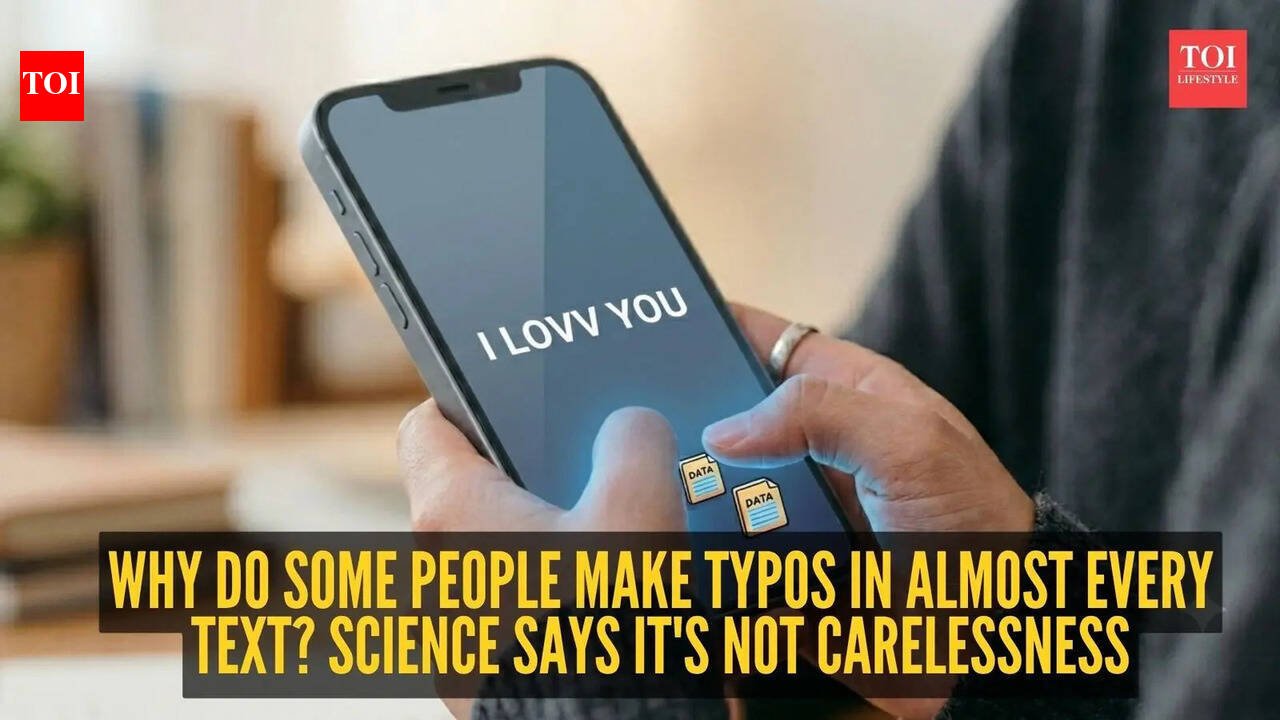
You know that feeling when you read a text you’ve just sent and immediately spot a mistake? Maybe you typed “teh” instead of “the.” Maybe “from” somehow became “form.” Or maybe autocorrect decided to create chaos and sent a completely different word than the one you intended.The frustrating part is that you often notice the typo the second after hitting send. Which raises a question: if your brain knew the right word all along, why did your thumb type the wrong one?As it turns out, those everyday texting mistakes aren’t always about bad spelling or being careless. In many cases, they are the result of a surprisingly complicated process happening in a fraction of a second. Your brain is thinking ahead, your eyes are tracking the screen, your thumbs are moving across tiny digital keys, and your attention is probably split between three other things at the same time.That’s a lot to ask from a simple text message.
Your brain is usually a few steps ahead
Most people imagine typing as a straightforward process. You think of a word, then type it. But that’s not really how the brain works.By the time you’ve started typing a sentence, your brain has often already planned the next few words. Sometimes it’s even working on the next thought before you’ve finished the current one. That’s where things can get messy.Your thumbs are essentially trying to keep up with a brain that’s moving much faster. And every now and then, they miss the mark.
Researchers who study touchscreen typing have found that many typing mistakes follow predictable patterns. A study published in Applied Ergonomics found that errors frequently happen near the edges of virtual keys. In simple terms, people often hit exactly where they think they’re tapping, but the touchscreen registers something slightly different.That’s why letters sitting next to each other on the keyboard get mixed up so often. Your thumb wasn’t wildly off target. It was just off by a millimetre.And on a smartphone screen, a millimetre is sometimes all it takes.
Typing on a phone is harder than it looks
Most of us spend hours texting every week, so it feels like second nature. But when you think about it, typing on a phone is actually a pretty awkward activity.A laptop keyboard gives you feedback. You can feel each key. Your fingers know where they are without constantly checking.A touchscreen doesn’t offer that luxury. You’re tapping a completely flat piece of glass. There are no physical boundaries between letters. Your brain has to judge distance, speed and accuracy every single time your thumb moves.Researchers have consistently found that people make more mistakes on touchscreens than on traditional keyboards. The reason is simple: your fingers have less information to work with.So if you’re someone who types flawlessly on a laptop but turns into a typo machine on your phone, you’re not imagining things.
Multitasking is a typo factory
Think about the last time you sent a message while walking through a mall, crossing a parking lot or carrying groceries.Chances are your typing wasn’t at its best. Studies have shown that texting accuracy drops when people are moving. Every step slightly shifts the body, making precise thumb movements more difficult. But you don’t even need to be walking.Watching TV while texting can do it. So can talking to someone, listening to a podcast, replying during a work meeting or trying to message while scrolling social media.The brain likes to think it’s great at multitasking.
Science says otherwise.When attention gets stretched in multiple directions, small errors start sneaking in. And typing mistakes are often among the first signs that your attention is overloaded.
Some people are simply better at texting
Ever notice how some people can type lightning-fast with almost no mistakes, while others constantly correct every second word? Part of that comes down to habit.Part of it comes down to how people physically use their phones. Research has found noticeable differences in thumb movement, hand size, grip style and typing technique. Some people use one thumb. Others use both. Some make quick movements while others type more slowly and carefully.Over time, these habits shape accuracy.Scientists at the University of Zurich have even found evidence suggesting that frequent smartphone use may influence activity in areas of the brain linked to thumb movement and touch processing. In other words, texting isn’t just a communication skill. It’s also a motor skill. And like any skill, some people naturally become better at it than others.
Sometimes the mistake starts before your thumb moves
Here’s the part most people don’t realise. Not every typo is caused by hitting the wrong key. Sometimes the brain itself creates the error.You’ve probably experienced it before. You know exactly what you want to say, yet somehow a completely different word appears on the screen.Researchers who study typing behaviour have found that errors can happen at different stages. Sometimes your thumb lands on the wrong letter. Sometimes your attention briefly slips. And sometimes your brain accidentally swaps one word for another before your fingers even get involved.
That’s why people occasionally type “their” when they mean “there” or send a word that sounds right in their head but looks completely wrong once it’s written down.The mistake isn’t always mechanical. Sometimes it’s cognitive.
When should you actually be concerned?
For most people, constant typos are nothing more than an annoying part of modern life. They’re usually linked to speed, distraction, screen size or simple human error.But doctors say there are situations where changes in typing habits deserve attention. If someone suddenly starts struggling with typing after years of having no issues, especially if it’s accompanied by problems with speech, memory, coordination or reading, it’s worth speaking to a healthcare professional.The important word here is “suddenly.” If you’ve been typo-prone since your first Nokia phone, there’s probably no reason to worry.You’re most likely dealing with the same thing millions of other smartphone users experience every day.
The reality of texting in 2026
The truth is, texting is a lot more demanding than it looks. We’re asking our brains to think, organise thoughts, choose words, move our thumbs accurately and monitor autocorrect all at the same time. Often while we’re doing something else.That’s a surprisingly complicated task for something we do without thinking. So the next time you send “I’ll be there in ten mintues” or accidentally write “pubic” instead of “public,” don’t be too embarrassed.Your brain probably knew exactly what it wanted to say. Your thumbs just couldn’t keep up. And honestly, that’s happened to almost everyone.


