






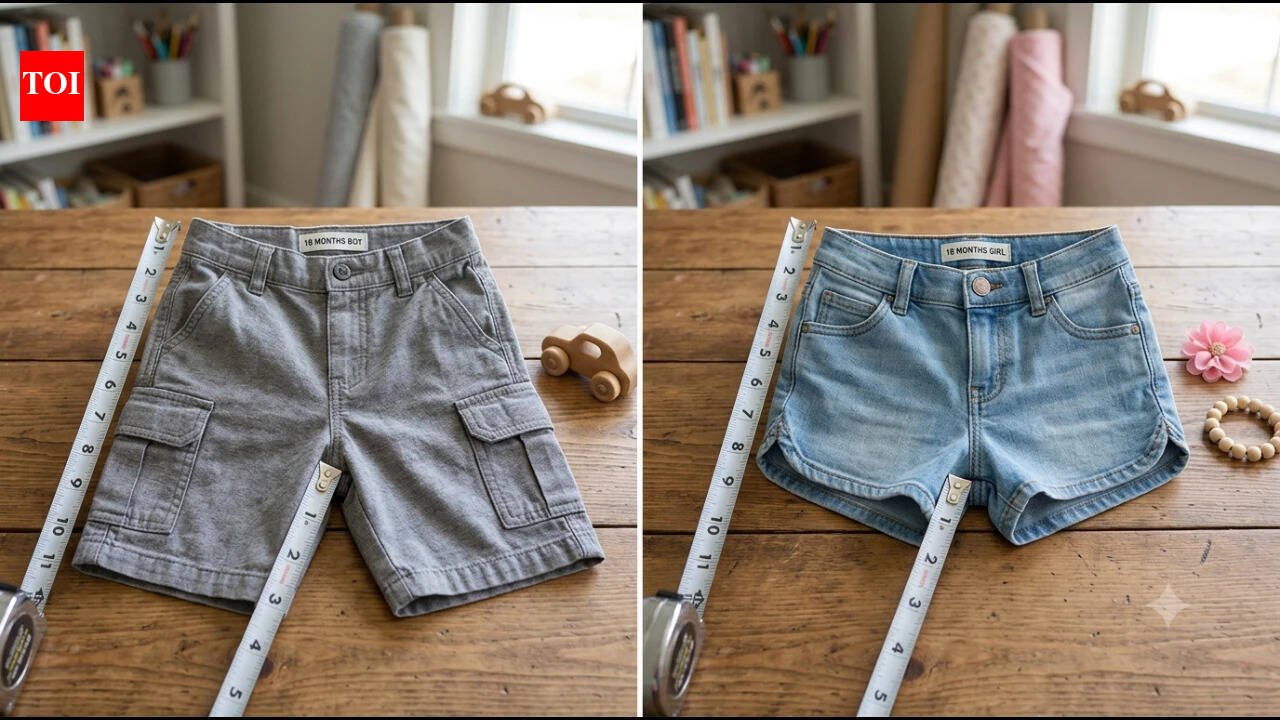
A simple shopping trip turned into a close look at how differently children’s clothes can be designed for boys and girls. A digital creator known as “Kat” recently compared two pairs of shorts made for 18-month-old children. The difference was not just the colour or decoration. The cut itself was noticeably different.Her comparison has sparked a wider conversation among parents about comfort, practicality and the assumptions built into children’s clothing.
10 Sept 2026 | 12:19
What’s one thing you swore you’l never do as a parent now you find yourself doing?
The shorts looked similar, but the measurements were not
In the video, Kat compared shorts labelled for an 18-month-old boy and an 18-month-old girl.According to her comparison, the girls’ shorts were around an inch shorter. The sides were also cut higher, while the inseam appeared considerably narrower than the boys’ version.The observation caught attention because the clothes were intended for children of roughly the same age. At 18 months, children are still crawling, running, climbing and spending much of their day moving around.Kat ended the comparison by saying, “We are buying 18-month-old boy clothes today.”She has also posted several videos under the title “girl moms, I am sorry,” encouraging parents to look more closely at how children’s clothing is made.
Why can boys’ and girls’ clothes be cut differently?
There are legitimate reasons for some differences in children’s clothing. Manufacturers may account for differences in average body proportions, fit, diaper space, intended activity or the construction of particular garments.But those differences do not automatically explain every design choice.A pair of shorts can be made shorter, narrower or more fitted because of a particular style rather than because a toddler physically needs that design. Clothing companies also use different colours, prints, silhouettes and cuts to separate products marketed towards boys and girls.
At this age, comfort is more important than appearance
An 18-month-old is unlikely to care whether shorts are marketed as boys’ or girls’ clothing. What matters is whether the waistband feels comfortable, whether the garment allows free movement and whether it stays in place during play.A shorter or higher-cut pair may work perfectly well for one child. For another, it could mean more exposed skin, less coverage around a diaper or simply a less comfortable fit.That is why parents often end up choosing clothes from both sections of a children’s store.Several commenters on Kat’s video said they regularly buy boys’ shorts for their daughters. Others pointed out that girls’ clothing can sometimes be designed with more emphasis on appearance than practicality.ID@undefined Caption not available.ID@undefined Caption not available.
The comments show that parents are noticing more than one issue
Some parents raised concerns about girls’ swimwear, while others mentioned bikinis and more fitted designs being marketed to very young children. Another commenter said her daughter’s diaper sometimes showed beneath girls’ shorts, leading her to buy biker shorts instead.There were also parents who disagreed with the criticism. Some argued that boys and girls have different body shapes and that clothing companies may simply be accounting for those differences.That is an important distinction. A difference in design is not, by itself, proof of a problem. The more useful question is whether the design serves the child’s actual needs.
What parents can take from the conversation
The viral comparison offers a small but useful reminder: children’s clothing labels should not decide what fits a child best.Parents can check the actual measurements, fabric, waistband, inseam and coverage instead of relying only on the section of the store where an item is displayed.Sometimes the most practical pair of shorts for a little girl may come from the boys’ section. There is nothing unusual about that.Children’s clothes are ultimately meant to let children play, move, explore and feel comfortable. A label should come second to those basics.Disclaimer: This article is based on a social-media video and the claims shared by the creator. The measurements described above reflect her comparison and have not been independently verified across brands or clothing sizes.


