


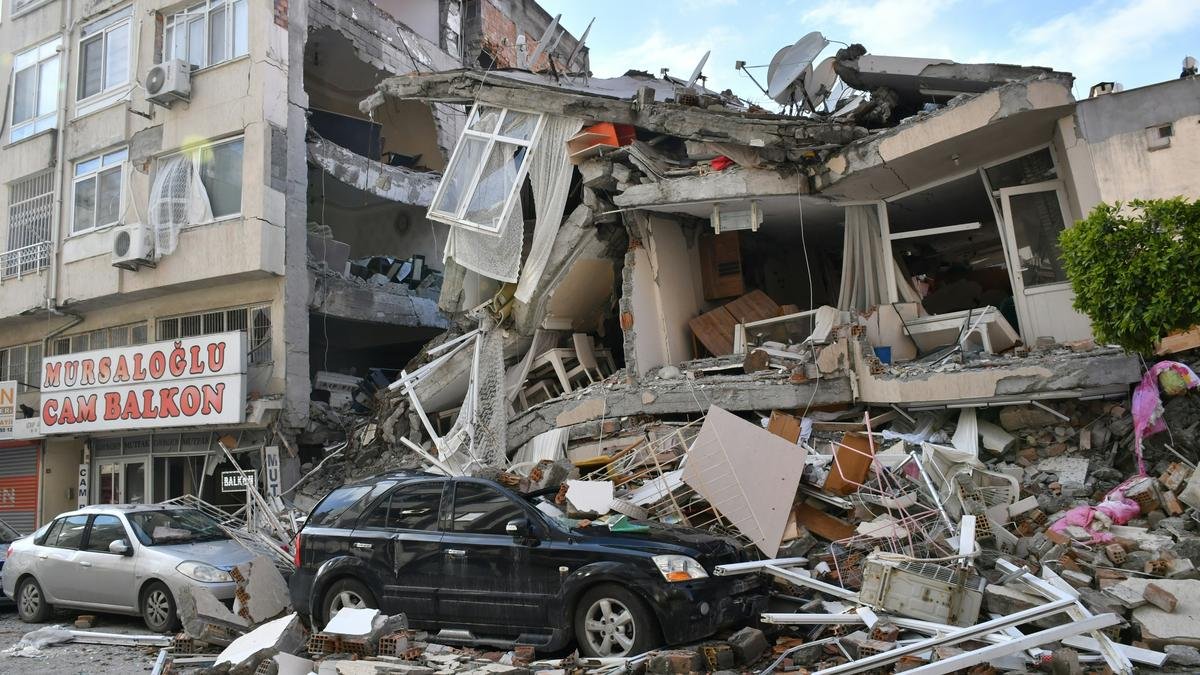
A view of a collapsed building in Iskenderun, Türkiye, following the February 2023 earthquake.
| Photo Credit: Çağlar Oskay/Unsplash
— S. Prakash, Tiruchi
The processes that produce earthquakes happen deep underground. These processes include stress building up in rocks and faults and the complex ways in which they transmit or release it. Faults may also rupture suddenly after centuries of accumulating stress, small ruptures may trigger larger ones, and some formations may release stress without causing earthquakes. Thus, a variety of outcomes remain possible.
This is why scientists forecast rather than predict. They have no way to say if a quake of a given strength will occur at a given place at a given time. Instead, they estimate the probability of a quake happening in a place over many years based on the long-term history and behaviour of faults there. Scientists are also working on early-warning systems that can give people up to tens of seconds of advance notice before the ground starts to shake violently.
Artificial intelligence (AI) can help significantly improve forecasting because it excels at finding patterns in large and complicated datasets, and can assess seismic recordings, GPS measurements, satellite data, geological maps, and historical measurements together. However, it cannot improve predictions because the data for predictions do not exist.
Have a question you would like answered? Send an email to science@thehindu.co.in with ‘Question Corner’ as the subject.
Published – August 26, 2026 08:30 am IST
