


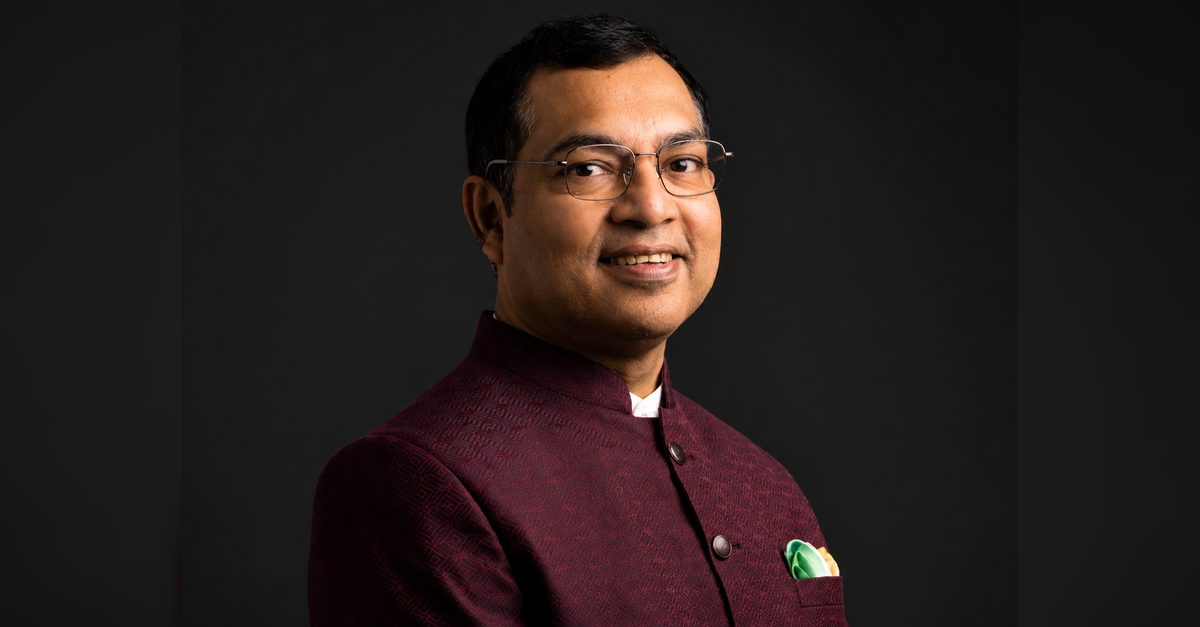
By Atish Chattopadhyay and Barnali Chaklader
Artificial intelligence is rapidly mastering the mechanics of teaching—delivering content, personalising pace and answering questions at scale. But education is more than instruction: it is a social, human process where mentorship, interaction and shared experience turn information into understanding.
We recently asked an AI platform a simple question: Can you replace teachers in schools and universities?
Its response was precise—AI can be a powerful collaborator, but it cannot replace a teacher.
At first glance, that answer seems cautious.
Imagine a classroom led entirely by AI. The teacher is flawless—never tired, never uncertain. Every concept is explained with clarity, every question answered instantly. There is no need to “check and revert.” The system works almost continuously, scales effortlessly and reduces costs dramatically. Students log in from anywhere, learn at their own pace and interact in virtual classrooms unbound by time or geography.
Efficient. Personalised. Perfect—at least in theory.
But education is not merely the transmission of knowledge. It is a lived, co-created experience.
Teaching, at its core, is a performing art—one in which students play an essential role in shaping the outcome. A classroom comes alive through participation: questions are raised, insights uncovered and experiences shared. Discussions evolve organically, often in directions that cannot be pre-scripted. The teacher, in this setting, is not merely an instructor but a facilitator of discovery.
A vibrant classroom resembles a musical concert, where the energy of the audience elevates the performance itself.
Artificial intelligence, however advanced, operates differently. Neuroscience suggests that while AI can simulate empathy, it does not feel it. Students, by contrast, are deeply human—experiencing anxiety before examinations, disappointment after failure and uncertainty about the future. In such moments, the role of a teacher extends far beyond instruction.
A teacher can pause, look a student in the eye and ask, “Are you okay?”
AI can generate the same sentence. But can it mean it?
The distinction is subtle, yet profound.
Consider the episode from the Mahabharata. Ekalavya, in devotion to Dronacharya, taught himself archery by practising before his teacher’s statue. He acquired knowledge, even technical proficiency. Yet his learning remained incomplete—symbolised by the absence of the thumb, and more deeply, by the absence of guru kripa.
Learning without human mentorship risks becoming rich in information, but limited in transformation.
Our philosophical traditions describe learning as a three-stage journey—Shravan (acquiring knowledge), Manan (reflection) and Dhyan (deep internalisation). True learning occurs when knowledge passes through reflection and becomes part of one’s being. It is shaped not only by information, but by lived experience, dialogue and introspection.
AI can significantly enhance Shravan, and support aspects of Manan. But the transition to Dhyan—where knowledge becomes internalised and embodied—remains deeply human.
Education is also inherently social. Friendships are formed, ideas contested and identities shaped in shared spaces. Alumni return not to reconnect with platforms, but with people—with teachers who influenced them and peers who shared their journey. These bonds are forged in lived experience, not virtual interfaces.
Even humour and discipline reveal the difference.
An AI system might say, “Your answer is 60 per cent statistically correct.”
A human teacher might respond, “You haven’t read the case properly—come prepared. You’re capable of much more.”
The former informs; the latter transforms.
The distinction extends beyond the classroom. Watching a match on television is not the same as being in the stadium watching Sachin Tendulkar bat. Streaming a film cannot replicate the experience of seeing Shah Rukh Khan on the big screen. The collective energy of a live audience creates an intensity no screen can fully reproduce.
Universities function in much the same way. They are ecosystems where students participate in clubs, lead initiatives, learn from peers and are mentored by faculty who guide them beyond the syllabus. These interactions build confidence, character and judgment—qualities that cannot be programmed.
And then there are the moments that define memory.
Imagine a university event where the microphone suddenly fails. The AI responds instantly—switching to captions or restoring sound. Efficient. Seamless. Forgettable.
A human teacher, by contrast, taps the mic, gestures for silence, calls for a backup and, in the process, creates a moment—students laugh, improvise and engage. What begins as a technical glitch becomes a shared experience, remembered long after the event. AI handles the mic but humans handle the moment.
The future of education lies not in replacement, but in integration. AI can personalise learning, assist with evaluation and expand access. But the deeper purpose of education—the shaping of judgment, the nurturing of curiosity and the awakening of human potential—remains irreducibly human. The real shift lies elsewhere. AI will not replace teachers.
But teachers who use AI will replace those who do not.
Atish Chattopadhyay is the Director, IMT Ghaziabad. Barnali Chaklader is the Dean (Academics), IMT Ghaziabad.
DISCLAIMER: The views expressed are solely of the author and ETEDUCATION does not necessarily subscribe to it. ETEDUCATION will not be responsible for any damage caused to any person or organisation directly or indirectly.
