



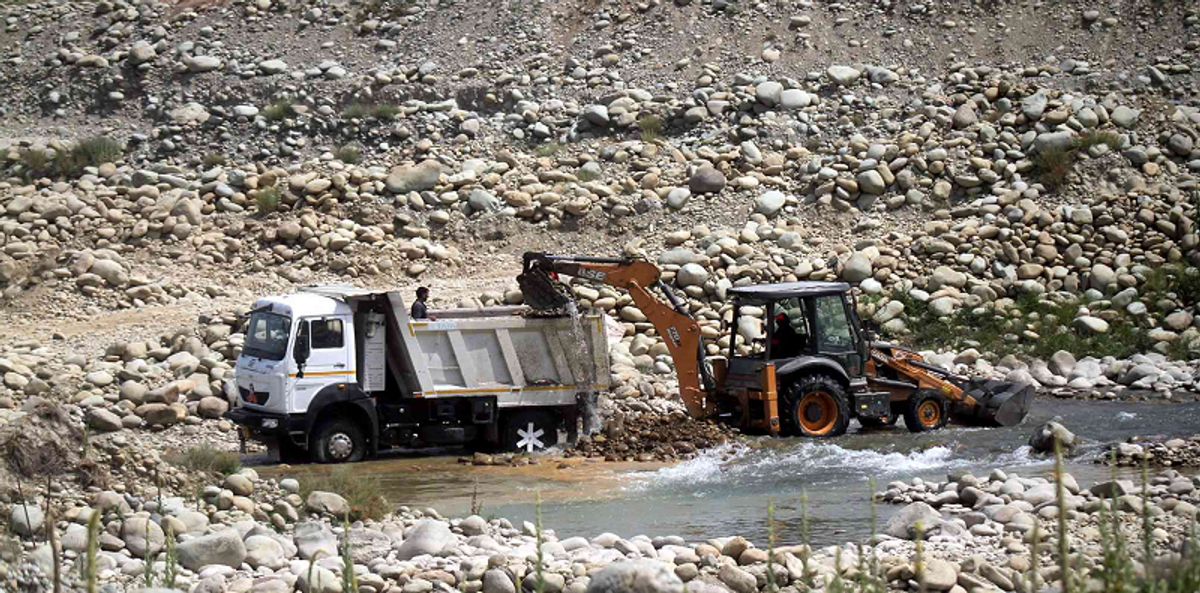
Illegal mining in Kashmir is no longer a hidden violation confined to a few riverbanks or remote stretches of land. It has become a serious assault on the Valley’s fragile ecology, public safety and collective future. Across several districts, the unchecked extraction of sand, gravel, boulders and other minerals is altering river channels, damaging agricultural land, destabilising slopes and deepening the sense that environmental laws exist only on paper.
The scale of the problem is visible in the scars left behind. Riverbeds are excavated without regard for natural flow. Heavy machinery enters areas where mining is prohibited. Trucks move material under the cover of darkness or in full public view. Water sources are disturbed, embankments weakened, and fertile soil carried away. What is presented as a local business or a source of construction material is, in reality, a destructive activity that transfers private profit to a few while imposing long-term costs on the entire population.
Kashmir’s rivers are not merely channels carrying water. They are living ecological systems that sustain agriculture, recharge groundwater, support biodiversity and protect settlements from floods. When their beds are indiscriminately dredged, their natural balance is disturbed. The consequences may not always appear immediately, but they accumulate over time. Riverbanks become vulnerable to erosion, bridges and roads face greater risk, and flood patterns can change in ways that threaten communities downstream.
The damage is even more dangerous in a mountainous region. Unregulated quarrying and hill cutting weaken slopes that are already vulnerable to landslides, cloudbursts and intense rainfall. The removal of vegetation and the blasting of rock can turn a natural hazard into a preventable disaster. Every illegally excavated hillside increases the burden on roads, homes, farms and public infrastructure. When calamity strikes, the destruction is often described as an act of nature. But in many cases, human greed and administrative negligence have already prepared the ground.
The question that demands an answer is simple: how does illegal mining continue despite the presence of laws, departments, inspections and enforcement mechanisms? The answer lies partly in weak monitoring, but it also lies in selective enforcement and institutional failure. Authorities often conduct raids after public complaints or media reports, seize machinery and announce action. Yet the activity resumes soon afterwards. Such temporary interventions cannot substitute for a sustained enforcement system.
There is also a troubling gap between official claims and ground reality. Government departments frequently report seizures and penalties, but the public rarely receives a clear account of how many cases resulted in prosecution, how much revenue was recovered, how many repeat offenders were blacklisted or whether officials responsible for permitting violations faced consequences. Without transparency, enforcement becomes a performance rather than a deterrent.
Illegal mining also thrives because of the powerful networks that surround it. The activity requires machinery, transport, labour, storage and access to markets. It cannot be sustained for long without local knowledge and administrative blind spots. The responsibility, therefore, cannot be placed only on individual operators. Those who finance the activity, transport illegally extracted material, facilitate access to protected areas or ignore repeated violations must all be held accountable.
At the same time, the demand for construction material cannot be dismissed. Kashmir is developing, and homes, roads, bridges and public projects require minerals. But development cannot mean the destruction of the natural systems that make human life possible. Scientific extraction, clearly marked mining zones, strict environmental assessments and regulated transport can help meet legitimate demand without sacrificing rivers and hills. The choice is not between development and conservation. The real choice is between responsible development and reckless exploitation.
The administration must move beyond sporadic raids and establish a credible, public enforcement framework. Mining sites should be mapped and monitored through technology, including satellite imagery, GPS-based transport tracking and digital permits that cannot be easily manipulated. District-level data on permissions, seizures, penalties and prosecutions should be made available to the public. Repeat offenders should face cancellation of licences, attachment of equipment and prosecution under environmental and criminal laws.
Local communities also need a meaningful role. Residents living near rivers and quarrying sites are often the first to witness violations, but their complaints may be ignored or delayed. A responsive complaint system, protection for whistle-blowers and community-based monitoring can strengthen official oversight. Environmental protection cannot be enforced effectively when the people most affected are excluded from the process.
The judiciary and pollution-control authorities, too, have an important role in ensuring that environmental violations are treated as serious public harms rather than minor regulatory offences. Penalties that are lower than the profits earned from illegal mining do not deter anyone. The law must make environmental crime financially unviable.
Kashmir has already paid a heavy price for poor planning and delayed action. Rivers have narrowed, wetlands have shrunk, slopes have been cut, and urban spaces have expanded without adequate safeguards. Allowing illegal mining to continue will only intensify these crises. The loss will not be limited to landscapes. It will affect drinking water, agriculture, roads, livelihoods and the safety of future generations.
Illegal mining is therefore not simply a matter of unauthorised extraction. It is a test of governance. If laws are enforced selectively, if powerful operators are allowed to return after symbolic action, and if public resources are treated as private property, the damage will become irreversible.
The government must act before the Valley’s rivers and hills are reduced to sources of profit for a few. Kashmir’s natural wealth belongs to the people and to generations yet unborn. Protecting it is not an environmental luxury. It is an obligation of the state and a matter of public survival.
( The Author is an environmental researcher and columnist)
