



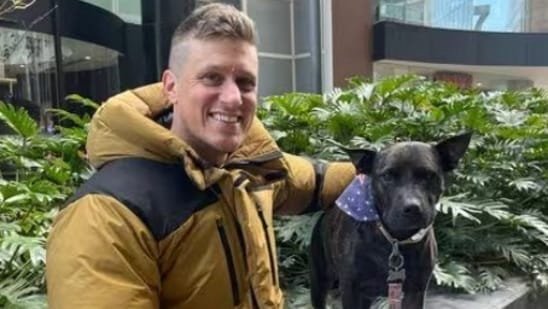
While narratives regarding the misuse of AI become increasingly common, an interesting discovery has emerged from Australia. A technology enthusiast utilized ChatGPT and Google DeepMind’s AlphaFold to create a vaccine for his dog, which had only a few months left to live.


Speaking to Today, Australian tech expert Paul Conyngham said, “Rosie is my best mate and uh, she’s been with me through really tough times, through a breakup, through hard business deals, walks in the forest and, when she was handed this sentence, uh, I felt I had to do my part for her as well.”
How did AI contribute to cancer treatment of Rosie?
In 2019, Conyngham adopted a Staffy-Shar Pei mix named Rosie from an animal shelter. Five years later, Rosie was diagnosed with cancer. Despite spending thousands on conventional treatments like chemotherapy, the tumor did not reduce in size. At this point, Paul resolved to take action, utilizing AI to assist him.
The Australian technology expert chose to sequence the dog’s DNA to identify the issue and develop a remedy. For this purpose, he turned to ChatGPT. He shared with The Australian, “I went to ChatGPT and came up with a plan on how to do this.”
Conyngham is well-versed in AI, having spent 17 years in machine learning and data analysis.
He reached out to The University of New South Wales Ramaciotti Centre for Genomics, which provided him with genomic sequencing for $3,000 Australian dollars.
Development of cancer vaccine
Conyngham subsequently compared Rosie’s healthy DNA with the DNA of the tumour to identify the issue. He elaborated, “It’s like having the original engine of your car and then a version of the engine 300,000km down the road – you can compare them and see where there’s damage.”
Following this, Paul utilized AlphaFold, an AI system developed by Google DeepMind that aids in understanding protein functions. This enabled the technician to pinpoint the mutations and correlate them with the drugs required to treat the tumour.
This facilitated Paul and the UNSW in developing a tailored mRNA vaccine for the dog. An mRNA vaccine stimulates an immune response by employing synthetic messenger RNA to direct cells to generate a harmless viral protein.
“This is the first time a personalised cancer vaccine has been designed for a dog,’’ Professor Pall Thordarson, director of the UNSW RNA Institute, said, as per The Australian. “This is still at the frontier of where cancer immunotherapeutics are – and ultimately, we’re going to use this for helping humans. What Rosie is teaching us is that personalised medicine can be very effective, and done in a time-sensitive manner, with mRNA technology.’’
Rosie’s first injection and further treatment
Rosie received her first injection in December, which was subsequently followed by booster shots. The tumour has notably decreased in size after the treatments, although the cancer was already in an advanced stage.
Conyngham is currently developing a second vaccine aimed at targeting a residual tumour, saying, “There’s actually a chance that for some cancers, we can change it from being a terminal sentence to a manageable disease.”


