Jet stream shifts, Arctic warming redirecting weather systems
Srinagar, Mar 04: The prolonged dry spell and unusually warm winter across Kashmir this year have once again put the spotlight on weakening Western Disturbances — the lifeline weather systems that traditionally bring rain and snow to the Valley.
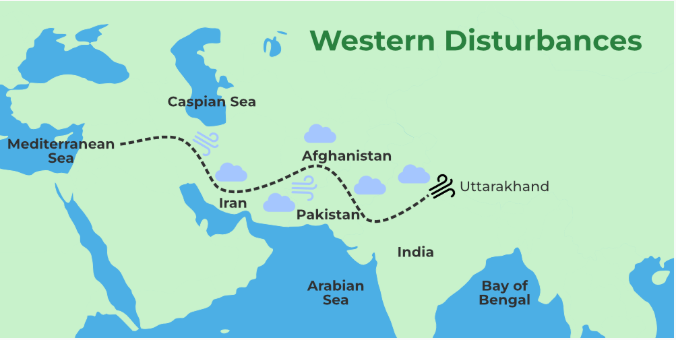
Western Disturbances (WDs), originating over the Mediterranean region and steered by the subtropical westerly jet stream, are responsible for the bulk of winter precipitation in Jammu and Kashmir. However, this season witnessed fewer impactful systems, resulting in significant precipitation deficit and below-normal snowfall across many parts of the region.
Director MeT Srinagar, Mukhtar Ahmad, said the Valley experienced a noticeable decline in effective Western Disturbances.
“Most Western Disturbances this winter were either weak or passed north of Jammu and Kashmir, limiting their impact. As a result, precipitation remained below normal, and temperatures stayed above average,” Ahmad said.
He added that large-scale atmospheric circulation patterns and jet stream positioning influence the intensity and track of these systems.
Independent weatherman Faizan Arif also attributed the dry winter to a reduced frequency and strength of WDs. “We have observed that over the past few winters, effective Western Disturbances have declined in both intensity and duration. Snowfall events are becoming less frequent and shorter. This pattern is concerning because winter snowpack is crucial for glaciers and summer water flow,” Arif said.
Arif noted that several systems this year lacked sufficient moisture, leading to cloud cover without substantial precipitation.
Climate experts from the University of Kashmir believe the trend may be linked to broader climate variability and warming patterns.
“Global warming is affecting atmospheric dynamics. Arctic warming and shifts in jet streams can alter the path and behaviour of Western Disturbances. If these changes persist, the Himalayas may witness more erratic winters with reduced snowfall,” a senior climatologist at the university said.
Studies cited by the Intergovernmental Panel on Climate Change indicate that mountain regions, including the Himalayas, are warming faster than the global average — a phenomenon known as elevation-dependent warming. Experts say this increases the chances of precipitation falling as rain instead of snow, further shrinking winter snow reserves.
The impact extends beyond winter aesthetics. Reduced snowfall affects river discharge, irrigation, hydropower generation and horticulture. Apple orchards, in particular, require adequate chilling hours — something warmer winters increasingly threaten.
While meteorologists caution that Western Disturbances are naturally variable and influenced by global climatic drivers, the recurring pattern of weak winter systems has raised concerns about a deeper climatic shift.
For Kashmir, where winter has long been synonymous with snowfall, the question is no longer just about when the next Western Disturbance will arrive — but whether the very character of winter is quietly changing.