How does one survive the dark, grim times? I guess everyone has a coping mechanism. For me it’s reading. And what works best is satire, humour, irony. If nothing else, at least one can laugh!
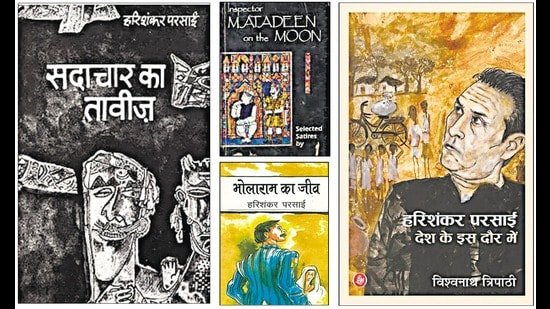
Parsai wrote about the daily hardships of ordinary people, in tales such as Sadachar Ka Taweez, Matadeen on the Moon, Bholaram Ka Jeev and Desh Ke Is Daur Mein.
Lately, in this mood, I have found myself returning to the short stories of Hindi literature’s greatest satirist, Harishankar Parsai (1924-1995). His devastating humour and social and political satire should ideally be read in the original (though some stories are available, and a delight, in English translation).
Parsai tore into the hypocrisy and corruption around him. He wrote of the daily hardships and inequalities of ordinary people’s lives, crushed under the weight of an uncaring bureaucracy and political class. He wrote of the inhumanity of religious bigots, and the uphill struggles faced by women. He drew most of his characters from the working or lower-middle classes, and wrote of pensions, taxes and unaffordable prices.
I’ve picked three short-stories, below, to give you an idea of his work.
* In Inspector Matadeen on the Moon, the Moon Government writes to the Government of India, seeking help running an efficient police force. The government despatches Inspector Matadeen, who is shocked to discover that the Moon police follow rules, protect the innocent, and spend weeks looking for the real perpetrators of each crime. He immediately begins enforcing Earth rules: It’s not important who is guilty of a crime. What is important is: Who should be proven guilty? Pick someone who has been a nuisance to the police, he advises; or, someone whose conviction will please those at the top.
Always have a list of eyewitnesses at hand, he adds; thieves, goons and petty criminals who will say whatever the police want them to. “Don’t let a small thing like ‘but he wasn’t at the scene’ get in the way.”
Eventually the Prime Minister of the Moon sends Matadeen back to Earth, saying they don’t want him, as he has nearly destroyed all civilised life on the Moon.
* In Bholaram Ka Jeev, a government servant has died. The time has come for his soul to leave with a yamdoot. The problem is, the yamdoot can’t find Bholaram anywhere.
The sage Narad Muni is asked to help. He visits Bholaram’s house and asks the wife what the man died of. “His illness was poverty,” she replies. He had filed numerous petitions over five years in a vain attempt to get his pension. The family sold their jewellery and household effects till nothing was left. Consumed with worry, starving, Bholaram died.
Narad Muni now heads to the pension office, where he is told that yes, they received the letters but because he hadn’t put enough “weight” on them, nothing was done. Narad offers his veena as “weight”. Satisfied, the Bada Sahib asks for the file, which arrives stuffed with 150 petitions.
Name of petitioner? he asks. Narad Muni calls out: Bholaram. Now, a voice emerges from the file. It is his soul, trapped in the pages, crying out, “I can’t leave these petitions!”
* In Rashtra Ka Naya Bodh, an honest, civic-minded citizen complains to the Collector that two traders have illegally hoarded grain. The traders say the accusation is false, and label their accuser an “anti-social element”. They fund the ruling party in every election, they add. Soon, the citizen finds he’s being followed by the police. When he asks why, he is told the government suspects him of indulging in anti-national activities.
Parsai’s satire was savage but laced with compassion. He had known extreme hardship himself. A teenager by the time of World War 2, he grew up in a poverty-stricken India.
The son of a land agent in Madhya Pradesh, he lost his mother to a plague epidemic when he was in Class 8. His father never recovered, and died a few years later. Parsai, the eldest but still just a teenager, found work to help support his three siblings, and went on to qualify for a job as a teacher. He was 23 when his first short story appeared, in a publication called Prahari (Sentinel), in 1947.
Realising that “others are oppressed too… I am just one of them… I thought, I’m not going to cry, I’m going to fight. That’s when I began a serious study of history, society, politics and culture… and began writing satire in earnest,” he would later write, in a publication he founded called Vasudha.
Parsai never married, dedicating his life to his family and his writing. He died aged 70, leaving behind an extraordinary body of literature that can still make us smile, and gasp.
(Email Poonam Saxena at poonamsaxena3555 @gmail.com. The views expressed are personal)