



At Lamayuru’s Yuru Kabgyat Festival, tradition is not performed. It is lived
FARAH ZAIDI
We arrived in Lamayuru under grey skies.
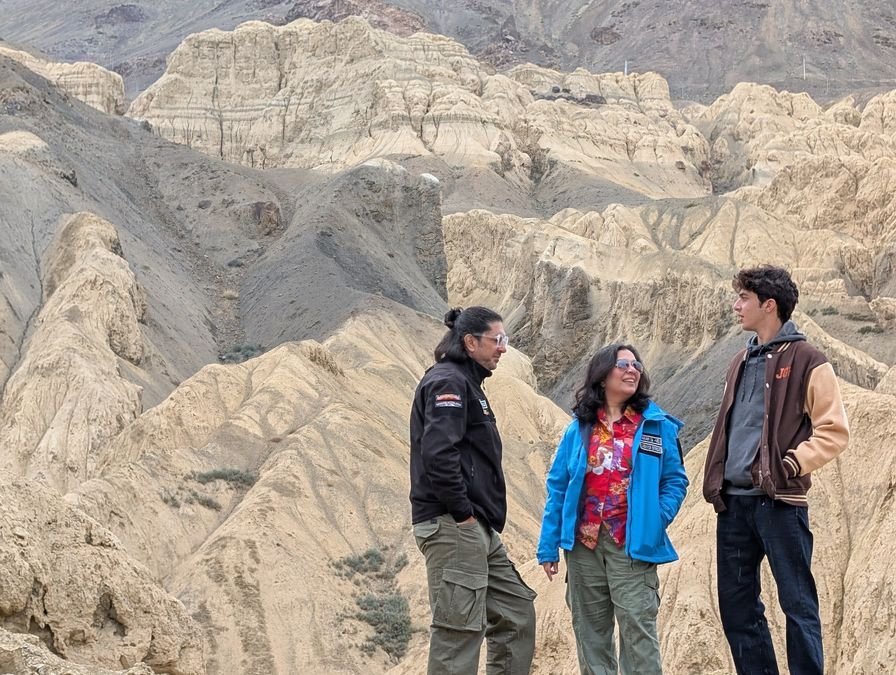
Rain drifted across the mountains in brief, unhurried spells, appearing and disappearing as quickly as the clouds rolling across the ridgelines. The monastery stood above the village as it has for centuries, watching over a landscape that seemed almost otherworldly — eroded hills known popularly as the Moonland stretching towards the horizon, their pale formations set against the dark skies of an unsettled summer afternoon.
Like many travellers, we had come for Yuru Kabgyat, one of Ladakh’s most significant monastic festivals. But as the days unfolded, it became clear that the festival was about something larger than the ceremonial dances for which it is known. It was about gathering — and in today’s world, perhaps gathering itself has become something worth paying close attention to.
The road from Srinagar to Lamayuru crosses landscapes that can appear vast and empty. Yet throughout our journey, we encountered constant movement: shepherds guiding their flocks towards high summer pastures near Drass, families travellingtowards Ladakh, villagers moving between settlements, monks returning to the monastery, travellers arriving from distant corners of the Himalayas. Everyone was moving, and many — directly or indirectly — were moving towards the same place.
When Yuru Kabgyat begins, Lamayuru transforms. The monastery courtyard fills with colour, sound and anticipation. Monks wearing elaborate masks perform sacred Cham dances that have been preserved across generations. To an outsider, the movements can appear theatrical; their purpose, however, is deeply spiritual — representing the triumph of wisdom over ignorance, compassion over negativity, harmony over disorder. For visitors, the masks are often the first thing they notice. For local communities, they are only one part of something much larger.
The festival serves as a social, cultural and spiritual anchor for people living across the region. Families reunite. Communities reconnect. Elders pass stories and traditions to younger generations. Familiar faces reappear after months apart. The festival is not merely watched — it is participated in.
Even as rain swept across the monastery courtyard during our visit, the gathering continued without interruption. Nobody seemed particularly troubled by the weather. The rituals had endured far greater challenges than an afternoon shower, and there was something quietly reassuring about that persistence — a reminder that this rhythm does not answer to social media, tourism calendars or modern urgency. Its timing is determined by tradition, and tradition moves differently.
Spending time among local residents during the festival, we were reminded that cultural heritage rarely survives through monuments alone. Buildings can be preserved and structures restored, but living traditions require something monuments cannot provide: people, and their continued participation. A monastery without a community becomes a museum. A festival without participants becomes a performance. What keeps places like Lamayuru alive is the sustained relationship between landscape, faith and the people who inhabit both — and that relationship, despite everything, remains remarkably strong.
Later, as we travelled through nearby Wanla village and ventured onto quieter roads above the monastery, the festival stayed in our thoughts. The Himalayas are changing rapidly. Roads reach places that were once isolated, tourism expands into new valleys, technology shortens distances, information travels instantly. These changes bring genuine opportunities alongside real challenges. Amid all this transformation, gatherings like Yuru Kabgyat offer something increasingly rare: continuity. They remind communities where they come from, reinforce relationships that extend beyond geography, and create spaces where identity is not explained but experienced.
That, perhaps, is why such festivals continue to matter — not because they are ancient, but because they remain meaningful. Traditions survive not by resisting change entirely, but by continuing to offer something worth returning to within changing times.
As visitors, it is easy to focus on the visual spectacle of Yuru Kabgyat: the masks, the costumes, the monastery, the dramatic setting of Moonland beneath shifting skies. All of it is undeniably remarkable. Yet the most memorable aspect of our time in Lamayuru was something less obvious — the simple act of people coming together. Families sitting side by side. Children watching attentively. Monks performing rituals passed down through centuries. Neighbours meeting after months apart. Communities quietly reaffirming their connection to one another and to this place.
In many ways, that gathering is the festival’s most important tradition — older and more durable than any single ritual within it.
The dances eventually end. The crowds disperse. The roads carry people home, and the monastery returns to its quieter rhythm. Yet something remains behind: a reminder that in a rapidly changing world, some places continue to create space for reflection, belonging and continuity.
And perhaps that is why, year after year, the mountains gather once again at Lamayuru.
(The Author is Co-Founder of Kashmir Off Road)


