


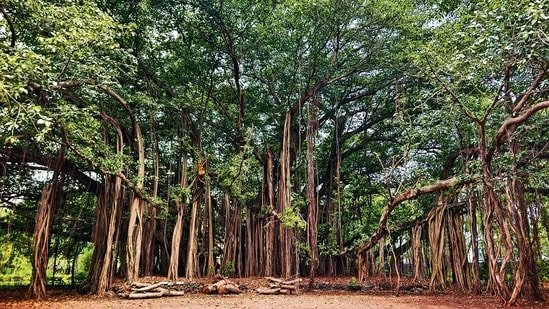
There was a time when a tree was not just a tree. It was a presence. A witness. A keeper of time. A banyan, in particular, was something more. Its aerial roots like pillars, its canopy spreading wide enough to hold generations who gathered, rested, prayed, and simply were.
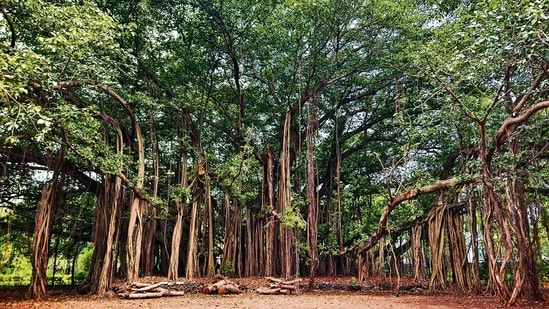
It did not belong to us; we belonged, in some quiet way, to it.
And yet today, we find ourselves in an age where such ancient ecosystems are reduced to obstacles. Cleared, compensated for, or relocated. We measure them in road widths, project timelines, and efficiency. Their worth, once immeasurable, is now negotiable.
It’s not just our priorities that have changed, but our relationship with the living world itself.
In ancient Indian thought, there runs a quiet but enduring idea: that all life is interconnected, that the same consciousness pervades everything. The tree, the river, the mountain are not separate from the sacred; they are its expression. It places us within nature, not above it. There is a rhythm, a reciprocity. We take, but we also revere. We build, but we also bow.
For all that progress has given us, it has also come with a subtle but profound amnesia. We have learnt to extract without asking, to replace without grieving, to accelerate without reflecting. In doing so, we have not just altered landscapes; we have altered ourselves.
It is not just the ancient and visible that we are losing. It is also the quiet and unseen wetlands that lie low and uncelebrated, absorbing our excesses, holding water, sustaining life and livelihoods in ways that rarely make it into our financial models. These are not empty lands waiting to be filled; they are living systems that can store three to five times more carbon than terrestrial forests, much of it locked deep within waterlogged soils, held in place by dense root systems for centuries.
These ecosystems make urban life more liveable. If we fail to recognise this, we will build cities that become unliveable. We are already seeing the consequences of reckless urbanism. Rising temperatures. Intensifying urban heat. Cities that trap and amplify heat rather than absorb and release it. As we fragment green cover and degrade natural systems, we are not just losing ecosystems; we are altering the very microclimates we inhabit.
We are breathing the consequences. Fine particulate matter, PM2.5, much of it driven by construction dust and the constant churn of development, settles into the air we live in. It enters our lungs, our bloodstream, our daily lives. This is not an abstract environmental cost. It is a public health crisis, unfolding in plain sight.
These outcomes are not inevitable. They are the result of how we plan our cities. This is not an argument against development. It is an argument for redefining it. It is also a standard we must hold ourselves to, as we shape the next phase of development in our cities.
As our cities grow, the question cannot simply be how much more we can build. It must be where we build, how we build, what we preserve, and what systems of life we treat as essential. Urban planning must move beyond roads, buildings and floor space. It must begin to plan for heat, water, biodiversity, public health, and human dignity.
This requires three shifts:
- First, reclassification. Natural ecosystems like wetlands, forests, urban green cover and water bodies must be recognised as essential ‘blue green’ infrastructure, not residual land. Their protection cannot be discretionary.
- Second, integration. Urban planning must be treated as a unified function, not a fragmented set of approvals across agencies. Cities need empowered institutions with accountability for outcomes, capable of balancing blue green infrastructure with grey infrastructure.
- Third, enforcement. Regulations exist, but are unevenly applied. Without consistent enforcement, planning frameworks lose both credibility and impact.
Beneath the banyan lies an intricate, expansive network of roots and fungal connections. Systems through which trees communicate, share nutrients, and respond to stress. Forests, as we now understand, are not collections of individual organisms; they are communities. They sense, they adapt, they support. An old tree is not just larger; it is wiser, more deeply connected, and more essential to the life around it.
And yet, in our attempt to reconcile progress with preservation, we often tell ourselves that what is removed can be replanted, that what is displaced can be restored elsewhere.
But can it? Can we relocate not just a tree, but the centuries of relationships it has built? Can we transplant soil memory, microbial life, the quiet exchanges that sustain entire ecosystems? To believe so is not just optimistic; it is, perhaps, a reflection of how far removed we have become from the systems we are uprooting.
This question extends beyond nature, into the spaces we have inherited. Across our landscapes are places shaped not just by design, but by devotion. Riverfronts, ghats, pathways, and precincts that have evolved over centuries. They hold memory, continuity, and meaning that cannot be recreated through replication or scale. When such places are reshaped in the name of progress, we must ask ourselves: Are we expanding possibility, or erasing context?
Does progress have to come at the cost of heritage? Or is that, too, a failure of imagination?
We don’t have to choose between progress and preservation. What we do need is a way to hold both. To design with sensitivity. To integrate rather than overwrite. To ask not just what we can build, but what we must protect.
The truth is, we are not separate from what we are changing. Every ecosystem we fragment, every ancient tree we remove, every living system we reduce to a line item, we move a little further away from the intelligence that sustains us. And perhaps that is the real loss.
What this moment really asks of us is simple, though not easy: To remember.
To look at a tree, neither as timber nor as an obstacle, but as time. To look at the land, not as opportunity, but as inheritance. To build, not just for scale, but for soul.
These are not just carbon sinks we are losing; they are carbon vaults we are opening. Releasing what has been held for centuries back into the atmosphere, compounding the very crisis we are seeking to contain.
In that sense, destruction is not neutral. It is not just loss. It is reversal. And in this quiet, irreversible exchange, we must decide what kind of future we are building.
(The views expressed are personal)
This article is authored by Nyrika Holkar, executive director, Godrej Enterprises Group.
