



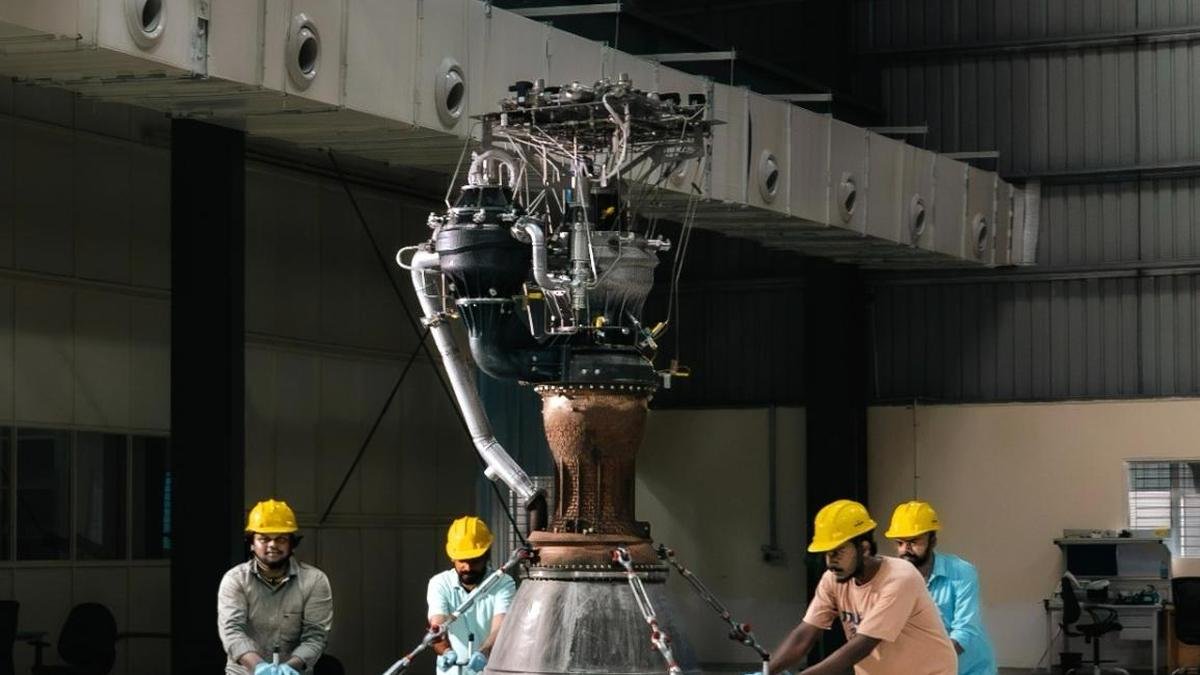
Bengaluru-based Astrobase Space Technologies unveiled India’s first privately built 800 kN Full-Flow Staged Combustion (FFSC) LOX-Methane rocket engine named EVEREST.
| Photo Credit: Special arrangement
The story so far: A Bengaluru-based space company, Astrobase Space Technologies, on Friday (August 7, 2026) unveiled India’s first privately built 800 kN Full-Flow Staged Combustion (FFSC) LOX-Methane rocket engine named EVEREST.
This makes India the fourth nation to have FFSC engine technology after Russia, USA and China.
What are high thrust FFSC rocket engines?
The FFSC rocket engines are very powerful engines where the propellant flows from the tank or the source to the rocket engine’s combustion chamber. Staged combustion refers to combustion taking place in two stages wherein the fuel flows into the rocket engine from one side and the oxidiser from the other side.
In the case of a staged combustion, the engine fuel is injected in relatively small quantities while oxidiser is on the higher side. The fuel and oxidiser which is burnt and gases generated out of it are used for turning the turbines connected to the pump.
The gases generated are not left to the atmosphere but put back into the rocket combustion chamber ensuring that the propellant is utilised and not wasted.
How are FFSC rocket engines different from conventional engines?
FFSC engines are one of the most advanced liquid rocket engine architectures. Neeraj Khandelwal, co-founder and CEO of Astrobase, told The Hindu that unlike conventional rocket engines —where only a portion of the propellants is used to drive the turbopumps— an FFSC engine routes both the fuel and the oxidiser through separate pre burners before they enter the main combustion chamber.
“This allows the turbopumps to operate more efficiently while ensuring that all of the propellants ultimately contribute to generating thrust. The architecture offers several long-term advantages. It enables high propulsion efficiency, supports precise throttle control and is well suited for reusable launch systems. When paired with LOX-Methane propellants, it also benefits from cleaner combustion, which can simplify refurbishment and support faster turnaround between missions,” he said.
Why are FFSC rocket engines important?
While the FFSC cycle is significantly more complex to design and develop than conventional engine cycles, it is widely regarded as an architecture that can support reliable, high-performance and reusable launch vehicles, said Mr. Khandelwal, who founded Astrobase Space Technologies in 2024 with former ISRO scientist Devakumar Thammisetty.
“At Astrobase, we see this as an important technology for building indigenous launch capability and strengthening India’s long-term access to space,” he said.
In rocket science FFSC engines are considered to be very challenging technology which is more efficient over conventional engines. However they are very complex to develop and execute.
What is the significance of the unveiling of the EVEREST engine?
Globally only three commercial companies have successfully developed high thrust FFSC engines, which are SpaceX and Stoke Space, both from the United States of America, and Land Space from China. Of these only SpaceX’s Raptor is the only operational FFSC engine as of now.
The Bengaluru-based space company is the first Indian company to develop this engine and the fourth globally. Besides this is the first time an Indian company has built a LOX-Methane high thrust engine which bats for cleaner next-generation launch systems.
This development also unlocks reusable launch capabilities upto 30 tonnes to low earth orbit and a possible medium lift platform for launching commercial and strategic missions for the Indian Government and from abroad. The EVEREST has been built using advanced manufacturing, including India’s largest industrial 3D printer.
When will EVEREST power a rocket launcher with satellites onboard?
The development of the engine started in 2024 and two years later the company unveiled the 800 kN FFSC rocket engine at its facility in the outskirts of Bengaluru. Subsystems of the engine have so far been tested.
Fully integrated testing including the engine hot fire campaign is planned to start in next few months at its test facility Anantapur in Andhra Pradesh. The first flight is targeted for December 2028.
The company said that it plans to manufacture and test around 20 engines before its first orbital flight. Currently, it has established a capacity to build six to eight engines per annum which will be scaled up to build 60 engines per annum.
The company has been selected under the Indian National Space Promotion and Authorization Centre’s (IN-SPACe) Technology Adoption Fund for the development of this FFSC rocket engine.
Published – August 09, 2026 03:03 pm IST


