



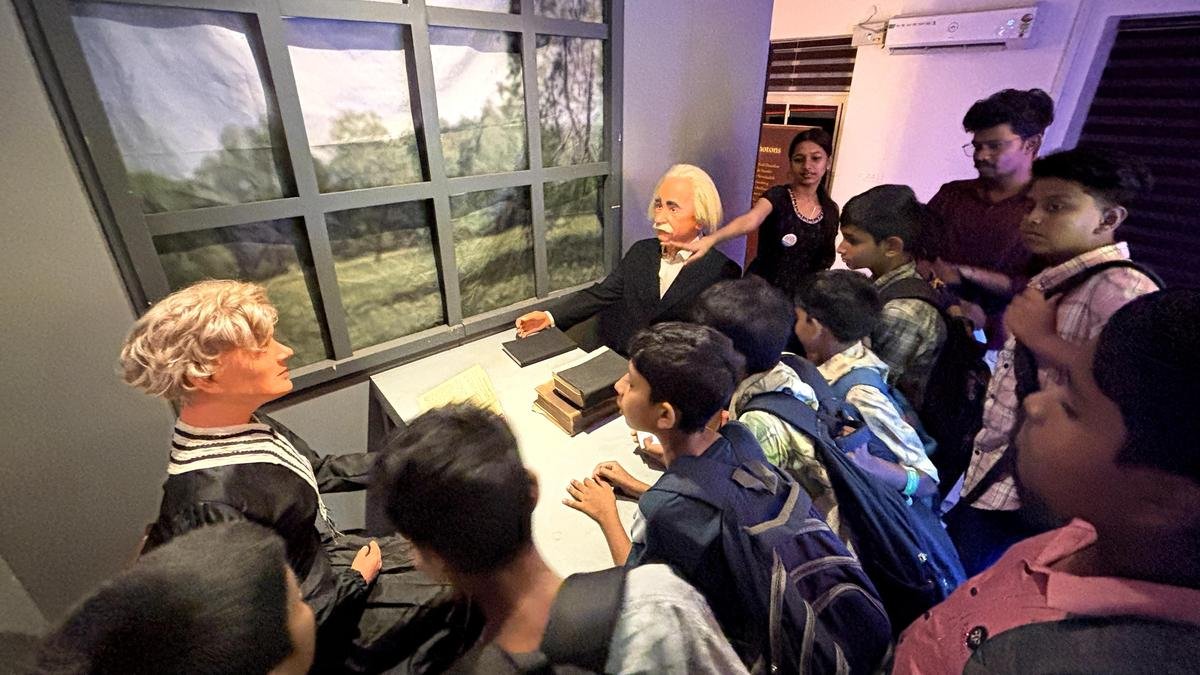
Science can be fascinating if you approach it the right way. Here, children listen carefully as a volunteer explains at the Quantum century exhibition at the Government College for Women in Thiruvananthapuram.
| Photo Credit: NIRMAL HARINDRAN
The scientific method is a mathematical and experimental technique that is used in sciences to build a hypothesis and testing it. You knew that, didn’t you? The goal of discovering cause and effect is central to the scientific method, and it is achieved through a flexible, iterative cycle rather than a rigid, linear set of rules. The core components of the scientific method are:
Click on the image to see a larger version, full screen.
| Photo Credit:
Text: A.S.Ganesh, Graphic: Prabhakaran. G
Now that you know how the scientific method works, here’s your chance to delve deeper on the subject through a medium of your choice. We’ve got a selection of two podcasts, one documentary, one book and one movie for you to choose from. Pick one or pick them all and find out how these different mediums have explored the same topic.
Podcasts:
Curious Cases – A BBC Radio 4 science programme, Curious Cases looks to answer a question sent in by a listener by harnessing “the power of science”. Launched in 2016, the podcast is a blend of scientific inquiry and wit, with the hosts taking on both complex themes and everyday curiosities. Initially featuring British mathematician, author, and broadcaster Hannah Fry alongside British geneticist and science communicator Adam Rutherford, the show has transitioned from the 22nd season onwards, replacing Rutherford with Irish comedian Dara O Briain. Having completed the 24th series as of 2025, the podcast has over 160 episodes across various scientific subjects.
The Skeptics’ Guide to the Universe– If you are a bookworm, you probably already know where this podcast gets its name from, don’t you? Named after The Hitchhiker’s Guide to the Galaxy — a comedy science fiction franchise created by English author Douglas Adams — this weekly sceptical podcast from the U.S. is hosted by American clinical neurologist Steven Novella. Originally launched in 2005, this podcast has over 1,000 episodes on a wide range of scientific topics. In addition to discussing recent developments in the world of science, this podcast interviews authors and people in the area of science, explaining everything in a simple way with the scientific point of view at the core. The show has won awards both in the categories of science and education.
Movie
Primer – This 2004 movie directed by Shane Carruth might belong to the genre of science fiction, but it is well known for its realistic portrayal of the scientific method. Two engineers, Aaron and Abe, try to develop a device that reduces the “apparent mass” of objects, only to accidentally stumble upon time travel. The film accurately shows the experimental phase and the accidental discovery, before moving on to prototyping, iterations and the consequences that follow. As opposed to focussing just on the grand outcome, the movie meticulously focuses on the technical, slow, maybe even boring process, of discovery.
Documentary
Geniusby Stephen Hawking – A television documentary series hosted by English theoretical astrophysicist and cosmologist Stephen Hawking, Genius had six episodes that was originally aired over just three weeks in May-June 2016. What with Hawking dying in 2018, only one season was produced and aired on PBS. The six episodes that were made, however, saw complex scientific concepts made accessible to the public at large.
Questions like What, Why, Where, are We (as in humanity), along with questions like Are We Alone and Can We Time Travel were posed in front of ordinary people, who were guided, along with the viewers, to use the scientific method by Hawking and think like history’s greatest geniuses. The show was designed to inspire and educate, while highlighting the power of the human mind and the importance of embracing the scientific method to push the boundaries of human knowledge.
Book
The Joy of Scienceby Jim Al-Khalili – An Iraqi-British theoretical physicist, Jim Al-Khalili is a science populariser and communicator. A regular contributor to the Curious Cases podcast that we’ve mentioned earlier, he’s written a number of books on scientific subjects. The Joy of Science is his book from 2022 which has the scientific method at its core. As opposed to giving it a treatment wherein the method can be used in different fields of science, Al-Khalili instead turns the book into a eight-lesson guide on using the scientific method as a framework to navigate life as we know it today. He highlights it as a valuable tool in the arsenal to make sense of an increasingly complex world. Al-Khalili’s book is a call to adopt curiosity and intellectual humility at the same time, and one that sees the scientific method as a way of life.
This article appeared in The Hindu in School on Sunday as part of its National Science Day special. Click here to subscribe to this product.
Published – February 28, 2026 07:20 am IST


