



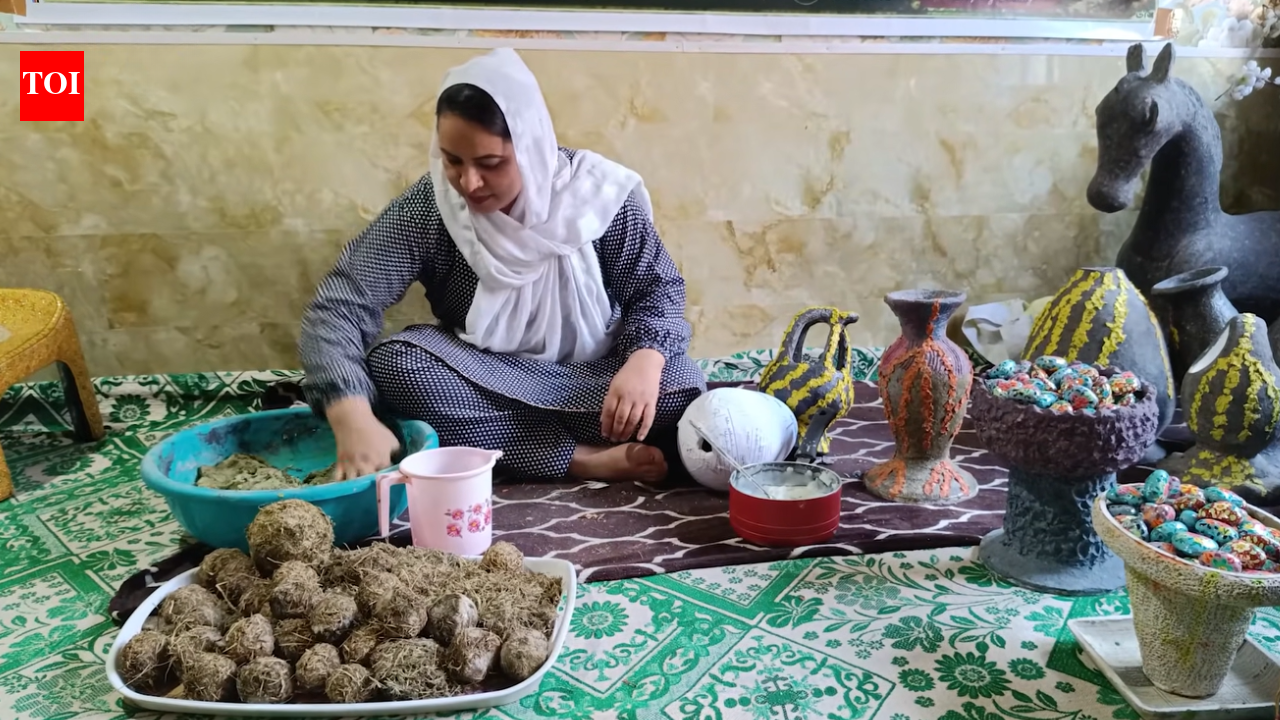
For years, the weeds and vegetation removed from Dal Lake were simply something to be cleared away. For Srinagar artisan Simran Irshad, however, they became a possible answer to two problems at once – the growing cost of paper used in papier-mâché and the need to find new livelihoods for women.Irshad, 35, has developed a technique she calls “Grass Mâché”, in which dried aquatic vegetation is processed into pulp and combined with recycled paper to make decorative objects.The idea did not come to her fully formed. It grew out of a concern about the future of the craft she had learned.“I was initially working with paper pulp,” Irshad told Kashmir Life. She began wondering what would happen if the availability of paper became a problem in the future. “That kept going around in my mind that my craft would eventually end.”
Srinagar artisan Simran Irshad turns discarded Dal Lake weeds into handmade products.
She began with papier-mâché, then questioned the material
Irshad, who is from Nowshera in Srinagar, had entered the traditional craft world despite resistance from a largely male artisan community. Irshad left school after Class 10 and eventually learned papier-mâché from artisan Mohammad Yousuf Najar.“I was repeatedly told that, as a woman, I belonged at home,” she recalled. She persisted and eventually found a mentor who taught her the craft.But traditional papier-mâché depended heavily on paper pulp, and rising costs pushed her to look for an alternative. Her question was simple: could something locally available, inexpensive and otherwise treated as waste become part of the craft?That led her to the vegetation regularly removed from Dal Lake.Irshad experimented with different vegetation before finding that the lake weeds worked particularly well because of their moisture content. She collects the material, dries and processes it, then combines the pulverised weeds with recycled paper pulp and a binding agent.“For the past 100 years this craft has been done this way, using only paper,” she told AFP.Then came the question that shaped her experiment: “Why not use something that can increase production, make it durable and also make it cheaper?”
Irshad processes aquatic weeds into pulp to create an alternative to paper-based papier-mâché.
Nearly two years of trial and error
The transformation of lake weeds into a workable craft material was not immediate.Irshad spent nearly two years developing the process. The discarded vegetation had to be processed into pulp before it could be moulded into objects. She experimented, failed, adjusted the process and eventually found a way to make the material usable.The resulting pieces retain the basic idea of handmade papier-mâché while introducing a material that comes from the local environment. Irshad has a particularly different way of looking at what others regard as waste.“Paper comes from trees, trees are cut down to make paper,” she told AFP. “What I am removing from the lake is like a treasure given to me by God.”Her work therefore sits at the intersection of traditional craft and reuse. Instead of bringing all the raw material from outside, she is looking at something already being removed from a local water body.
Dal Lake weeds, once treated as waste, are being given a new life through traditional craft.
For her, cleaning Dal Lake is also about livelihood
Irshad’s connection with Dal Lake is not limited to sourcing material.In her conversation with Kashmir Life, she linked the health of the lake directly with Srinagar’s tourism economy. “The residents here depend on tourism,” she said.She believes the condition of Dal Lake matters not only because it is an important part of Kashmir’s landscape, but because tourists come to see it.“If the Dal is clean, tourism will flourish,” she said.That thought also influenced how she viewed the weeds being removed from the lake. Instead of seeing them merely as waste that needed to be discarded, she began thinking about whether they could be converted into something useful.Her finished products include decorative objects and handmade pieces that give the discarded vegetation a second life.
Her ‘Grass Mâché’ initiative also aims to create livelihood opportunities for women.
The bigger idea: women earning from the craft
For Irshad, the experiment is not only about making a new kind of craft material.She wants other women to be able to earn from it. Irshad has been willing to train women and young people interested in learning the process. She has also expressed a desire to build a women-led craft platform around locally available discarded materials.The effort has already extended beyond her own workshop. AFP reported that she has trained around 50 women in making paper products, with 15 currently working on the weed-based craft.But scaling the idea is not easy.Irshad says that space and machinery are among the practical difficulties limiting production. Getting the products into larger markets is another challenge. While she has seen interest in the handmade pieces, she said the products had not yet fully entered the market.She is therefore looking towards government support and funding.“My business holds huge potential for employment generation,” she said, according to Kashmir Life. “I have always wanted to be at the front, particularly when it has been about women’s improvement.”
From an experiment to a possible industry
What makes Irshad’s idea unusual is that it does not attempt to replace Kashmir’s traditional craft with something entirely new. Instead, she is changing one part of the process – the material.The decorative language remains connected to Kashmir’s papier-mâché tradition, while the raw material is partly drawn from the vegetation removed from Dal Lake.And Irshad is clear that she does not want other women who join her to face the same long learning curve she did.“I don’t want their two years to go the way my two years went,” she said.For now, the idea remains a growing enterprise rather than a large-scale industry. But the proposition is straightforward: vegetation pulled out of one of Kashmir’s most recognisable water bodies can become raw material for a centuries-old craft – and that craft, in turn, can become a source of income for women.In Irshad’s hands, what was once removed from Dal Lake as waste is being given another possibility: not to be thrown away, but to be shaped, painted and sold as something new.
