



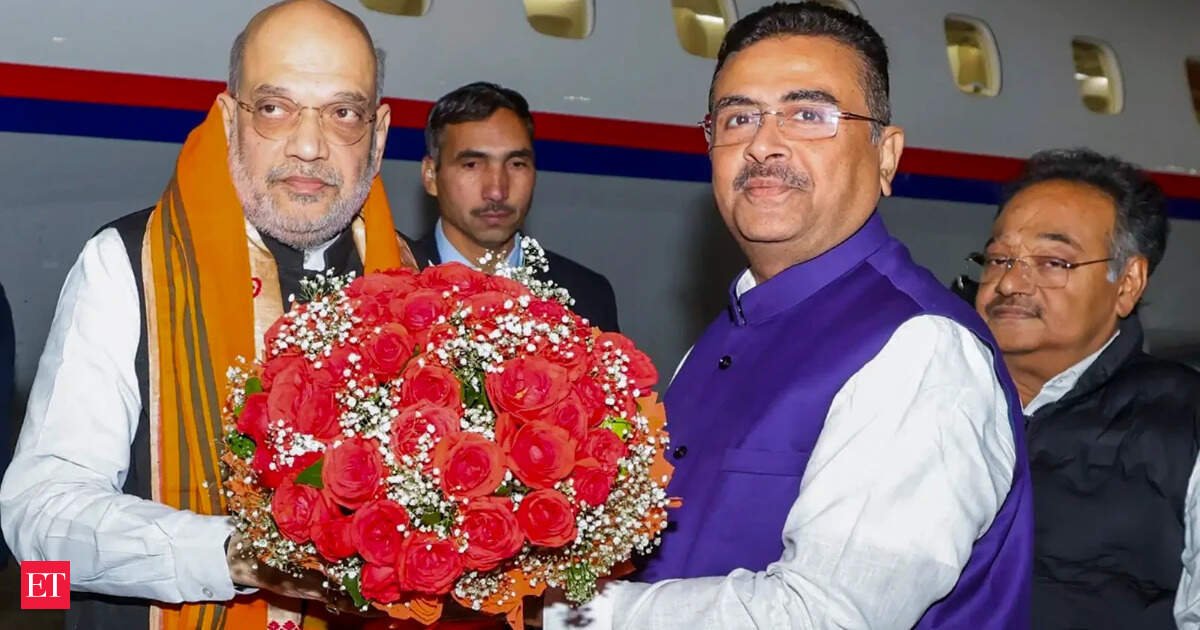
After much anticipation, the decision was reached after a high-stakes party meeting overseen by Central observers Union Home Minister Amit Shah and Odisha CM Mohan Charan Majhi in Kolkata.
Also Read | Suvendu Adhikari aide murder probe intensifies; CID takes over, no arrests yet
The swearing-in ceremony is scheduled for May 9, a date chosen for its deep cultural resonance—Pochishe Boishakh, the 165th birth anniversary of ‘Kobiguru’ Rabindranath Tagore.
The event will take place at the iconic Brigade Parade Grounds in Kolkata at 10 am with a star-studded attendance, from Prime Minister Narendra Modi to the chief ministers from 20 BJP-ruled states.
For most, the decision does not come as a surprise.
Adhikari’s ascent to the top post in the saffron party was cemented by his “Giant Killer” performance in the 2026 polls.He achieved a historic double victory, successfully defending his home turf of Nandigram while simultaneously unseating incumbent CM Mamata Banerjee in her home bastion of Bhabanipur.
Also Read | New Delhi asks Bengal to fast track central schemes after Mamata exit
In a result that sent shockwaves through the political landscape, Adhikari defeated the Chief Minister by a margin of a bit over 15,000 votes.
From a political perspective, the significance of this victory cannot be overstated.
By defeating the face of the TMC in her own bastion, Adhikari not only established his personal mandate but also effectively decapitated the leadership structure of the opposition.
As a former TMC heavyweight himself, who defected to the BJP in late 2020, Adhikari brought with him deep knowledge of the TMC’s grassroots machinery.
Over the last five years, he transformed from a “defector” to the undisputed face of the Bengal BJP, serving as the Leader of the Opposition with a ferocity that consistently kept Mamata Banerjee’s ruling party on its toes.
Other prominent faces
While Adhikari was the frontrunner, the BJP Bengal had several other key figures who were also likely in the fray.
Currently the BJP State President, Samik Bhattacharya was a strong candidate.
Recognised for his sophisticated communication style and intellectual roots, he is seen as a leader who would resonate with the urban Bhadralok, bridging traditional Bengali values with the saffron party’s vision for growth.
Moreover, his tenure as a long-standing spokesperson established Bhattacharya as a composed and steadying presence, making him a favoured choice.
Another candidate likely in the mix was the former state president and current MoS, Sukanta Majumdar, who represented the ideological core of the party.
With his background as a professor and a long-standing RSS member, his ideology was more in-tune with that of the Sangh Parivar. Majumdar was seen as a leader who could ensure that the BJP’s governance remains rooted in its core values while maintaining a “clean image,” free from the baggage of past political associations.
The MLA from Asansol Dakshin, Agnimitra Paul, emerged as another significant contender to signal a massive shift in the state’s gender-political landscape.
Given the BJP’s heavy campaign focus on “Nari Shakti” and women’s safety, especially following the controversies in Sandeshkhali, Paul provided a fresh, representative face for the party.
Her background as a successful fashion designer turned firebrand politician gave her a unique appeal across both urban and rural demographics.
Another foundational figure in the BJP’s Bengal rise is Dilip Ghosh, who won victory in Kharagpur Sadar by a margin of over 30,000 votes.
As the former state president and a former Member of Parliament from Medinipur, Ghosh is widely credited with building the party’s organisational base from the ground up.
His Narendra Modi-style “Chai Pe Charcha” campaigns and his roots as an RSS Pracharak have made him a massive crowd-puller among the grassroots.
Breaking the 15-year TMC hegemony
The 2026 results have effectively rewritten the political history of West Bengal.
For 15 years, Mamata Banerjee’s Trinamool Congress maintained an iron grip on the state, surviving major challenges in 2016 and 2021.
However, the BJP successfully flipped the narrative this year.
The saffron party finished with a resounding 207 seats in the 294-member assembly, while the TMC was reduced to just 80 seats.
This is the first time since 1972 that West Bengal will be governed by the same party that holds power at the Centre, ending what many described as a “state of permanent friction.”
A landslide beyond logic
The scale of the victory caught even the most seasoned pollsters off guard.
Most Exit Polls had predicted a “dead heat” or a slim majority for the BJP, ranging between 145–160 seats. Many analysts suggested that the TMC’s extensive welfare schemes, such as Lakshmir Bhandar, would act as a safety net against anti-incumbency.
However, the actual results showcased a massive shift.
The BJP didn’t just win; it swept the North Bengal districts and made unprecedented inroads into the TMC’s South Bengal heartlands, particularly in the Medinipur and Hooghly belts.
The record voter turnout of 92.47%, the highest since Independence, indicated a “silent wave” of voters who were seeking a complete systemic change rather than simple reforms.


