



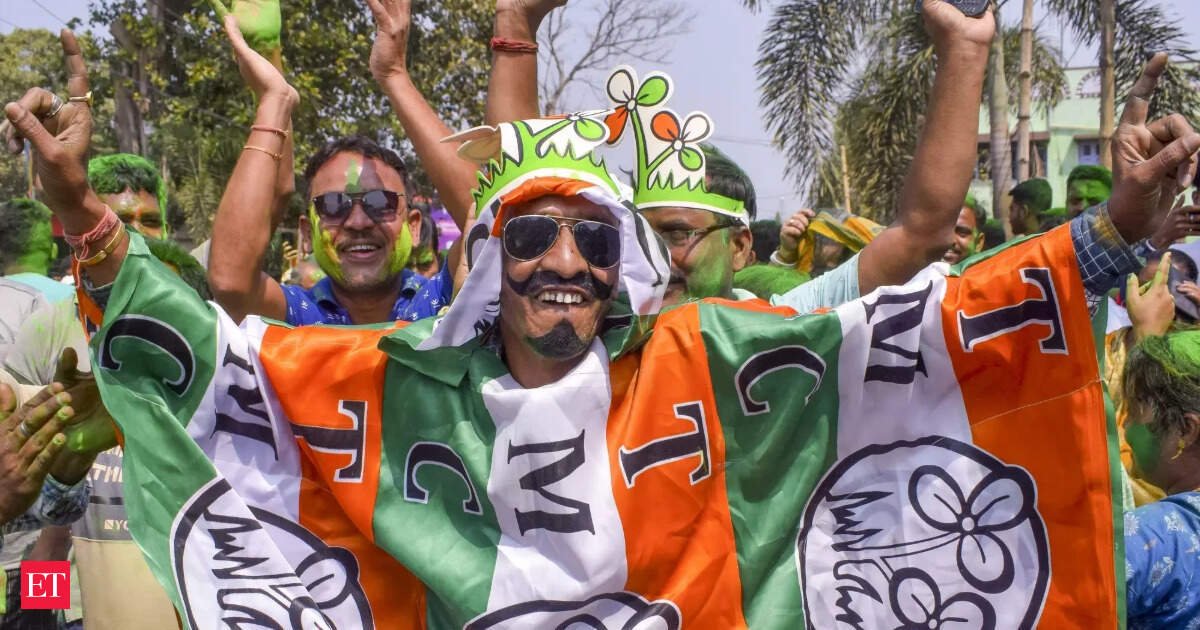
The stakes are unusually high for the party, which has governed the state since 2011 and now faces an assertive BJP challenge, turning the election into a battle over welfare politics, unemployment and identity mobilisation.
Also Read: West Bengal Assembly Elections: TMC drops 75 MLAs, hopes to win 226 seats
At the heart of the TMC’s campaign remains its welfare-driven governance model, which has helped the party build a vast beneficiary base. Programmes such as ‘Lakshmir Bhandar’, ‘Kanyashree’ and ‘Swasthya Sathi’ have significantly strengthened the party’s connection with women, rural voters and economically weaker sections.
The party has also sharpened its emphasis on Bengali cultural identity, positioning itself as the custodian of the state’s linguistic and regional ethos.
From invoking the slogan of “Bangla Nijer Meyekei Chay” in previous elections to foregrounding issues of federal autonomy, attack on Bengali migrants in other states and regional pride, the TMC has increasingly framed the political contest as one between Bengal’s cultural identity and the BJP’s “outsider-driven” politics.
Senior TMC leader Jaiprakash Majumdar said the party’s electoral strength has grown steadily over successive polls, reflecting the impact of its welfare programmes and grassroots governance model.”In three terms, our vote share and representation have expanded because people have seen the benefits of these schemes in their daily lives,” he said, adding that welfare delivery has remained the cornerstone of the TMC’s outreach.
Yet, welfare politics alone does not define the electoral battle.
After 15 years in power, the TMC must also contend with anti-incumbency. Discontent over local governance, allegations of corruption and factional rivalries within district units have periodically surfaced, providing ammunition to the opposition.
It is partly to address these pressures that the TMC has undertaken one of its largest candidate reshuffles.
In one of the most significant changes in its electoral strategy, the TMC dropped 74 sitting MLAs, nearly a third of its legislative strength, while announcing candidates for 291 of the 294 seats.
The candidate list reflects what party insiders describe as a strategy of “controlled churn”, balancing generational change with organisational continuity as the TMC attempts to counter accumulated anti-incumbency while confronting an aggressive campaign by the BJP.
Political analysts say the approach reflects a careful attempt to refresh the party’s image without disrupting the organisational network that has long underpinned its electoral success.
“The TMC’s organisational depth is still its biggest advantage. The party’s booth-level machinery and welfare delivery system together create a powerful ecosystem,” said a political analyst.
TMC MP Sougata Roy said the party’s greatest asset remains its grassroots structure. “The TMC fights elections on the strength of its organisation,” he said, adding that Mamata Banerjee’s popularity remains intact among social groups.
Bengal’s political landscape has changed dramatically since the BJP’s rise in the state after 2019, bringing communal polarisation into sharper focus. The party has consistently sought to consolidate Hindu voters by attacking the TMC over alleged minority appeasement.
In response, the TMC appears to be recalibrating its messaging by blending welfare politics with a stronger emphasis on Bengali identity.
Observers say this strategy attempts to balance minority consolidation with outreach to Bengali Hindu voters, framing the election as a contest over regional pride and political autonomy.
Another factor in the 2026 polls is the Special Intensive Revision of electoral rolls, which has triggered a political controversy, as it witnessed large-scale deletions and ‘under adjudication’ voters. The TMC has alleged that deletions could disenfranchise sections of voters, particularly in districts where it has traditionally enjoyed strong support.
Majumdar said, “When people feel that their democratic rights may be affected, that concern can overshadow other political issues.”
Political observers note that the controversy could reshape voter mobilisation patterns in several districts where electoral margins have historically been narrow.
The election also inevitably evokes comparisons with the 2021 assembly polls, when the BJP mounted a challenge in Bengal with the full weight of its national leadership campaigning. Despite a high-voltage campaign and a wave of defections from the TMC ahead of the polls, Banerjee had secured a decisive victory.
The TMC won more than 215 seats, halting the BJP’s expansion and cementing Banerjee’s reputation as one of the few regional leaders capable of defeating the saffron party.
This election, the cumulative effects of incumbency, an entrenched BJP challenge and the controversy surrounding voter roll revisions have introduced new uncertainties into the contest.
Whether the party’s blend of welfare politics, organisational renewal and identity messaging can outweigh anti-incumbency will determine if the TMC secures a historic fourth straight term in Bengal.


