



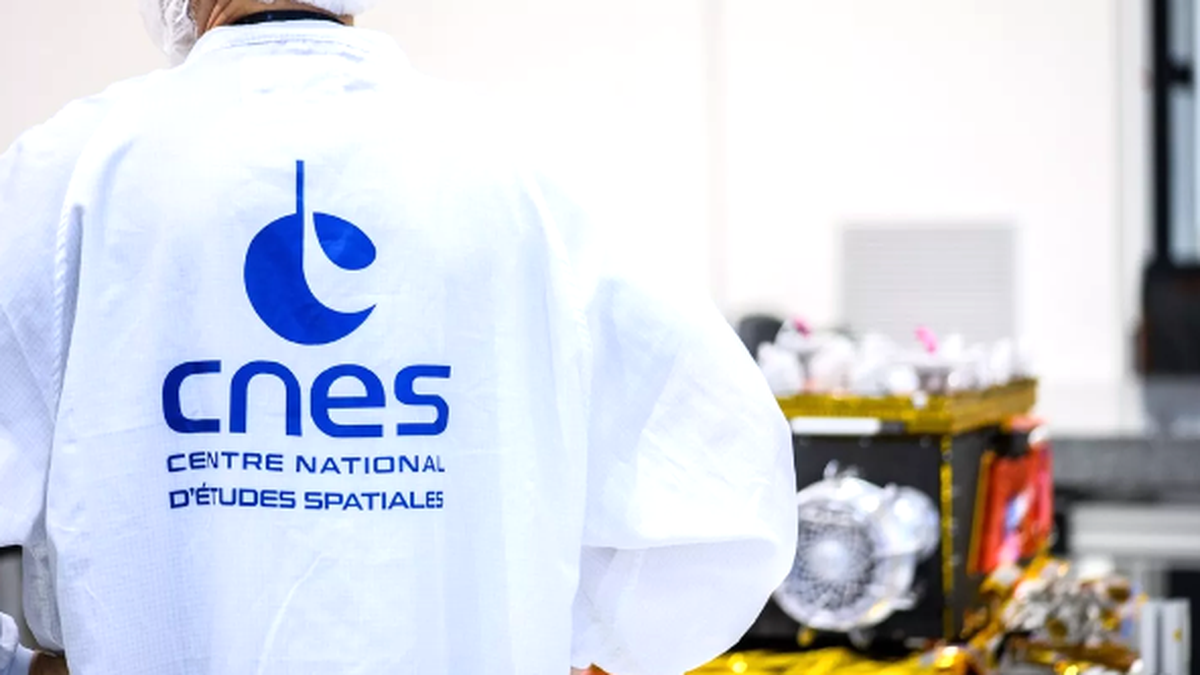
The PSLV is scheduled to launch the Indo-French TRISHNA (Thermal Infra-Red Imaging Satellite for High-resolution Natural Resource Assessment) mission next year which is a collaborative endeavor between ISRO and CNES. Photo credit: cnes.fr/en
The French space agency Centre National d’Etudes Spatiales (CNES) said that it is not perturbed with the back-to-back failures of Indian Space Research Organisation’s (ISRO)’s workhorse rocket, the Polar Satellite Launch Vehicle (PSLV), and has complete trust in its Indian partner.
The PSLV is scheduled to launch the Indo-French TRISHNA (Thermal Infra-Red Imaging Satellite for High-resolution Natural Resource Assessment) mission next year which is a collaborative endeavor between ISRO and CNES.
“There is always a risk with launches and we know the risks. You must trust your partners and trust is very important in space cooperation because we do difficult things together and to do difficult things you trust each other. ISRO is a huge space player in the world, they know what to do. So we trust them for the launch and the satellite also,” Lionel Suchet, Chief Operating Officer, CNES told The Hindu.
The PSLV had suffered two setbacks. On January 12, 2026, the PSLV-C62 mission carrying the EOS-N1 earth observation satellite failed to finish its intended trajectory after an anomaly was detected during the end of the third stage of the launch vehicle. On May 18, 2025, while ISRO attempted to launch the EOS-09 satellite aboard the PSLV-C61 mission, it couldn’t complete it. It was also due to an anomaly in the third stage of the rocket.
“Setbacks sometimes happen with vehicles and we are not responsible for the launch but we trust our Indian partners ISRO in particular to launch the mission with the vehicle (PSLV),” said Christophe Venet, Director of Europe and International Affairs, CNES.
ISRO and CNES are jointly developing TRISHNA which is engineered to deliver high spatial and high temporal resolution monitoring of earth’s surface temperature, emissivity, and biophysical and radiation variables for surface energy budgeting at regional to global scale.
According to ISRO, this mission addresses critical water and food security challenges, focusing on the impacts of human-induced climate change and efficient water resource management through evapotranspiration monitoring.
The satellite will have two primary payloads, the Thermal Infra-Red (TIR) payload, developed by CNES and the Visible – Near Infra-Red – Short Wave Infra-Red (VNIR-SWIR) payload, developed by ISRO.
“The mission will be launched next year and the French instruments have been delivered to India. They are currently being integrated, we are having regular technical exchanges with our colleagues at ISRO and everything is looking pretty fine as of now,” Mr. Venet said.
(The reporter is in Paris at the invitation of France’s Ministry for Europe and Foreign Affairs to cover the International Space Summit)
Published – September 08, 2026 06:30 am IST
