



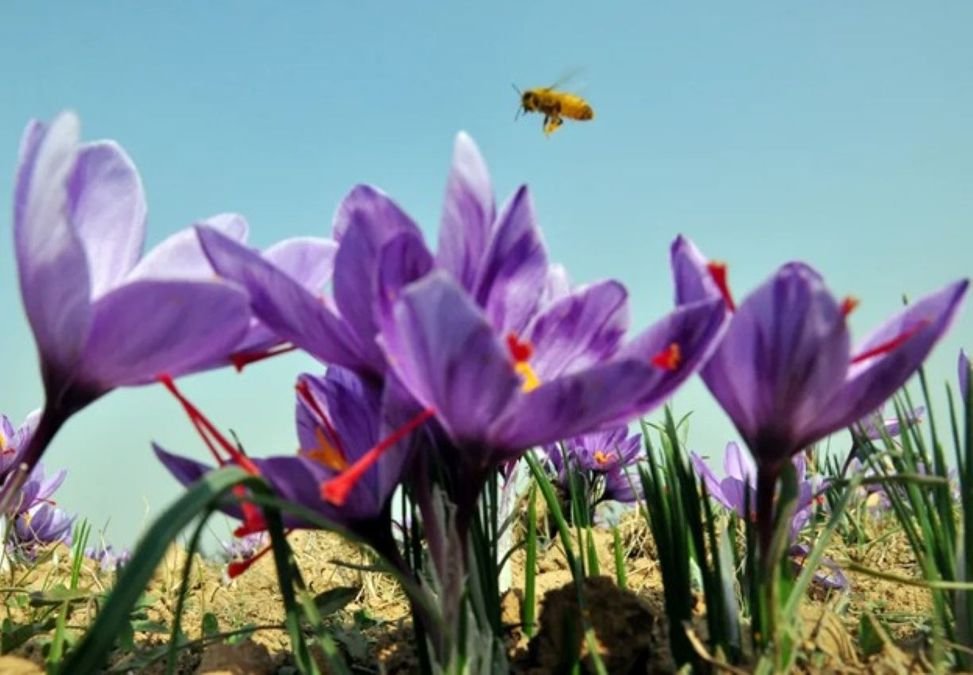
Srinagar, Oct 13: Saffron-growing land in Pampore is being used for high-density fruit plantations as changing weather patterns, inadequate rainfall and the lack of assured irrigation make the traditional crop increasingly difficult to sustain, growers have said, raising concerns over the future of Kashmir’s prized saffron cultivation.
Growers said the continued dry spell and declining production have discouraged many farmers from investing in saffron, with some turning to high-density plantation (HDP) as an alternative. They warned that the gradual shift could affect the region’s traditional saffron-growing landscape and the livelihoods of families dependent on the crop.
Cultivated in the Karewa highlands of Pampore and adjoining areas of south Kashmir, saffron is one of the region’s most important cash crops and a source of livelihood for thousands of families. Its cultivation depends heavily on favourable weather conditions, particularly adequate moisture at crucial stages of the crop cycle.
Abdul Majeed Wani, president of the All Jammu and Kashmir Saffron Growers Association told Rising Kashmir that the diversion of saffron land towards high-density fruit plantations had become a major concern for growers.
“Many people have started opting for high-density plantations, and saffron land is being used for fruit cultivation. With inadequate rainfall and declining production, growers are gradually losing interest in saffron cultivation,” Wani said.
He said the government had promised irrigation facilities for saffron-growing areas, but the assurance had not translated into adequate relief for farmers despite the passage of years.
According to Wani, the absence of an affordable and reliable irrigation system has left growers struggling to provide water to their fields, particularly during prolonged dry spells.
“A grower cannot afford to spend Rs 5,000 a day on diesel to run a generator and motor to lift water and supply it to the fields,” he said.
He added that, in the absence of adequate government support, some growers had installed small borewells at their own expense to meet their irrigation requirements.
Wani said the rainfall received so far was insufficient to ensure a good saffron crop and expressed apprehension that production could decline again this year.
The concerns come amid the broader challenge of sustaining saffron cultivation in Kashmir, where growers face weather-related uncertainties and the high cost of maintaining fields. Unlike fruit plantations, which can offer farmers an alternative source of income, saffron cultivation requires suitable soil and weather conditions and timely moisture for successful flowering and corm development.
Growers said improving irrigation infrastructure and providing affordable water access were essential to prevent more saffron land from being diverted to other uses. They stressed that timely intervention was needed to protect the traditional crop and sustain the livelihoods linked to it.
However, Director Agriculture Kashmir Sartaj Ahmad Shah acknowledged the issue, saying that saffron cultivation currently remains heavily dependent on rainfall. “At present, farmers depend on rainfall for saffron production. However, we are also working to provide proper irrigation facilities to farmers,” he told Rising Kashmir.
