



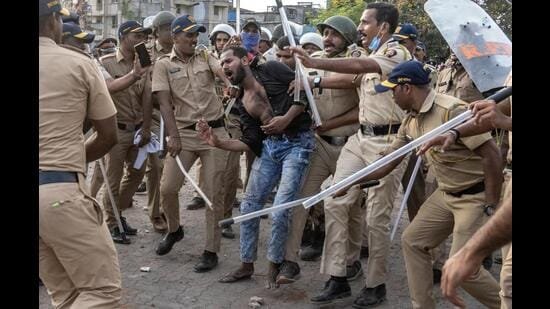
June 26 is International Torture Survivors Day. But P Jayaraj and, his son, J Bennix did not survive. Five years ago this month, they died from torture in police custody. Since then, others have too.


Jayaraj and Bennix were aged 59 and 31. They ran a small mobile accessories shop in Sathankulam, in Tamil Nadu’s Thoothukudi district. On June 19, 2020, during the Covid-19 lockdown, police picked them up on the pretext that they had kept the shop open a little beyond permissible hours. Three days later, both were dead.
The postmortem report documents the savagery at the police station: Batons were shoved into their anuses; the father was kicked repeatedly in the chest with heavy shoes; the flesh on their buttocks was entirely peeled off; their toes were broken and they had nail marks all across their bodies.
Outside the station, a small crowd pleaded for their release. Inside, the officer in charge chided his men whenever the father and son’s cries subsided, and threatened a constable who begged him to stop. On June 22, 2020, Bennix died at the Kovilpatti Government Hospital, from heavy internal bleeding. A few hours later, Jayaraj died from a punctured lung, and perhaps from grief.
Were it not for the testimony of head constable R Revathi, the nine Sathankulam officers who tortured Jayaraj and Bennix might never have faced justice. Terrified but steadfast, her testimony set in motion a slow trek to justice. It took six years, a CBI inquiry, a brave policewoman, and a determined judicial magistrate to push through an atmosphere of defiant non-cooperation, intimidation, and insubordination from a police network convinced nothing could — or should — touch them. So hostile was the environment that the entire family, Selvarani, Jayaraj’s wife and Bennix’s mother, and Bennix’s sisters were forced to leave Sathankulam.
Finally, in April this year, a special CBI court in Madurai found all nine police personnel guilty. Described as a “rarest of rare” case, Judge G Muthukumaran sentenced them to death. It is the first such ruling in India for custodial killing.
The death sentence settles nothing, but it may go some way to assuage the family’s wounded hearts. Elsewhere, nine other families — those of the convicted — will now live through their own version of that anxiety, agony, and sorrow, as the theatre of justice unfolds through inevitable rounds of appeal. In the narrow, institutional sense, “justice has been done.” But not yet fully. Many of the supporting actors remain untouched.
The record shows that Dr N Vinila, medical officer at Sathankulam Government Hospital who had the legal duty to record each injury she saw, despite more than 20 visible signs of severe wounds, declared father and son fit for remand.
By his own testimony, magistrate D Saravanan, who is required by law to physically examine any person produced before him for remand and satisfy himself that they had not been subjected to any kind of police violence, admitted that he had glanced at father and son from 15 feet away and granted remand based on the medical report.
The pair were taken away. The jailors at Kovilpatti sub-jail took them in but without getting the mandatory medical screening done. Instead, for two days, they watched the two die slowly before their eyes.
Doctor, magistrate and jailor have each faced little consequence. The survivor family though are sentenced to spend the rest of their lives haunted by the question: Why did those who could have saved them refuse to do their duty?
“Torture”, like “abuse” and “custodial violence”, is a polite-society word that obscures the horror we want to hide from. The annals of law enforcement record its bewildering ferocity. Only recently in one single case, a shocked Supreme Court recorded amputated genitalia, private parts sprinkled with pepper, electric shocks until bones got fractured.
These are not isolated instances. Distinct from custodial deaths, the recurring nature of custodial violence is significant enough to warrant its sub-section in the National Human Rights Commission’s annual reports.
The Status of Policing in India Report 2025 — a survey of over 8,000 police personnel across 17 states — finds that a significant proportion of personnel justify the use of violence in their work, and believe they should be free to use force without fear of punishment.
Beatings are so common in the lexicon of police investigative technique as to be unremarkable. From there it is a slippery slope to severity, denial, and protection — a manifestation of unbridled power and near certainty that there will be little consequence. Between 2017 and 2022, of over 300 judicial inquiries into custodial deaths, about a third led to arrests, less than 80 to chargesheets, and not a single one to conviction.
At the level of international law, India has signed the UN Convention against Torture (UNCAT). This requires States to criminalise torture as a distinct offence, review practice and enhance training. India signed in 1997 but has never ratified it, holding that domestic legislation must come first.
That has been waiting for 25 years. In 2010, the Prevention of Torture Bill 2010 passed the Lok Sabha, went on to the Rajya Sabha, was referred to a Select Committee, and lapsed with the dissolution of Parliament in 2014. In 2017, the Law Commission again recommended a standalone law; the NHRC championed the idea for a while, with now-diminished vigour.
Presently, allegations of torture are prosecuted — if at all they surface — under provisions for murder, hurt, wrongful confinement, or custodial death. Recent police acts and amendments to criminal procedure have avoided an explicit prohibition against torture. The closest any Indian law comes is Section 96 of the Kerala Police Act, which merely obliges an officer to report torture he witnesses — a moral duty, not an enforceable one.
So today, we have the promise and the principle, but not yet the policy or the practice. In 2017, at India’s Universal Periodic Review before the UN Human Rights Council, the attorney general declared that the concept of torture was “completely alien to our culture” and had “no place in the governance of this nation”. He may be right: If you refuse to name something, and refuse to see it, it ceases to officially exist.
Maja Daruwala is an independent legal consultant. The views expressed are personal


