



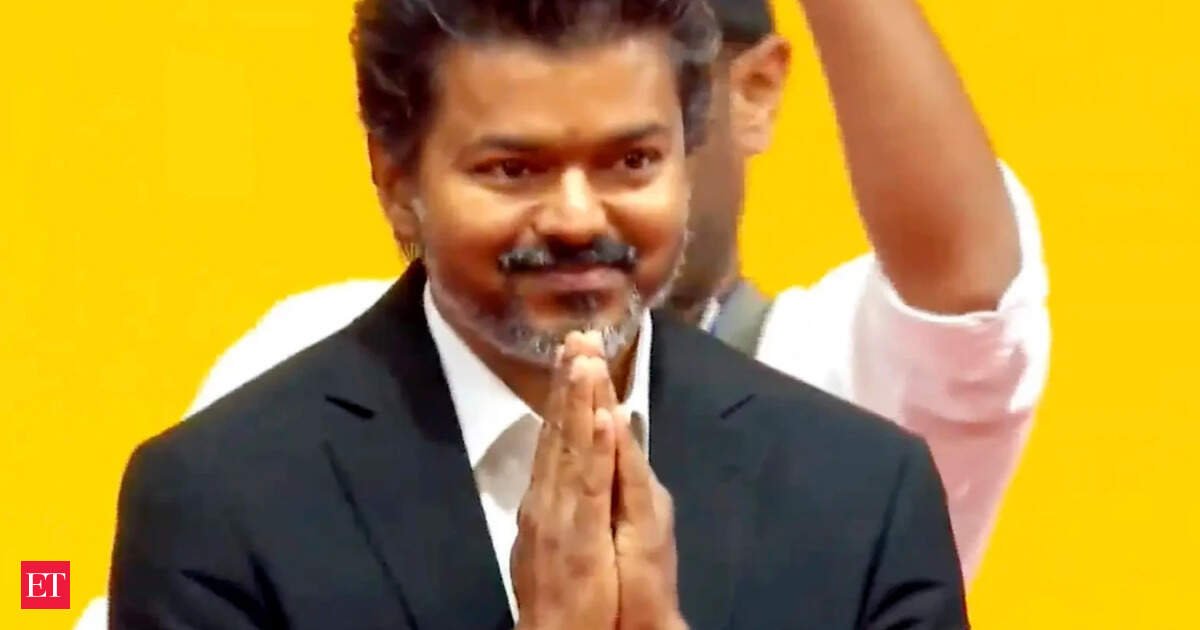
The roar that left the cinema hall
By the time Vijay walked onto the stage at his party launch in October 2024, the crowd was already roaring like it was the opening day of a blockbuster film. Flags waved wildly. Firecrackers burst in the background. Thousands lifted their phones into the air just to catch a glimpse of him.
Only this time, the man they had come to watch was not arriving as a superstar. He was arriving as a politician.
Also Read: TVK Vijay ‘Thalapathy’ takes oath as Chief Minister of Tamil Nadu, along with 9 ministers
Less than two years later, Joseph Vijay Chandrasekhar — known to millions simply as “Thalapathy” Vijay — is set to take oath as the Chief Minister of Tamil Nadu after his Tamilaga Vettri Kazhagam (TVK) stunned the state by winning 108 of the 234 Assembly seats in its electoral debut.
Most politicians spend years learning how to lose before they learn how to win. Not Vijay.
TVK refused to align with either of Tamil Nadu’s Dravidian giants — the DMK or the AIADMK — a gamble many believed would destroy the party before it even began. Exit polls largely predicted an advantage for the incumbent DMK, though Axis My India hinted at a political upset, projecting that Vijay could emerge as the “next MGR.”
Today, that comparison no longer feels exaggerated.
From ‘Ilaya Thalapathy’ to Tamil Nadu’s newest power centre
For decades, Tamil Nadu has remained uniquely open to cinema-born politics. MG Ramachandran transformed fan worship into political legitimacy and became the state’s most iconic actor-chief minister. Jayalalithaa followed. Vijayakanth tried to recreate that model.
Now Vijay has entered that lineage — but with a distinctly modern formula built on branding, emotional accessibility, and years of carefully cultivated symbolism.
In his 2010 film Sura, Vijay delivered a line that now sounds almost prophetic: “I have honesty and courage in my heart. Above all, I have a crowd willing to give their lives for me.”
Theatres erupted then. Today, that roar has travelled far beyond cinema halls and into electoral politics.
The making of a mass hero
Born on June 22, 1974, in Chennai to filmmaker S A Chandrasekhar and playback singer Shoba Chandrasekhar, Vijay grew up around cinema. He debuted as a child artist in Vetri in 1984 and later became a lead actor with Naalaiya Theerpu in 1992.
Success did not arrive instantly.
Several of his early films underperformed, and critics often dismissed him as awkward and lacking screen presence. But persistence slowly transformed him into one of Tamil cinema’s most dependable stars. Films like Poove Unakkaga, Kushi, Ghilli, Thuppakki, Kaththi, Mersal, Master, Leo and The Greatest of All Time cemented his superstardom.
But Vijay’s biggest achievement was not merely box-office success. It was the image he built around himself.
When fans stopped seeing him as just an actor
Over the years, Vijay stopped being viewed as just an actor. He became “anna” — elder brother, protector, leader, saviour. Fans did not simply admire him; they emotionally invested in him.
That image slowly became political capital.
Its earliest signs appeared in 2009 when Vijay unveiled a flag for his fan clubs carrying the slogan Unnal Mudiyum — “You can do it”. Many fans saw it as a subtle indication that his ambitions extended beyond cinema.
Then came Thalaivaa in 2013. The film’s tagline — “Time to Lead” — sparked controversy amid speculation that the then Jayalalithaa government was uncomfortable with its political undertones.
By then, audiences had already begun reading politics into Vijay’s films.
How Vijay spent decades rehearsing for politics
In retrospect, his political entry now appears less like a sudden plunge and more like a decades-long rehearsal.
His films repeatedly revolved around corruption, injustice, and the rise of a lone moral hero who protects ordinary people. Cinema trained audiences to see Vijay not just as an entertainer but as someone capable of intervention.
In 2021, Vijay cycled from his Chennai residence to a polling booth to cast his vote in the Assembly elections. Fans flooded the streets behind him, causing traffic disruptions.
His publicist denied any political messaging.
But symbolism rarely waits for confirmation.
Many interpreted the bicycle ride as a protest against rising fuel prices under the AIADMK government. More importantly, it felt relatable and anti-establishment — exactly the image Vijay had spent years building on screen.
‘Isn’t it selfish to think only I should live well?’
When Vijay formally launched TVK in 2024, he did not sound like a fiery ideologue.
He sounded like the hero of a Vijay film. “Isn’t it selfish to just think that only I should live well?” he asked a massive crowd at his first major political speech.
“Beyond a certain limit, what is one supposed to do with the money we earn? How am I going to repay the people who gave me life?”
The speech leaned heavily on emotion, sacrifice, and kinship.
Family grief, Anitha, and the emotional core of Vijay’s politics
Known to be fiercely private, Vijay made a rare reference to the death of his younger sister Vidhya, who died at the age of two in 1976.
He then drew a parallel with Anitha, the 17-year-old NEET aspirant whose suicide in 2017 triggered outrage across Tamil Nadu.
The framing was deliberate.
Vijay was not positioning himself as a policy intellectual or ideological crusader. He was presenting himself as a guardian figure — emotionally accessible, morally upright, personally invested.
Throughout the speech, he repeatedly referred to “my mothers, my sister, and my friends,” while promising to prioritise women’s safety and education.
What he did not do was equally striking. He offered little ideological clarity.
Instead, he relied almost entirely on emotional legitimacy — a formula Tamil Nadu has embraced before.
Why comparisons with MGR refuse to go away
No actor entering politics in the state can escape the shadow of MGR, whose on-screen morality seamlessly blended into political credibility. Like MGR, Vijay cultivated an image of generosity and righteousness. Like MGR, he understood that in Tamil Nadu, cinema is not merely entertainment.
It is political rehearsal. Political analysts often underestimated Vijay because they viewed him through traditional electoral metrics — caste arithmetic, alliances, ideological positioning.
But Vijay’s real machinery already existed.
Turning fan clubs into political machinery
Fan clubs. Volunteer networks. Neighbourhood organisers.
The infrastructure once used to celebrate movie releases quietly evolved into a political ecosystem.
What once guaranteed packed theatres now delivered crowds to rallies and votes to ballot boxes. That attempt has now reshaped Tamil Nadu politics.
Vijay’s timing also proved crucial.
The deaths of M Karunanidhi and J Jayalalithaa left Tamil Nadu without the towering personalities that had dominated politics for decades. Their successors inherited parties, but not necessarily the same emotional hold over voters.
That vacuum created space for Vijay.
And he entered it with the instincts of a performer and the calculation of a strategist.
By refusing alliances with the DMK and AIADMK, Vijay positioned TVK as a genuine alternative rather than an extension of the existing order.
For a generation of younger voters raised on Vijay films and disillusioned with traditional Dravidian binaries, that message resonated.
Beyond the cutouts and punch dialogues
The challenge before Vijay begins now. Tamil Nadu’s political culture may celebrate cinema stars, but governance eventually demands more than symbolism. Yet for now, Vijay’s rise represents something larger than an electoral victory.
It is the culmination of a cultural phenomenon decades in the making. For years, fans poured milk over Vijay’s giant cutouts outside theatres.
Today, they are celebrating outside counting centres. The location has changed.
The devotion has not. And perhaps that explains Vijay’s extraordinary political success better than any exit poll or electoral statistic.
He did not suddenly become a politician. He spent decades convincing millions that he already was one.


