






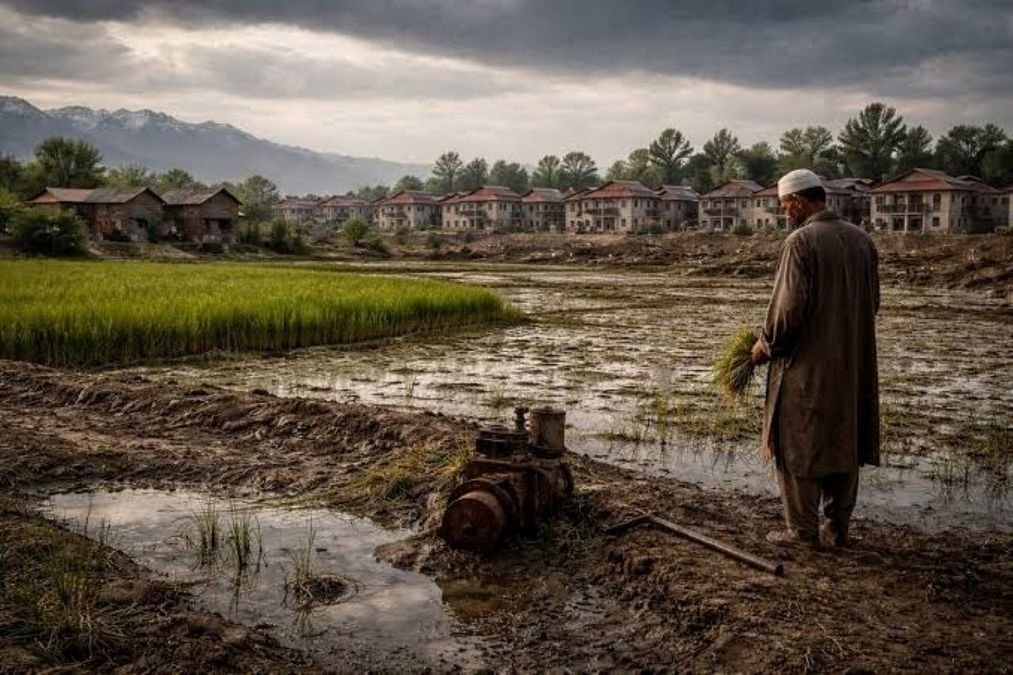
The disappearance of farmland in Kashmir is taking place quietly, almost routinely. A field is sold, divided, levelled and gradually covered with concrete. A new house rises where crops once grew. A commercial structure appears beside an orchard. A road cuts through agricultural land, and the loss is described as development. By the time the consequences become visible, another productive patch has already vanished.
This is not merely a change in land use. It is a transformation of Kashmir’s social, economic and ecological character. Farmlands are not empty spaces waiting for construction. They are sources of food, employment and rural stability. They absorb rainwater, support biodiversity, moderate local temperatures and preserve the open landscape that has long defined the Valley. When they disappear, society loses much more than a harvest.
Kashmir’s population is growing, and the need for housing, roads, schools, hospitals and commercial spaces is real. No serious policy can deny the importance of development. But development that consumes fertile land without planning is not progress. It is the transfer of today’s convenience to tomorrow’s crisis.
The most visible pressure comes from unplanned urban expansion. Towns are spreading into surrounding villages, often without a clear distinction between residential, commercial and agricultural zones. The areas closest to roads and urban centres are particularly vulnerable because landowners can obtain higher prices by selling plots than by cultivating them. Once one parcel is converted, neighbouring fields face similar pressure. Agriculture becomes fragmented, expensive and increasingly difficult to sustain.
For many families, selling farmland is not an easy or careless decision. Farming incomes are uncertain. Input costs have risen, labour is difficult to find, and markets do not always reward the effort invested in cultivation. A farmer may receive an attractive offer for land within weeks, while the income from crops may take months and remain vulnerable to weather, disease and price fluctuations. Without a dependable agricultural support system, selling land can appear to be the only practical choice.
This is where policy must look beyond the individual transaction. A landowner may have a right to seek financial security, but society has a collective interest in preserving productive farmland. Once converted, agricultural land is rarely restored. The decision may benefit one household in the short term while weakening the food system and rural economy for everyone.
The problem is particularly serious in the case of orchards. Fruit cultivation is not only an agricultural activity; it is a long-term investment involving trees, water, soil and generations of knowledge. When orchards are replaced by buildings, the loss cannot be measured merely by counting the trees cut down. It includes reduced production, lost employment, diminished biodiversity and the weakening of a sector that sustains thousands of families.
Kashmir’s farm economy already faces multiple pressures. Climate variability has affected flowering, fruit development and crop cycles. Unseasonal rain, hailstorms, drought-like conditions and changing temperatures create uncertainty for farmers. Water availability is becoming a concern in several areas. At the same time, many young people are moving away from agriculture because they see little dignity or financial security in it. The conversion of farmland adds another burden to a sector that is already under stress.
When farmland disappears, food security becomes more dependent on supplies from outside. Transport disruptions, extreme weather, market fluctuations or emergencies can expose the weakness of such dependence. A region that once produced a significant share of its food begins to rely increasingly on distant markets. Consumers then face higher prices, while farmers lose the opportunity to produce for local demand. The contradiction is stark: fertile land is lost even as food costs rise.
The ecological cost is equally important. Open fields and orchards allow rainwater to seep into the ground. Concrete surfaces accelerate runoff, increase waterlogging and place additional pressure on drainage systems. In areas already vulnerable to flooding, the conversion of natural absorption zones can worsen the impact of heavy rainfall. The removal of trees and vegetation also contributes to heat, dust and poorer air quality.
Unplanned construction changes the character of villages. Traditional settlement patterns, irrigation channels and common paths are disrupted. Buildings come up without adequate drainage, parking or waste-management arrangements. Agricultural roads are narrowed or blocked. Water sources are polluted by sewage and construction debris. A village loses the functions that made it liveable and becomes an overcrowded extension of the town.
The absence of effective land-use planning has allowed this process to continue. Regulations may exist, but weak enforcement, unclear records and fragmented authority create space for violations. Different departments often deal with roads, housing, agriculture, environment and revenue matters separately, without a shared vision for the landscape. A permission granted in one context can undermine the purpose of another policy.
There must be a clear and publicly available land-use map for the Valley. Agricultural land, orchards, wetlands, forests, water bodies, grazing areas and settlement zones should be identified and protected through enforceable plans. Such mapping should not remain a technical exercise confined to offices. Local communities, farmers, panchayats and urban planners must participate in deciding how land is used.
Protection, however, cannot mean imposing restrictions on farmers while offering them no support. Farmers must receive better returns, access to modern technology, reliable irrigation, storage facilities, crop insurance, affordable credit and stronger market links. If agriculture remains financially unattractive, legal restrictions alone will not prevent land conversion. A farmer who cannot earn a stable livelihood from the land will continue to face pressure to sell it.
The agricultural economy also needs diversification and value addition. Cold storage, grading, packaging and processing can reduce post-harvest losses and improve returns. Local products should be connected to larger markets without allowing intermediaries to capture most of the value. Young people can be encouraged to enter agriculture through support for nurseries, greenhouse cultivation, beekeeping, food processing and farm-based enterprises.
The government must also examine the role of speculative real estate. Land prices rise rapidly when agricultural parcels are treated as future construction sites. This encourages distress sales and makes farming increasingly unaffordable for those who wish to continue. Transparent registration, strict scrutiny of land conversion and penalties for illegal construction are necessary to limit speculation. Development permissions should be based on a broader assessment of infrastructure and ecological impact, not merely ownership documents.
Urban growth should be directed towards existing settlements and low-value land wherever possible. Vacant plots, underused buildings and degraded areas should be prioritised for construction before fertile fields. Town planning must encourage compact, serviced growth rather than uncontrolled outward expansion. Every new residential colony should have adequate roads, drainage, water supply, waste management, public transport and open space. Without such planning, development simply creates new civic problems while consuming productive land.
The preservation of farmland is also connected to cultural memory. Fields and orchards are woven into Kashmir’s seasons, festivals, food habits and village relationships. They provide more than income. They sustain knowledge about seeds, soil, water and weather. When agricultural landscapes disappear, younger generations lose contact with the work that produces their food. A society that knows only the market price of food but not the labour behind it becomes more vulnerable to indifference.
There is also an important question of social justice. The benefits of construction often go to a limited number of landowners, builders and investors, while the costs are spread across the wider public. Everyone bears the consequences of traffic congestion, flooding, higher food prices, reduced green space and environmental degradation. Public policy must therefore prevent private gain from creating collective loss.
Local bodies should be empowered to monitor land-use changes and report violations promptly. Community participation can make enforcement more effective because residents know where new construction is taking place and which fields are under threat. But local institutions must also have technical support and protection from political pressure. A rule that cannot be enforced against influential violators is not a rule; it is an invitation to selective compliance.
The language used around farmland also needs to change. A field is often described as “vacant land” when it is temporarily uncultivated. This is misleading. Agricultural land may be left fallow for a season, awaiting planting, recovering its fertility or remaining part of an orchard cycle. Treating it as unused makes conversion easier to justify. Land must be valued for its ecological and productive function, not only for its current appearance.
Public awareness can support policy, but awareness campaigns should not become a substitute for action. Citizens should understand that buying a house on converted farmland may appear beneficial at the individual level while contributing to a larger crisis. Builders and buyers must be held accountable for violating zoning rules. Authorities must publish information about approved land-use plans so that people are not misled into purchasing illegal plots.
The preservation of farmland does not require freezing Kashmir in time. Villages need better homes, modern facilities and improved connectivity. Farmers need access to markets, technology and education. Young people need opportunities beyond subsistence cultivation. The challenge is to provide these while protecting the land that sustains the region. Conservation and development are not enemies when planning is intelligent, and the public interest is placed above short-term profit.
Kashmir’s agricultural landscape is being lost parcel by parcel, often without a public debate. The damage becomes visible only after fields have been divided, trees removed, and drainage systems overwhelmed. By then, the possibility of reversal is small.
The Valley must decide what kind of development it wants. If every open field is treated as a construction opportunity, Kashmir will eventually face the consequences in the form of food insecurity, environmental stress, traffic congestion and weakened rural livelihoods. If farmland is treated as a protected public asset, development can proceed in a manner that respects both people and place.
The disappearance of a field may not make headlines. But each lost field is part of a larger story—the erosion of food security, ecological balance and rural dignity. Saving Kashmir’s farmlands is therefore not a sentimental demand. It is an economic necessity, an environmental obligation and a responsibility to the generations that will inherit the Valley after the last fields have been built over.
(The Author is a lecturer in HED and a columnist)


