



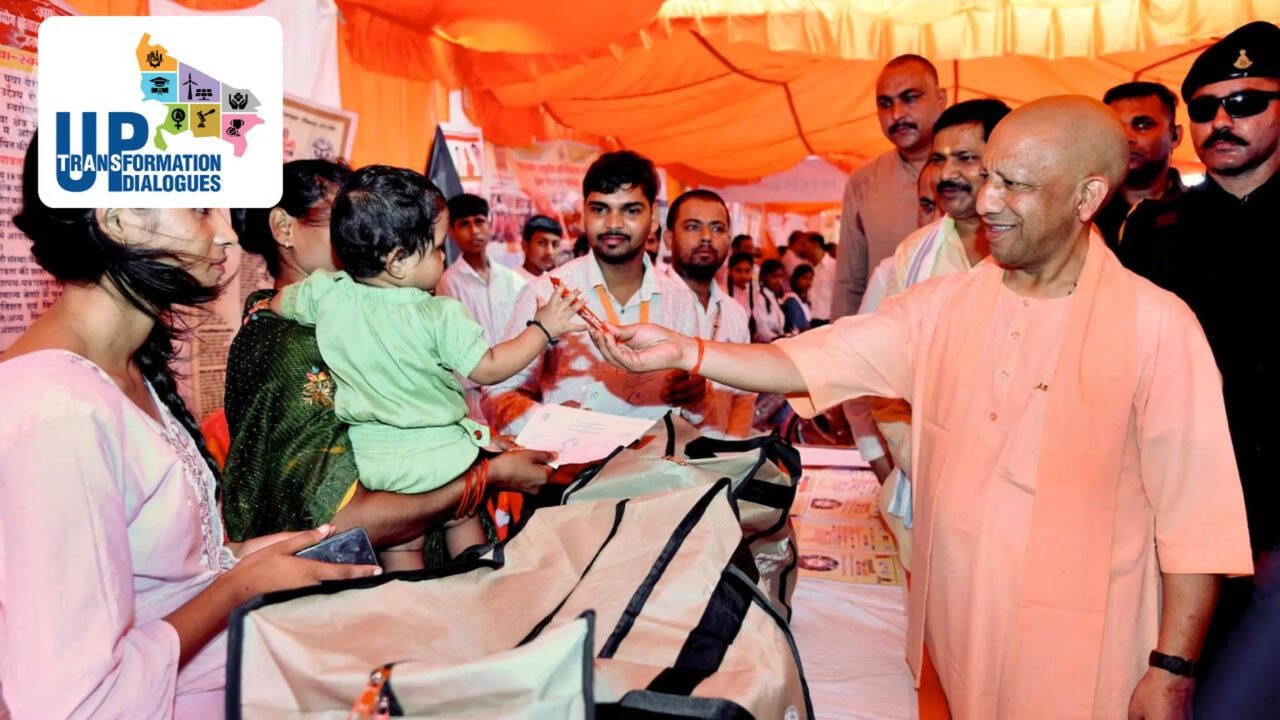
One of many success stories which may be credited to Yogi government in Uttar Pradesh since 2017, is certainly the women empowerment endeavour.In the expansive rural landscapes of Uttar Pradesh, where agriculture has long been the backbone of livelihoods and women traditionally bore the brunt of domestic responsibilities alongside back-breaking farm work, a profound transformation is taking place. The ‘Lakhpati Didi initiative’, implemented with vigor through the Uttar Pradesh State Rural Livelihood Mission (UPSRLM) under the national umbrella of the Deendayal Antyodaya Yojana – National Rural Livelihoods Mission (DAY-NRLM), stands as a flagship program for women’s economic empowerment.At its core, the scheme seeks to enable women members of self-help groups (SHGs) to build sustainable enterprises that generate an annual household income of at least Rs one lakh. This is achieved through a holistic blend of entrepreneurship training, skill enhancement, easy access to credit, robust market connections, and continuous hand-holding support. What began as an effort to organize women into collectives has evolved into a powerful movement that is reshaping not just individual lives but entire rural economies.Uttar Pradesh, home to one of the largest concentrations of rural populations in India, has distinguished itself by creating one of the most extensive SHG networks in the country. Over 98 lakh women have been mobilized into approximately 8.9 to 8.93 lakh self-help groups across thousands of villages. This vast network forms the bedrock of the Lakhpati Didi program, providing a ready institutional platform for collective action, mutual support, and scaled interventions.The journey gained significant momentum around 2017 when intensified social mobilization efforts aligned with national DAY-NRLM priorities. In the initial years, the focus remained on forming SHGs, promoting financial inclusion through bank linkages, and imparting basic capacity-building training. By the early 2020s, the mission shifted gears toward livelihood diversification and income generation, setting the stage for the formal launch of the Lakhpati Didi thrust in 2023.The results have been striking. By mid-2025, approximately 11.15 lakh women had successfully attained the status of Lakhpati Didis, meaning they were generating or contributing to household incomes of Rs one lakh or more annually. At the same time, over 31 lakh women were identified for targeted, intensive livelihood support to help them cross this threshold. Demonstrating remarkable acceleration, the numbers rose sharply to over 18.55 lakh Lakhpati Didis by mid-2026.Buoyed by this progress, the Uttar Pradesh government has set an ambitious long-term target of creating 1 crore (10 million) Lakhpati Didis. This goal aligns with the broader national momentum, where the overall target for Lakhpati Didis has been scaled up significantly, reflecting the program’s growing recognition as a key driver of women’s entrepreneurship and rural prosperity.Several interconnected factors have driven this success. The scheme’s structured approach emphasizes the formation and nurturing of strong community institutions. SHGs are not merely savings groups; they function as platforms for collective bargaining, risk-sharing, and peer learning. Regular meetings foster solidarity and enable women to address common challenges while exploring new economic opportunities. Skill development programs form another critical pillar.Women receive practical training in high-potential, context-appropriate activities such as dairy farming and livestock rearing, food processing (particularly millet-based value-added products), handicrafts, tailoring and garment manufacturing, agriculture-related enterprises, digital services, and various micro-enterprises. These trainings are designed to build on local resources and traditional knowledge while introducing modern techniques and market-oriented practices.Financial inclusion is seamlessly integrated into the ecosystem. Women gain access to collateral-free bank credit, revolving funds for immediate needs, and community investment funds for larger initiatives. Financial literacy sessions teach bookkeeping, budgeting, and enterprise management, empowering participants to handle finances confidently. Marketing and enterprise support have received special attention. SHG federations play a pivotal role in aggregating produce, negotiating better prices, and exploring new markets.Women benefit from participation in exhibitions, tie-ups with e-commerce platforms, and the emerging network of SHE-marts — self-help entrepreneur marts envisioned as community-owned retail hubs that will allow direct producer-to-consumer linkages. Additionally, convergence with complementary schemes like the One District One Product (ODOP) initiative, Pradhan Mantri Formalisation of Micro Food Processing Enterprises (PMFME), and technology-driven programs such as Namo Drone Didi has amplified impact. These linkages introduce innovation, such as drone-based agricultural services, while opening doors to diverse sectors including beekeeping, sericulture, fish farming, solar energy solutions, and producer organizations.The diversity of livelihood activities undertaken by Lakhpati Didis reflects the scheme’s adaptability to Uttar Pradesh’s varied agro-climatic and socio-economic conditions. Dairy farming and livestock rearing have emerged as particularly popular streams, with thousands of women linked to producer companies and over 2.64 lakh benefiting specifically through dairy initiatives. These activities provide steady income flows and valuable nutritional benefits to households.In the realm of agriculture and allied sectors, nearly 50,000 women are part of integrated farming clusters that combine crop cultivation with allied activities like poultry, goat rearing, and organic inputs production. Food processing units, especially those focused on millets and traditional grains, are adding value to local produce and tapping into growing health-conscious markets. Handicraft artisans are leveraging district-specific specialties under ODOP to reach national and even international buyers, preserving cultural heritage while generating revenue.Service-oriented enterprises are also gaining ground. Thousands of women have become Banking Correspondents (BC Sakhis), with nearly 40,000 on boarded, bringing formal banking services to remote villages and earning commissions in the process. Others operate solar enterprises as Vidyut Sakhis or provide digital services, bridging the urban-rural divide. The Startup Village Entrepreneurship Programme (SVEP) has been instrumental in nurturing over 30,000 small entrepreneurs, many of whom are now running successful micro-units in tailoring, garment making, and local manufacturing. By encouraging income diversification, these activities help families withstand market fluctuations, seasonal variations, and unforeseen shocks, fostering long-term resilience.The visible impact of the Lakhpati Didi Scheme is multifaceted, touching economic, social, and personal dimensions of rural life. At the household level, increased incomes have led to tangible improvements: better nutrition through enhanced food security, higher investments in children’s education, and the acquisition of productive assets such as livestock, equipment, and improved housing. Women are experiencing greater financial independence, which translates into enhanced agency within families and communities. Many now actively participate in gram panchayat meetings, voice their opinions on local development issues, and take on leadership roles within SHGs and federations. This shift is gradually altering traditional gender dynamics and promoting more equitable decision-making.Economically, the program is contributing significantly to rural growth. Strengthened value chains in dairy, food processing, and handicrafts are boosting local markets and creating employment opportunities not just for SHG members but for entire communities. The multiplier effect is evident as increased purchasing power stimulates demand for goods and services, further energizing village economies. On a broader scale, the initiative aligns with national goals of poverty reduction, inclusive development, and building an ‘Atmanirbhar Bharat’ — a self-reliant India — where women are not passive beneficiaries but active architects of progress. Uttar Pradesh’s large contribution to the national tally of over 3 crore Lakhpati Didis underscores its pivotal role in this movement.
Success Stories
The inspirational success stories from the ground bring these statistics to life. In Lakhimpur Kheri district, Meera Devi from Nighasan block faced severe financial hardships due to limited landholdings and her husband’s prolonged absence. Joining an SHG opened new doors. After completing Agri-Entrepreneur training, she established a cattle feed production unit in partnership with organizations promoting organic fertilizers.Today, her enterprise generates a sustainable income exceeding ₹1 lakh annually, allowing her to support her family while mentoring dozens of other women in her village. Similarly, 23-year-old Poonam, a mother of two, transformed her circumstances by launching the Mahima-Yash Smart Solar enterprise. By providing clean energy solutions to households, she has achieved financial independence and is contributing to environmental sustainability in her community. Such narratives are replicated across regions — dairy clusters in western Uttar Pradesh, handicraft hubs in the east, and food processing units in central districts — demonstrating the scheme’s wide reach and adaptability.Of course, the journey is not without challenges. Ensuring the sustainability of income levels beyond initial years, achieving uniform geographic spread especially in lagging areas, and building resilience against climate vulnerabilities remain key concerns. Addressing these requires continuous innovation, stronger monitoring mechanisms like the Aajeevika Register, and deeper partnerships with the private sector and technical institutions. The state government is actively focusing on these aspects through expanded training modules, quality certification for products, and technology integration for better market intelligence.Looking to the future, the road to one crore Lakhpati Didis is filled with promise. Plans include scaling up SHE-Marts, deepening convergence with emerging schemes, promoting women-led producer companies, and leveraging digital platforms for end-to-end support — from training to sales.As the program matures, emphasis will shift toward quality enhancement, brand building, and integration with larger value chains to ensure higher and more stable returns. National leadership, including Prime Minister Narendra Modi, has consistently highlighted the role of Lakhpati Didis as vanguards of rural transformation, a vision that finds strong resonance in Uttar Pradesh under Chief Minister Yogi Adityanath‘s administration.Truly, the Lakhpati Didi Scheme in Uttar Pradesh represents far more than a government program; it is a movement for dignity, equality, and shared prosperity. From modest beginnings in SHG meetings under village trees to thriving enterprises that light up homes and markets, these women are scripting a new chapter in the story of rural India. Their success is measured not only in rupees earned but in the growing confidence, expanded horizons, and empowered futures of millions of families.As Uttar Pradesh marches toward its ambitious target, the Lakhpati Didi initiative promises to be a cornerstone of ‘Viksit Uttar Pradesh’ — a developed state where women lead the way toward inclusive and sustainable growth. With sustained commitment, community ownership, and adaptive strategies, the state is poised to create history; one empowered Lakhpati Didi at a time. This silent revolution is not just changing lives today; it is laying the foundation for a brighter, more equitable tomorrow for generations to come.


