



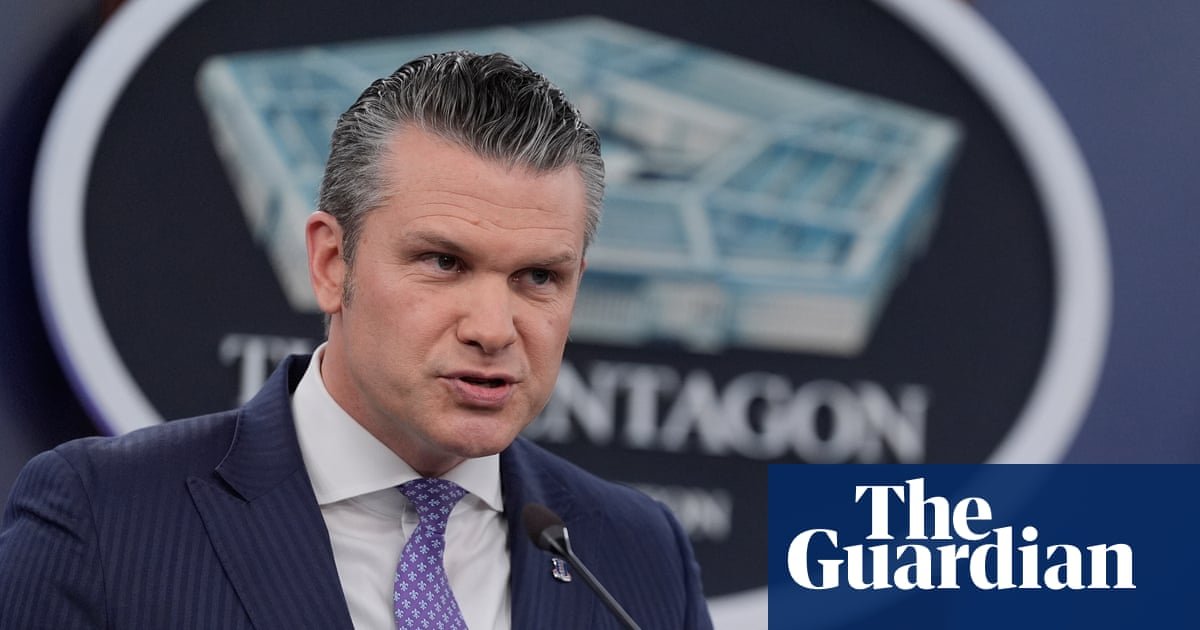
The US defence secretary, Pete Hegseth, had his tongue firmly in his cheek when he singled out the “big, bad Royal Navy” in a recent press update on the US-Israeli war against Iran.
Hegseth’s sarcastic comment was the latest in a long line of jibes against the capabilities and readiness of the British Royal Navy.
However, less political figures have also warned of the perilous state of the UK’s naval warfare force, including the First Sea Lord, the highest-ranking naval officer on active duty.
Donald Trump has dismissed the UK’s aircraft carriers as “toys”, compared with their US equivalents. He reportedly told Keir Starmer to not “bother” sending them to the Gulf.
In perhaps more scathing comments, the US president told the Daily Telegraph: “You don’t even have a navy. You’re too old and had aircraft carriers that didn’t work.”
Hegseth and Trump’s comments should be viewed through the political lens: both are under pressure at home and abroad for launching an offensive against Iran that many say has no clear objective. The British prime minister, like many European counterparts, has refused to be drawn into the conflict, which has clearly angered Trump.
But the uncomfortable truth for Starmer is that many British politicians, military officials and experts suggest that there is some substance to the US barbs.
On 10 March, the House of Commons defence committee expressed grave concerns over whether the navy had the “capacity and resilience” to respond to the crisis in the Middle East. Last month, the former general Richard Barrons, one of three members of Labour’s strategic defence review team, said the lack of military readiness was because of the “armed forces we have ended up with at the end of the post-cold war era – a military right-sized for an era free of threat”.
A recent report by the Center for European Policy Analysis, a US-based non-profit, said the Royal Navy was “on course for national embarrassment”.
But perhaps the most serious intervention has come from Gen Sir Gwyn Jenkins, the First Sea Lord, who has admitted the navy is not ready for war.
Speaking to the Swedish newspaper Svenska Dagbladet on Monday, he said: “According to the defence investigation that was completed last year, I will be ready for war by the end of this decade.”
When asked to clarify if this meant the navy was not “ready for war” now, he confirmed he did not think so.
The flurry of criticism was initially triggered by what critics said was the slow deployment of the first British warship after the US and Israel attacked Iran. It took more than three weeks to get HMS Dragon to Cyprus in the eastern Mediterranean.
At the end of the cold war, the UK had 51 destroyers and frigates after a period during which Britain spent 3.2% of its GDP on defence. The number had halved to 25 by 2007 and is now at 13, with much of that fleet ageing. The UK spends 2.4% of GDP on defence, a figure that Labour has promised to lift to 2.5% by April 2027.
Britain had maintained four minehunters and a mothership in Bahrain for 20 years, in the belief that Iran might, in a crisis such as now, try to mine the Gulf and the strait of Hormuz. But the final three were removed in the past year, two to be retired, including HMS Middleton, which was towed back to the UK in January.
The government says its Atlantic Bastion programme, a UK-led defence initiative unveiled in December, aims to transform the Royal Navy into a hybrid navy, integrating autonomous vessels, AI-enabled sensors, warships and aircraft to safeguard the fleet.
A spokesperson for the Ministry of Defence said: “As the First Sea Lord has repeatedly said, the navy is absolutely ready to fight, including on advanced operations above and below the sea.
“Our nuclear deterrent protects us every moment of every day and Royal Navy personnel are deployed across the world keeping Britain secure at home and strong abroad.
“The government is providing a generational increase in defence spending, with an extra £270bn across this parliament, ensuring no return to the hollowed out armed forces of the past, and the strategic defence review sets out our path to increasing warfighting readiness.”
Despite refusing to be drawn into the conflict in Iran, which is politically unpopular in the UK, Starmer has reportedly accepted the need to increase military spending amid global uncertainty. At last summer’s Nato summit he agreed to lift defence budgets by about £30bn to 3.5% of GDP by 2035.
But unless he completely changes tack on Iran, it is unlikely that the and jibes from the increasingly isolated Americans will end any time soon.


