


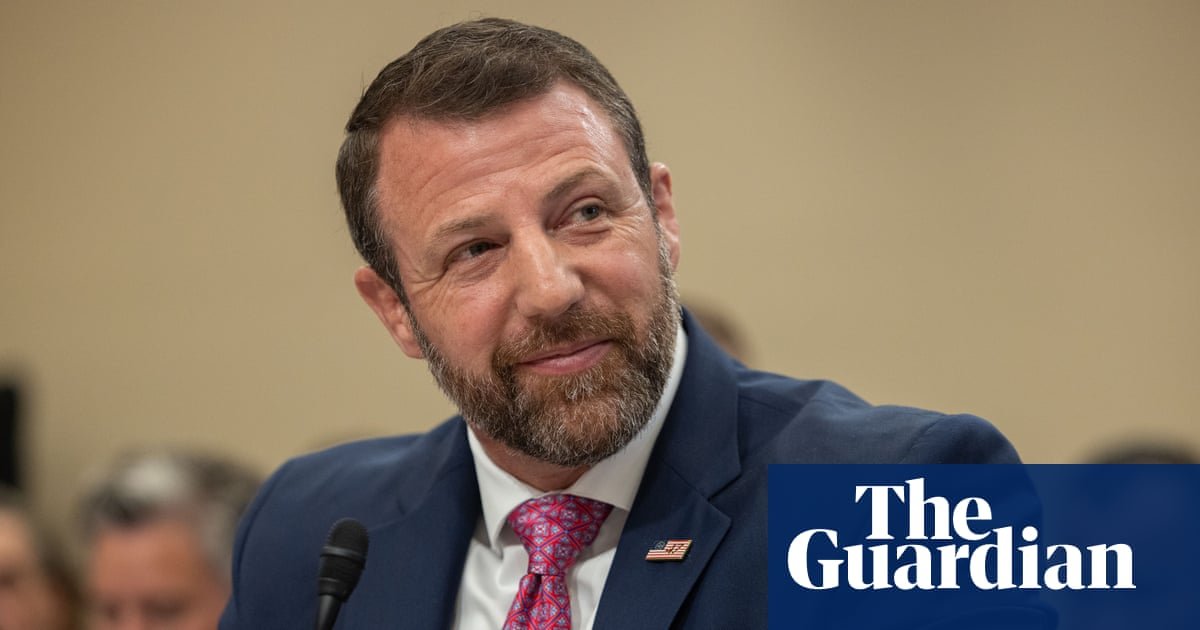
Migrants in the US on temporary protected status should seek permanent residence or leave, Markwayne Mullin, Homeland Security secretary, said in the wake of last week’s supreme court decision that stripped humanitarian protections from hundreds of thousands of immigrants.
The remarks to CNN’s State of the Union program comes after a decision that could allow Donald Trump’s administration to deport Haitian and Syrian immigrants to home countries plagued by conflict and destitution.
“Either try to fill out the paperwork and be here underneath a permanent status or we’ll help you get back to your country,” Mullin said.
“We’ll actually give you a plane ticket, plus roughly $2,100 to help you re-establish when you get there, but temporary protective status, according to the courts and in its name itself, is not permanent status,” he added.
Federal law allows the administration to grant temporary legal residency in the United States to people fleeing war, disaster or other conditions.
The status had previously been renewed successively and, despite the move to end these protections, the state department currently warns against traveling to either Haiti or Syria, citing widespread violence, crime, terrorism and kidnapping.
The United States first provided temporary protected status (TPS) to Haitians after a devastating earthquake in 2010, and to Syrians after their country descended into civil war in 2012.
Thursday’s supreme court decision is set to affect an estimated 350,000 Haitian and 6,000 Syrian immigrants who now face Immigration and Customs Enforcement (ICE) detention or deportation as protections end.
Haitian TPS holders and advocates have widely condemned the ruling, warning that it will disrupt the lives of thousands who have been living and working in the US for decades.
Haitian residents in Springfield, Ohio, have expressed despair about the coming effects of ending TPS protections. During the 2024 election, Trump falsely accused Haitians living in the town of eating others’ household pets. The repeated insults resulted in bomb threats as well as white supremacist marches in the city.
The supreme court’s conservative majority found, however, that Haitians suing the administration were unlikely to succeed in their argument that the administration’s actions were racially biased.
“For Springfield, it’s going to hurt. When I came here, this area was dead. In this plaza, there are 1782673699 seven Haitian businesses,” said Franky Pierre to the Guardian on Thursday after the decision. Pierre is a Haitian immigrant who came to the US with his family during the 1991 military coup to overthrow then president Jean-Bertrand Aristide.
Pierre added: “All of these people are going to have to run away or go somewhere, which I’m pretty sure is going to start tonight,” referring to TPS holders.
Republicans have also been critical of the supreme court decision. Mike DeWine, Ohio’s governor, called Thursday’s ruling a “mistake”. “The situation in Haiti could hardly be much worse. The violent gangs run most of the country. The government barely functions,” said DeWine in a statement on Thursday. “And the economy is in shambles.”
Other Republican congressmen, including Mike Lawler of New York and Don Bacon of Nebraska, have criticized Thursday’s ruling and argued for TPS extensions for Haitian immigrants.
In total, 1.7 million people from 17 countries have temporary protected status. Immigration advocates worry that the Trump administration could target TPS for other immigrants, effectively ending the 1990 program.
