



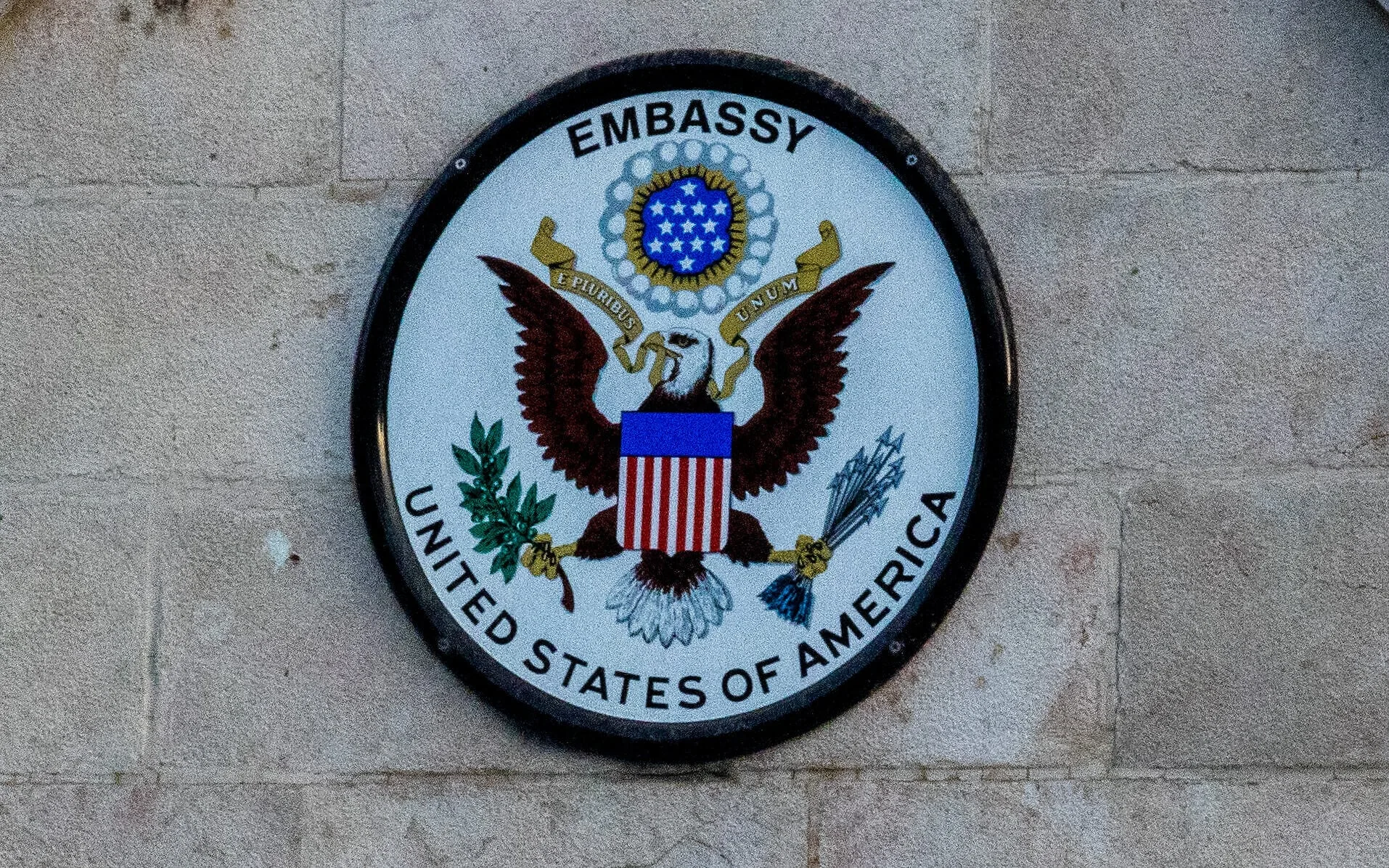
The US Embassy in Jerusalem on Friday issued a security alert advising that “persons may wish to consider leaving Israel while commercial flights are available”.
This guidance arrives as Washington significantly intensifies its military presence in the region, highlighted by the deployment of the world’s largest aircraft carrier, the USS Gerald R Ford, off the northern coast of Israel, according to The Times of Israel.
The advisory was issued on Friday amid these escalating tensions.
Pointing to “safety risks”, the US mission confirmed in an official statement that “the Department of State has authorised the departure of non-emergency US government personnel and family members of US government personnel from Mission Israel due to safety risks”.
Further highlighting the volatility, the mission cautioned that “in response to security incidents and without advance notice, the US Embassy may further restrict or prohibit US government employees and their family members from travelling to certain areas of Israel, the Old City of Jerusalem, and the West Bank”.
In tandem with these personnel movements, American citizens have been urged to re-evaluate plans to visit “Israel due to terrorism and civil unrest, and to the West Bank due to terrorism and civil unrest”.
Stringent warnings were also issued against entering specific high-risk zones, including Gaza, cited for “terrorism and armed conflict,” as well as the area within “11.3 km/7 miles of the Gaza periphery”.
Additionally, the embassy advised against travel within “4 kilometres/2.5 miles of the Lebanese and Syrian borders” in northern Israel due to “continued military presence and activity”.
Travellers were also warned to stay away from the Egyptian border within “2.4 km/1.5 miles,” with the exception of the Taba crossing, which currently stays open.
In a subsequent update citing the embassy’s announcement, the Israel War Room noted that the US State Department has permitted the exit of non-emergency staff from Mission Israel in response to “security risks”.
This step is described as a “precautionary measure” taken during a period of increased regional instability.
Consequently, individuals are encouraged to stay informed through regular updates and to review their travel arrangements in light of the situation. (ANI)


