



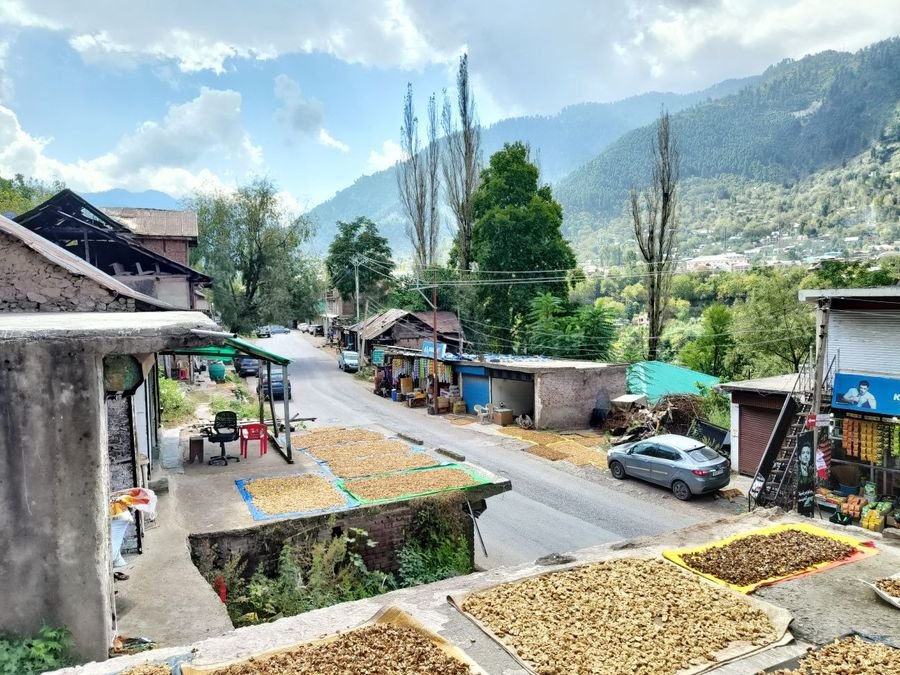
Srinagar, Sep 29: The historic Lagama walnut market in Uri area of north Kashmir, once a major trading hub for Kashmir’s prized walnut crop, is staring at an uncertain future as falling prices, weak demand and rising costs squeeze traders and growers.
Located around four kilometres from the Line of Control (LoC) along the historic Srinagar-Muzaffarabad road, the market is regarded by traders as one of the valley’s oldest walnut trading centres. Its trading history, they say, dates back to the period before partition, when Uri was connected commercially with Muzaffarabad in PoK.
Traders and growers associated with the market say the volume of walnuts handled by Lagama has declined sharply in recent years. From around 40,000-45,000 tonnes during a season earlier, the market now handles only around 15,000-20,000 tonnes, which traders attribute largely to declining demand and lower prices in major consuming markets such as Delhi and other parts of the country. This poor business is impacting over 10,000 families.
Mohammad Amin Chalkoo, president of the Dry Fruits Association Uri, said even premium-quality walnut kernels are fetching considerably less than they did in the past.
“Earlier, the best-quality walnut kernel used to fetch around Rs 1,200 to Rs 1,500 per kilogram. Today, the same quality is being sold for only around Rs 500 to Rs 800 per kilogram,” Chalkoo told Rising Kashmir.
He said the fall in prices was making it increasingly difficult for growers and traders to sustain the traditional business.
“The rates have come down drastically while the cost of production, transportation and other expenses have increased. If this continues, growers will lose interest in walnut cultivation, and traders will also find it difficult to continue,” he said.
Traders said the problem is not confined to prices alone. They said the five per cent Goods and Services Tax (GST) on walnuts has added to their financial burden at a time when margins are already shrinking.
“GST has become another challenge for small traders. We have to bear transportation, labour, loading and unloading costs, besides other expenses. After all these deductions, very little is left for the trader,” said Mohd Yousuf Kakroo, a trader associated with the Lagama market.
Bashir Bhat, a grower from Garkote village said the traditional market was gradually losing its importance because of changing market conditions and weak demand.
“We used to see huge quantities of walnuts arriving here during the season. The market would remain busy with growers, commission agents, traders and transporters. Now the business has reduced considerably,” he said.
Growers, too, said the decline in market prices was affecting walnut cultivation in the region.
“A walnut tree takes years to mature. We invest in its upkeep for years, but when the crop finally reaches the market, the price does not justify the effort,” said Shabir Ahmad, a walnut grower in Uri.
He said the falling returns could eventually discourage younger generations from taking up walnut cultivation.
“If farmers do not get a reasonable price, they will naturally look for other crops or sources of income. Walnut cultivation has been part of the economy of this area for generations,” he said.
According to traders, Lagama’s walnut market has been functional since before the 1947 partition and is closely linked to Uri’s historic commercial ties with Muzaffarabad.
Before partition, traders and growers from areas on both sides of the present LoC would travel through the Uri-Muzaffarabad route to buy and sell dry fruits, including walnuts. The market consequently developed as an important trading point for produce from the surrounding mountainous areas.
The Srinagar-Muzaffarabad road, which historically connected Kashmir with the western parts of the region, played a significant role in this trade. With the partition and subsequent closure of the traditional route, the nature and direction of trade changed, but Lagama continued to retain its importance as a walnut market.
For generations, the market has remained associated with walnut growers from Uri and neighbouring areas, with traders purchasing, grading and sending the produce to markets outside Jammu and Kashmir.
Traders say the market’s location near the LoC also gives it a distinctive place in the commercial and social history of Uri.
Despite its long legacy, however, those associated with Lagama say the market now needs institutional support if it is to retain its position in Kashmir’s walnut economy.
