



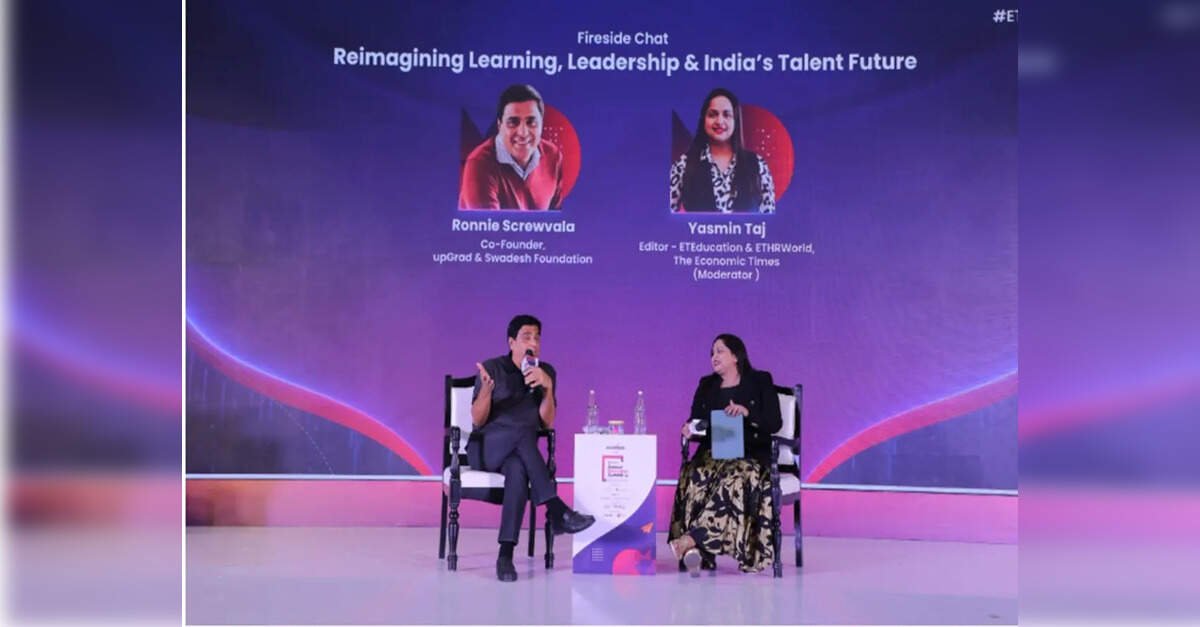
India’s demographic advantage cannot be treated as an automatic national strength and will deliver results only if education systems and young people build capability, adaptability and accountability, Ronnie Screwvala, Co-Founder, upGrad and Swadesh Foundation, said on Thursday.
Speaking during a fireside chat at the third edition of the ETEducation Annual Education Summit 2026, organised around the theme “India’s Education Revolution: For the World, With the World,” Screwvala said India’s talent future will depend less on population size and more on whether institutions can prepare learners for uncertainty, technological disruption and changing career pathways.
In conversation with Yasmin Taj, Editor, ETEducation and ETHRWorld, The Economic Times, Screwvala reflected on entrepreneurship, education and India’s evolving workforce landscape, arguing that long-term success increasingly depends on resilience, self-belief and multidimensional capability.
“Dividend is when you have profit. We don’t declare dividends if we don’t have profit,” Screwvala said, cautioning against assuming that a young population alone guarantees economic success.
According to him, India’s education challenge today is not merely unemployment but the mismatch between learning, employability and aspirations.
He argued that institutions must move beyond delivering qualifications and focus instead on preparing students to make decisions, solve problems and adapt continuously.
Drawing from his own journey across media, entertainment, education and social impact, Screwvala said he has never approached opportunities through industry labels but through understanding changing consumer aspirations.
“I’ve never looked at it from a sector point of view. I’ve always looked at it from consumer and aspiration,” he said.
Reflecting on entrepreneurship and leadership, Screwvala said failure has played a defining role in his career.
“My ratio of failures to success is eight failures to two successes,” he said, adding that timing, persistence and the ability to stay invested through setbacks often matter more than having the perfect idea.
For educators, he said, one of the most overlooked outcomes of education is self-conviction.
“Self-conviction is something that’s very undersold in our education system,” Screwvala said, arguing that students need confidence to make decisions and navigate uncertainty alongside technical and professional skills.
He linked this idea to his own upbringing, saying that limited financial safety nets created a stronger sense of accountability and reduced entitlement.
“Real success can happen on a prolonged basis, in spite of a lot of failure, if your sense of entitlement is low,” he said.
Screwvala also urged young professionals to think beyond short-term outcomes and understand the value of compounding.
“We overestimate what we can do in two years, and we seriously underestimate what we can do in five years,” he said, describing success as requiring both urgency and long-term thinking.
On the future of work, Screwvala said artificial intelligence and automation are changing traditional employment assumptions and reducing the idea of guaranteed career paths.
“There is no guaranteed job, and there’s no concept of a safe job,” he said.
Instead of relying on a single degree or narrow expertise, he encouraged young people to become “generalist specialists” who can combine deep knowledge with flexibility across technologies and work environments.
At the same time, he cautioned against presenting entrepreneurship as the only answer to changing labour markets.
“Entrepreneurship is not for everybody,” he said, suggesting that future opportunities will also emerge through independent work, creator economies and diversified income models.
Pointing to lessons from the Swadesh Foundation’s work in rural India, Screwvala said aspirations across geographies are rising rapidly and institutions must create pathways that convert ambition into outcomes.
His remarks reinforced one of the central ideas emerging from the summit — that India’s education revolution will not be defined by enrolment or demographics alone, but by whether institutions can build self-conviction, employability, adaptability and lifelong learning at scale.


