



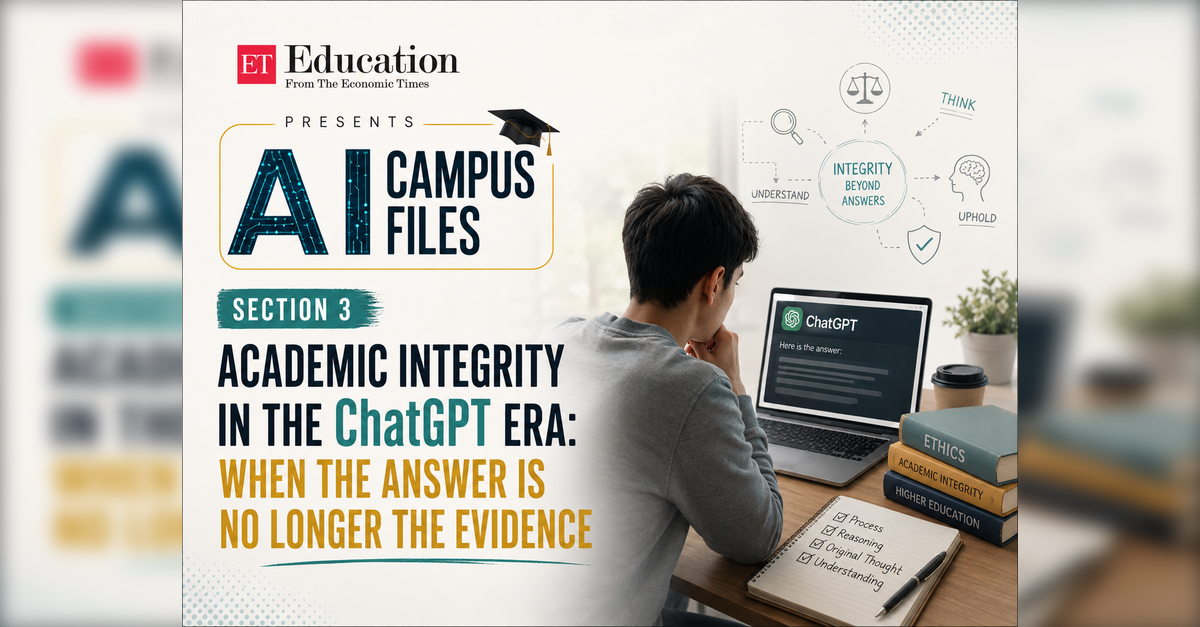
From banning AI to grading the thinking behind it, India’s universities are redesigning assessment around a new question: Can a student explain, defend and take ownership of what they submit?
The traditional university assignment had a relatively simple proposition: a student was given a question, went away, researched it, wrote an answer and submitted it.
Generative AI has broken that chain.
A polished case analysis, a working piece of code, a research summary, a presentation, or even a seemingly original essay can now be produced in minutes with varying degrees of human involvement. That has forced universities to confront the challenging scenario and the question – if AI can produce the answer, what exactly should an assessment measure?
Across a diverse set of institutions from XLRI and BITSOM to IIIT Hyderabad, Amity University, FLAME University, Lovely Professional University, BML Munjal University, IICT, Sharda University, JECRC University and Universal AI University, the response is becoming clearer.
The assessment is moving away from the final product and towards the process, reasoning and human accountability behind it, but there is no single Indian university playbook yet.
Some institutions are tightening the assessment environment through vivas, controlled examinations and AI restrictions. Others are deliberately integrating AI into assignments and grading students on how well they direct, interrogate and verify machine-generated outputs. A third group is building disclosure and process documentation into academic integrity itself.
The common thread is not the rejection of AI. It is the realisation that the student’s ability to think can no longer be inferred from the answer alone.
The take-home assignment has lost its monopoly
Perhaps the clearest shift is happening in the humble take-home assignment.
At XLRI, faculty are reconsidering traditional take-home case analyses because AI can now produce competent write-ups rapidly. The institutional response includes a renewed emphasis on viva voce and in-person, pen-and-paper examinations—formats that make it harder to outsource the demonstration of knowledge. At the same time, some faculty are experimenting with AI-assisted assignments, asking students to demonstrate that they can guide, evaluate and defend AI-generated outputs.
BITSOM is seeing a similar change. Homework assignments and written projects are increasingly viewed as vulnerable to cognitive offloading, prompting greater use of in-class exercises, quizzes, examinations and viva voce assessments.
BML Munjal University describes the shift in broader terms: assessment is moving from evaluating only the final answer to evaluating the learning process, application, reasoning and the student’s ability to defend the work. Its assessment mix increasingly includes demonstrations, presentations, vivas, process evaluation and classroom-based work.
The message is consistent: A submission is no longer sufficient evidence of learning.
The student increasingly has to be present, physically or intellectually, to explain how the submission came into being.
The viva is having a comeback, and AI may be the reason
If generative AI has made written output easier to produce, the oral defence has acquired new value.
JECRC University has built this principle into its Industry-Academia Internship Viva, where more than 3,600 students present their internship work before more than 100 industry experts across 10-plus sectors. The purpose is not simply to recount what students did, but to defend why they made particular decisions.
LPU has similarly made viva voce mandatory for technical assignments such as code submissions, with students questioned on the logic behind their solutions, alternative approaches and their choice of algorithms or structures. Across its engineering and management schools, the university conducts more than 2,000 project and dissertation evaluations per term, with assessment increasingly focused on problem decomposition, iterative design and real-world deployment rather than raw documentation.
Sharda University is also using project or laboratory work followed by individual viva as a key verification mechanism. Students may use AI during exploration and development, but must demonstrate that they understand the submitted work and can explain technical decisions and implementation choices.
The implication is significant.
The viva is no longer merely an additional assessment component. In the ChatGPT era, it becomes a mechanism for establishing authorship.
A machine may generate the answer. It cannot easily defend the student’s choice to use that answer.
From “Did you use AI?” to “How did you use AI?
Not every institution is responding by restricting AI, some are changing the definition of academic authorship itself.
IICT offers perhaps the most explicit example. Its approach assumes that AI will be part of creative education rather than treating its presence as inherently problematic. Students can be assessed through production-based portfolios, process vivas and assignments where prompt documentation itself becomes part of the submission. The focus is on human direction, iteration, taste and final judgement.
Its working principle is particularly revealing: AI use is expected and disclosed by default; undisclosed use is the violation. Authorship is associated with direction, judgement and revision—not simply with which keys were pressed.
FLAME University is moving in a comparable direction. It has increasingly adopted viva voce, applied project-based assessment and AI-collaborated assignments. The objective is not to prevent students from using AI but to evaluate how effectively they use it while demonstrating critical thinking, ethical judgement, creativity and domain expertise.
Universal AI University similarly argues that assessment needs to move from “What answer did the student submit?” to “How did the student think, decide, build and defend the work?” Its recommended assessment mix includes projects, vivas, portfolios, application-led examinations, classroom writing, AI-assisted assignments, capstones and live problem-solving presentations.
This represents a fundamental pedagogical shift. The university is no longer necessarily assessing whether AI was used. It is assessing whether the student remained intellectually in control while using it.
The new academic-integrity currency: disclosure
As universities become more accepting of legitimate AI assistance, disclosure is emerging as one of the strongest dividing lines between assistance and misconduct.
BITSOM takes a similarly explicit approach. Where AI is used, students must provide a disclosure statement identifying the tool, purpose and percentage contribution. AI can assist with brainstorming, outlining, grammar, complex concepts, data analysis and coding, but students cannot submit AI-written essays as their own or delegate an entire assignment to AI.
For IICT, disclosure is even more foundational: the problem is not AI use itself, but undisclosed use.
The emerging principle is therefore straightforward: Using AI is not automatically academic misconduct. Hiding the extent of AI’s contribution can be.
But universities are not agreeing on where to draw the line
The most revealing difference across the institutions is not whether AI should be addressed. Almost everyone agrees it should. The disagreement is how much freedom students should have and who should decide.
BITSOM also gives instructors room to interpret emerging cases, allowing course-level decisions to evolve alongside the technology.
At IIIT Hyderabad, the institution is taking a policy-development route. A faculty committee is working on a responsible-AI policy, with the proposed distinction centred on AI-assisted components versus intellectual responsibility for integration, architecture, validation and explanation. The policy was still awaiting broader faculty and Academic Council deliberation in the supplied response.
This is important because it shows that India’s higher education ecosystem has not yet converged on one definition of AI-assisted academic work.
The policy architecture is still being built.
Five Emerging Rules of Academic Integrity1. AI assistance ≠ automatic misconductSeveral institutions explicitly permit AI for brainstorming, research support, coding assistance, explanation, grammar, analysis or ideation, provided students remain accountable for the outcome. 2. Disclosure is becoming part of authorshipJECRC, BITSOM and IICT place strong emphasis on students disclosing how AI contributed to their work. 3. Process evidence is becoming more valuablePrompt trails, drafts, iterations, demonstrations and oral explanations are repeatedly positioned as stronger evidence of learning than the final submission alone. 4. Human judgement remains the final checkpointEven where detection tools are used, several institutions caution against treating them as definitive arbiters. 5. The question is shifting from “Can AI do it?” to “Can the student own it?”That is perhaps the most important common denominator across the institutional responses. |
Detection is losing ground to demonstration
One of the strongest findings across the responses is the declining confidence in AI detection as a standalone answer.
LPU uses multi-layered detection systems, including Turnitin Originality and AI Detection and DrillBit’s AI-detection capabilities. Amity University uses Turnitin to evaluate plagiarism and AI-generated content alongside faculty guidelines, awareness initiatives, viva-based verification and redesigned assessments.
Sharda University also mandates similarity checks for research reports, publications, theses and dissertations, while combining these with viva-based validation and practical assessment, but several institutions explicitly argue that detection cannot be the final arbiter.
JECRC uses detection as a conversation starter. IICT deliberately rejects AI-detection tools as arbiters of academic integrity. BML Munjal University describes them as only one supporting mechanism, preferring assessment design, faculty interaction, viva, demonstrations and process evaluation. FLAME University similarly emphasises academic judgement over automated detection. That points towards an emerging hierarchy: Detection can flag, Documentation can explain, but demonstration can establish.
The assessment room is becoming a laboratory of human judgement
The most resilient assessments across these institutions share a common characteristic: they require students to do something AI cannot easily outsource on their behalf. They must defend a decision, demonstrate a working solution, explain their code, show their process, respond to questions in real time, and connect theory to an unfamiliar problem.
This is why project-based assessment emerges repeatedly across the responses—from Amity, Universal AI University and FLAME to Sharda, BML Munjal University and LPU.
At LPU, project and dissertation evaluation focuses on problem decomposition, iterative design and deployment. At BML Munjal University, multidisciplinary projects require application to real problems. At Sharda, practical implementation and laboratory demonstrations complement conventional evaluation.
In other words, universities are gradually designing assessments where the route to the answer matters as much as the answer itself.
The emerging university divide: AI-resistant vs AI-native assessment
Taken together, the responses reveal two broad philosophies.
Model 1: Protect the assessment
Institutions following this approach increase controlled environments, in-person examinations, live coding, restricted AI use and detection mechanisms.
XLRI’s renewed interest in in-person and pen-and-paper examinations, BITSOM’s increased reliance on in-class assessments and LPU’s controlled coding environments represent elements of this model.
Model 2: Redefine the assessment
The second approach accepts AI as part of the learning environment and redesigns assessment around human contribution.
IICT’s prompt documentation, FLAME’s AI-collaborated assignments, Universal AI University’s process-oriented approach and JECRC’s AI Methodology note sit closer to this model.
Neither model is necessarily permanent.
As AI capabilities evolve, the boundary between the two is likely to keep moving.
Comparative Snapshot: How 13 Universities Are Responding
|
Note: The source material contains 12 distinct institutional entries, with Amity appearing once; the table should therefore be treated as a comparative snapshot of the institutions represented in the supplied responses, rather than a 13-university dataset.
The New Assessment StackAcross the responses, the following assessment formats repeatedly emerge: Most frequently recurring approaches
The important shift is not simply adding more assessment formats.It is changing what is awarded marks.Old model: Quality of final answerEmerging model: Quality of reasoning + application + process + defence |
The big takeaway!
Academic integrity is being rewritten, not abandoned. The ChatGPT era has not made examinations obsolete; it has exposed how easily some assessments can be completed without meaningful learning.
A take-home essay can be generated. A case analysis can be polished. Code can be produced. References can be fabricated. A presentation can be assembled.
What becomes harder to fake is a student explaining why a decision was made, defending a piece of code, walking through a project or questioning an AI-generated answer.
That is where academic integrity is heading: away from policing the final submission and towards establishing who actually owns the thinking behind it. For universities, this is more than an AI-policy exercise; it is an assessment redesign challenge.
The question now is simple: Are universities assessing what students can produce, or what they actually know? Leaving you all with that thought!
This is the third story in ETEducation’s special editorial series analysing academic integrity in the ChatGPT era. The next story will explore how AI will impact Skills, Employability & Workforce Readiness. Stay tuned!


